Introduction
Much of the time in paleoanthropology, all we have are fossils. Though we can certainly learn lots about an organism, such as what it looked like, how it lived, and how it evolved, there are some things which simply can not be fully determined just by fossils. Some examples of this are the sex of an organism and its evolutionary relationships.
The sex of an organism is much easier to tell, as many animals possess large amounts of sexual dimorphism, and it is easy to differentiate the sexes based on fossils, but it isn’t always so cut and dry. It is common for mistakes to be made here, such as fossils of two different sexes of the same species being confused for two different species.
Similarly, evolutionary relationships can be told by fossils, but there are many factors which can affect this. For example, two fossils of different species can look very similar, leading people to conclude that they are closely related, but it is always possible that these two species are a result of convergent evolution, and the similar traits are homoplasies rather than synapomorphies, meaning that they evolved independently in the two species.
The best way to determine these things is with ancient DNA (aDNA). Being able to collect, sequence, examine, and compare the DNA of hominins is very useful, but it is rare. We mostly have aDNA from recent, closely related hominins, such as Neanderthals. Even then, much of the Neanderthal genome that we have comes from our own genome, as a result of interbreeding between the two species.
DNA is more accessible from these species because they lived and died much more recently, giving less time for DNA to decay. However, in rare cases, DNA, or at least proteins, can survive for much longer. This is the case for new enamel proteins uncovered from 2 million year old Paranthropus robustus fossils from South Africa, which can have a big impact on the lives and evolution of this strange species.
What is Paranthropus?
Paranthropus is a unique genus of hominin which lived from 2.7-0.1 million years ago (mya). This genus is unique for several reasons. It possessed very specialized cranial anatomy, such as post canine megadontia, large zygomatic bones, and a sagittal crest, all adaptations for a very powerful bite.
These powerful jaws were adapted for chewing through tough vegetation. This is further supported by radiocarbon isotope analysis.
Paranthropus possessed 3 species, P. aethiopicus and P. boisei in eastern Africa, and P. robustus in South Africa. This distribution resulted in them living alongside many other hominins, though this likely wasn’t a problem as they were seemingly eating different things mostly,, resulting in little competition, something known as niche partitioning.
Along with all this, Paranthropus possessed very high levels of sexual dimorphism. Females of all 3 species were much smaller than males, and seem to have lacked notable features of the genus, such as the sagittal crest. I have recently done an article covering everything you need to know about this topic, so you can check that out on this website for more information.
As stated previously, fossils can’t be completely reliable for telling sexual dimorphism, but DNA and proteins can, for the most part. That is where this discovery comes in.

Preservation of DNA and Proteins
The genetic material from Paranthropus is the oldest genetic material from any hominin, being about 2 million years old, but not the oldest genetic material from any hominin ever. Ancient environmental DNA (eDNA) has been collected from faunal and floral assemblages in Kap København Formation in North Greenland. These assemblages were dated to about 1.9-2.1 million years old.
The eDNA showed that the area possessed an open boreal ecosystem, with many different plants, such as poplar, birch and thuja trees, along with various types of Arctic and boreal shrubs and herb. Many of these were not previously recognized in the area from fossils and pollen records.The eDNA also revealed the presence of many different animals, such as mastodons, rodents, hares, and geese. The DNA was preserved in sediments, which preserves DNA better than in bone due to the absorption of minerals which can modify the DNA conformation and prevent enzymatic degradation.
The previous oldest hominin DNA belonged to a 400,000 year old Neanderthal specimen from Spain. Proteins however, which are more resilient than DNA, can survive for longer, but there are many factors for protein preservation. Burial environment, fossil chemistry, time, and temperature are all very important.
Protein sequences have been obtained from ostrich (Struthio camelus) shells in Tanzania dating to 3.8 mya. These proteins were able to preserve for so long because they were encased in the minerals from the eggshells.
800,000 year old tooth proteins have been sequenced from Homo antecessor in Spain, and some from Homo erectus from the Republic of Georgia dating to 1.8 mya.
Genetic Material from Paranthropus robustus
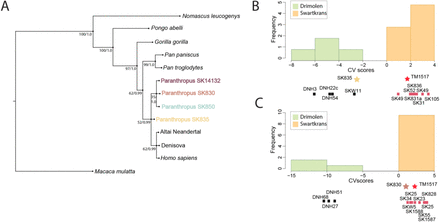
4 dental specimens (SK 850, SK 835, SK 830, and SK 14132) from Swartkrans belonging to Paranthropus robustus cave were sampled. By using mass spectrometry, hundreds of amino acids from the tooth enamel of the specimens. One significant protein found is amelogenin-Y. This protein is produced by the AMELX gene.

This protein is very important formation of tooth enamel. There is one copy of this gene on each sex chromosome. Amelogenin-Y is produced by the AMELY gene on the Y chromosome, but has no effect on enamel formation.
The specimens SK 850 and SK 835 were identified as male based on the presence of amelogenin-Y. This is significant as one of those specimens was originally thought to have been female due to its small size. SK 835 matched the local strontium isotope signal associated with male Paranthropus in the area, making it more likely that this individual was male.
However, Amelogenin-Y was not found in SK 830 and SK 14132. Rather, the X chromosome version of amelogenin-Y, amelogenin X, was found in these specimens.The absence of the amelogenin-Y gene in these specimens doesn’t mean they were automatically female however, as it is possible that it was not detected on them because the proteins were too far out of the detection limit of the instrument used to sequence the proteins.
About 400 of the amino acids sequenced were found in all 4 specimens, showing that modern humans, Neanderthals, and Denisovans are more closely related to each other than any are to Paranthropus, which is not a surprise. Sequence differences were found in one enamel protein, showing genetic variability in the species too. The SK 141132 specimen especially seems to be more unrelated to the rest of the specimens.
Though it is theoretically possible to reconstruct phylogenetic trees of ancient hominins using these proteins, it most likely won’t add much. This is because proteins aren’t very useful for reconstructing evolutionary relationships, and we don’t have any genetic material from other hominins from the time to compare it to. It is best to rely on fossils and skeletal morphology as of right now for determining this.
Conclusion
Proteins are much more resilient when it comes to ancient preservation, so it isn’t that much of a surprise that some were preserved in Paranthropus teeth, a place with plenty of minerals to preserve them in, similar to the 3.8 million year old ostrich protein sequences taken from eggshells.
It is not abnormal for genetic material to be preserved in hominin remains, as there is genetic material as old as 400,000 years old all the way up to 1.8 million years old. It is abnormal however for such old genetic material to be preserved in such an ancient species, making this find especially important.
This discovery has big implications for the sexual dimorphism and biology of Paranthropus. This shows that smaller Paranthropus individuals weren’t necessarily female, meaning that body, cranial, or tooth size may not be as sexually dimorphic as previously thought. This may mean that a reexamination of other Paranthropus specimens may be needed.
It is important to note that the paper this article is based off of is still in preprint, and has not yet been peer reviewed and published, meaning that some of the information may be inaccurate or need revisions. Once it has been reviewed and published, we can truly see the findings of this study and its implications for the lives and evolution of the unique genus of hominin, Paranthropus.
Sources
- Dorey, Fran, Baxland, Beth. “Paranthropus genus”. 04-29-22. The Australian Museum, https://australian.museum/learn/science/human-evolution/paranthropus-species/
- Callaway, E. (2023). Oldest genetic data from a human relative found in 2-million-year-old teeth. Nature, https://doi.org/10.1038/d41586-023-02242-z
- Kjær, H. K., Pederson, W. M., Sanctis, D. B., Cahsan, D. B. (2022). A 2-million-year-old ecosystem in Greenland uncovered by environmental DNA. Nature, 612, 283-291. https://doi.org/10.1038/s41586-022-05453-y
- Demarchi, B., Hall, S., Roncal-Herrero, T., Freeman, L. C. (2016). Protein sequences bound to mineral surfaces persist into deep time. eLife, 5:e17092. https://doi.org/10.7554/eLife.17092
- Madupe, P. P., Koenig, C., Patramanis, I., Rüther, L. P., et al. (2023). Enamel proteins reveal biological sex and genetic variability within southern African Paranthropus. Preprint at BioRxiv. https://doi.org/10.1101/2023.07.03.547326
- “AMELX gene”, (ND), Medline Plus. https://medlineplus.gov/genetics/gene/amelx/
 World of Paleoanthropology