Introduction
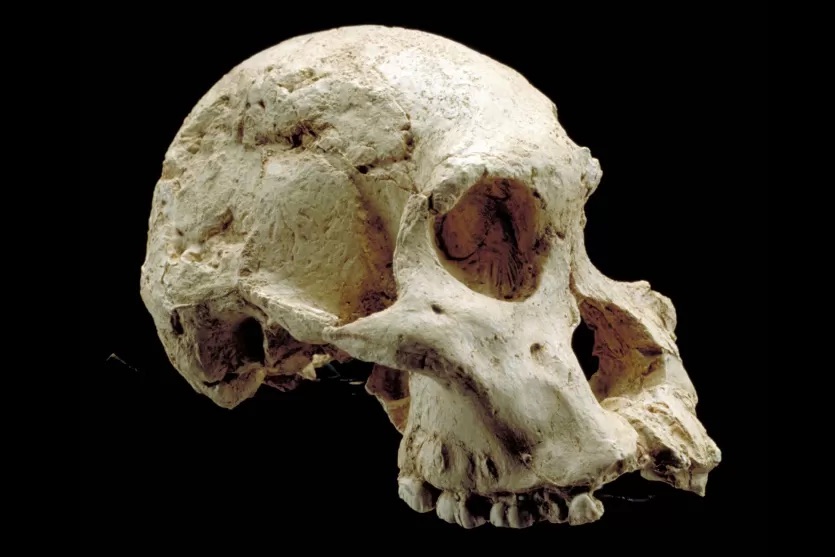
November 28th, 1924, exactly 99 years ago from today, a very significant hominin skull was unearthed near Taung, South Africa. On this day, a team of quarry workers uncovered the first described member of what would later be a very well represented hominin genus. This genus would be the genus Australopithecus, and the skull would be named the Taung Child, a juvenile member of the species Australopithecus africanus.
The Discovery
The Taung Child was found November 28th, 1924, in the Buxton-Lime Works quarry outside of Taung, South Africa. The physical location itself was a dissolution cavity, similar to a cave or sinkhole. The skull was surrounded by a carbonate-rich pedogenic sediment called a calcrete and breccia, a natural cement formed by water.
The skull was presented to anatomist Raymond Dart, who cleaned off the skull and researched it. The information of the skull would be published in 1925, and 3 photographs would be taken of Dart and the skull.

The Taung Child’s Significance
The Taung Child is the first member of the genus Australopithecus, the genus of bipedal ape that would give rise to the genus Homo of which all humans belong to. The name translates to ‘southern ape’ due to the location where the Taung child was found.
The species of the Taung Child is Australopithecus africanus. This species was closely related to the genus Homo, and lived from 3.2-2 million years ago.
What we Can Learn from the Taung Child
The skull was clearly that of a juvenile ape, but some features stood out as unique. The brain was much larger than that of other primates, like baboons and chimpanzees. The organization of the brain also suggested that the brain stem came down beneath the head, indicative of bipedal walking. Dart described the features of the skull as humanoid, and on the human lineage, supporting Darwin’s suggestions that humans arose in Africa.
The skull would be given the species name Australopithecus africanus, meaning southern ape of Africa, making it the first member of what would eventually be one of the most well known and well studied genera of extinct primate. The specimen itself would be identified as 3 years old, and given the name the Taung Child.
The child’s age was deduced by the presence of deciduous teeth, with its permanent molars growing in. On one of these permanent molars was the presence of linear enamel hypoplasia, an enamel defect associated with periods of malnutrition, illness or trauma. This suggests that the child underwent a period of stress or sickness around 2.5 years of age, although this is likely not what killed it.
One of the most significant aspects of the Taung Child is its endocast of its brain, a fossil imprint of the brain. The specimen’s endocast is very well preserved, and possesses many details. From this, it can be deduced that the Taung Child walked on its two legs due to the positioning of certain parts of the brain. Due to the young age of the Taung Child, the presence of an endocast is very important, as we can learn lots about the brain development of australopiths.
The Taung Child did not possess signs of postnatal brain development, such as a persistent metopic suture or an open anterior fontanelle. This suggests that Australopithecus had brain development more alike that of other apes rather than humans.
In modern humans, our brains grow to up to 70% their full size within a year after birth. In other apes however, this time is much longer. With the Taung child, we now know that this occurred later in the genus Homo, and australopiths had much slower brain development.
The rate of brain development from the Taung Child matches with adult members of the species, such as STS 71.
The Taung Child’s Death
One of the most interesting aspects of the Taung Child is the way it died. The Taung Child seems to have been killed by a predatory crowned eagle (Stephanoaetus coronatus).

Talon marks are present in the orbits of the Taung Child’s skull, identical to the marks in the eye sockets of modern monkeys that have been hunted by the same species. Scratch marks are also present on the rest of the skull, including the frontal, temporal, parietal, and occipital bones.
It seems that the Taung Child was carried off by a predatory eagle, and was eaten in its nest, where the skull would fall to the ground and preserve, to be later uncovered 99 years ago today.

Conclusion
The Taung Child is one of the most important discoveries in the history of paleoanthropology. It was the first described member of the genus Australopithecus, a very fascinating and significant genus in our lineage. The amount of research done on this genus and everything we know about it all started with this skull from South Africa.
From this small skull, we are able to learn so much about the development of our ancestors’ brains, a difficult thing to learn about from fossils, and how our ancestors lived in their environments, and the dangers they faced. All this crucial information became accessible this day, 99 years ago.
Sources
- Tietz, Tabea, “The Discovery of the Taung Child”. SciHi Blog, 11-28-16. http://scihi.org/discovery-taung-child/
- Hopley, J. P., Herries, R. I. A., Baker, E. S., Kuhn, F. B., Mentor, C. G. (2013). Brief Communication: Beyond the South African cave paradigm—Australopithecus africanus from Plio–Pleistocene paleosol deposits at Taung. American Journal of Biological Anthropology, 151(2), 316-324. https://doi.org/10.1002/ajpa.22272
- Strait, S. D. (2010). The Evolutionary History of the Australopiths. Evolution: Education and Outreach, 3, 341-352. https://doi.org/10.1007/s12052-010-0249-6
- Dorey, Fran. “Australopithecus africanus”. The Australian Museum, 11-11-18. https://australian.museum/learn/science/human-evolution/australopithecus-africanus/
- Brain, C. K., “Raymond Dart and our African Origins”. Uchicago Press (ND). https://press.uchicago.edu/Misc/Chicago/284158_brain.html
- Štrkalj, G., Kaszycka, A. K. (2012). Shedding new light on an old mystery: Early photographs of the Taung Child. South African Journal of Science, 108, 11-12. http://www.scielo.org.za/scielo.php?pid=S0038-23532012000600019&script=sci_arttext
- “Taung Child”. The Smithsonian Institution’s Human Origins Program, 08-30-22. https://humanorigins.si.edu/evidence/human-fossils/fossils/taung-child
- Lacruz, S. L., Rozzi, R. F., Bromage, C. T. (2005). Dental enamel hypoplasia, age at death, and weaning in the Taung child : research letter. South African Journal of Science, 101, 11, https://hdl.handle.net/10520/EJC96314
- Holloway, L. R., Broadfield, C. D., Carlson, K. J. (2014). New high-resolution computed tomography data of the Taung partial cranium and endocast and their bearing on metopism and hominin brain evolution. PNAS, 111(36), 13022-13027. https://doi.org/10.1073/pnas.1402905111
- Wits University, “Taung Child’s skull and brain not human-like in expansion”. Phys. org, 08-25-14. https://phys.org/news/2014-08-taung-child-skull-brain-human-like.html
- van Dyck, I. L., Morrow, M. E. (2017). Genetic control of postnatal human brain growth. Current Opinion in Neurology. 30(1), 114-124. 10.1097/WCO.0000000000000405
- McNulty, P. K., Frost, R. S., Strait, S. D. (2006). Examining affinities of the Taung child by developmental simulation. 51(3), 274-296. https://doi.org/10.1016/j.jhevol.2006.04.005
- “STS 71”. The Smithsonian Institution’s Human Origins Program, 08-30-22. https://humanorigins.si.edu/evidence/human-fossils/fossils/sts-71
- Berger, R. L. (2006). Brief communication: Predatory bird damage to the Taung type-skull of Australopithecus africanus Dart 1925. American Journal of Biological Anthropology, 131(2), 166-168. https://doi.org/10.1002/ajpa.20415
- “Crowned Eagle”. eBird (ND). https://ebird.org/species/crheag1
- Berger, R. L., McGraw, S. W. (2007). Further evidence for eagle predation of, and feeding damage on, the Taung child. South African Journal of Science. 103, 11-12. http://www.scielo.org.za/scielo.php?pid=S0038-23532007000600013&script=sci_arttext
 World of Paleoanthropology