
Introduction
In the field of anthropology, scientists will look at anything if it can give clues about the story of our evolution. Fossils and genetics of ancient hominins are the most commonly studied things when researching paleoanthropology, but oftentimes, evidence can be found in small, unexpected things. One such thing, surprisingly, is lice.
The 3 species of lice which live off of humans have very interesting evolutionary histories and very interesting, and helpful implications for our evolution. Specifically, we can learn lots about the loss of fur and the later invention of clothing in human history, both of which are very important for understanding our own story.
The Biology of Lice
Lice are small insect ectoparasites which live off of the blood of their hosts, mainly placental mammals and birds. Lice have short lives and have a short life cycle, consisting of an egg, nymph, then adult. Each lice species is specific to their host species, and rarely inhabit multiple species.
They live alongside their hosts, and cospeciate into new species when their hosts due so, though they evolve at faster rates. Lice are very common and diverse, with roughly 550 recorded species. Human head lice are especially common, with prevalences up to 61%. When it comes to genetics, lice are also diploid, and possess 6 chromosomes (5 metacentric and 1 telocentric), and human body lice have the smallest genomes of any lice species.
Lice belong to the taxonomic order phthiraptera. This group is split into two subgroups, sucking lice (suborder anoplura), and the 3 suborders of chewing lice (amblycera, iIshnocera, and rhynchophthirina). Human lice are sucking lice, and are therefore in the suborder anoplura.
There are 3 kinds of lice that live off of humans, head, body, and pubic lice. All 3 have different habitats on the human body, and have different morphology and behavior to match it.

Body lice Body lice are known to cause several diseases, such as epidemic typhus, trench fever, and louse-born relapsing fever. Body lice are also hosts to the bacterial endosymbiont, Candidatus Riesia pediculicola, which can affect humans as well. These diseases have mostly diminished since the 1940s, with the advent of new treatments and medical practices, but are still present in some places. Body lice are common among homeless people in refugee camps, especially in Africa.
How Lice Relate to Our Evolution
The 3 types of lice that live on humans belong to 2 different genera. Head and body lice belong to the genus Pediculus, while pubic lice belong to the genus Pthirus. These 2 genera are sister taxa, and share a common ancestor going about 25 million years ago (25 mya). Head and body lice are also in the same species, Pediculus humanus. Head lice are in the subspecies Pediculus humanus capitis, and body lice are in the subspecies Pediculus humanus humanus.
Human head and body lice are contained within 6 mitochondrial clades, from A-F. Each clade affects different populations of modern, geographically unique humans. For example, clade F lice affects Amazonian peoples. Clade B lice seem to have arisen from Middle eastern people groups, but are found in many other groups as well, showing that later contact with other peoples, such as Native Americans, transferred the lice. Clade A is common throughout Thailand, and clade C is prevalent throughout Central, southern, and northeastern regions of this area. Genetic evidence shows a possible ancient connection between these people groups in South Asia. Other genetic evidence from lice suggests contact between archaic and modern humans.
Pediculus humanus shares their genus with chimpanzee lice, Pediculus schaefii, which is their closest relative, and the lice of platyrrhine (new world monkeys) (P. mjobergi). It is thought that these monkey’s lice were transmitted to them by the clade F Amazonian peoples who share the rainforest with them. Chimpanzee lice are very similar to human head and body lice, sharing 16/17 of their minichromosomes. Genetic studies show that the divergence of human head and body lice and chimpanzee lice took place around 6-7 mya, which lines up perfectly with the common ancestor of humans and chimpanzees.This suggests that when humans and chimpanzees diverged, their lice diverged and evolved with them, adapting to their new hosts in a cospeciation event. Pediculus lice had genetic substitution rates 14% faster than both humans and chimpanzees, and therefore likely evolved and diverged at a faster rate.
Pubic lice however, share their genus with gorilla lice (Pthirus gorillae). These two groups seem to share a common ancestor with each other, going back 3-4 mya, long after the common ancestor between the two, showing that humans got pubic lice from gorillas somehow else. Gorilla lice were likely transferred to a species of australopith.
What We Can Learn
- Fur Loss
There are several hypotheses for why humans lost their fur. The not widely accepted aquatic ape hypothesis suggests that hominins would wade in bodies of water in the dry season to collect aquatic food sources, such as tubers and shellfish. Under this hypothesis, hominins lost their fur and developed a layer of fat to better adapt to the water.
Another hypothesis suggests that humans lost our fur in turn for more sweat glands. Support for this comes from the fact that humans have more sweat glands than any other mammal. Having lots of fur on our body would not go well with this, and thermoregulation is more efficient without it.
It is also possible that humans lost our fur because of the development of fire. With the development of fire and clothing, there was less of a need for fur to keep us warm at night.
One of the most common ideas is that as hominins began spending more time in the sun, leaving the trees as we became bipedal and becoming more active hunters in the open savannah, fur became much less advantageous. Less fur would reduce heat overload in the new environments hominins were exposed to. However, fur did not seem as big a problem to australopiths.
There were several assumptions made when this hypothesis was proposed however, such as that the temperatures australopiths lived in were at sea level (while they seemingly lived much more above sea level), australopiths were active all day (while they most likely were only active for about 16 hours a day), and that animals don’t take any thermal costs overnight (while in reality nightly temperatures in eastern Africa can get very low, and thus require more fur to stay warm).
It is more likely that major loss of fur occurred later, in later species of Homo, with exploitation of lower altitude habitats. Later species of genus Homo, such as Homo erectus, would have been much less affected, especially at night, due to their evident use of fire or even living in caves which also raises temperature at night. After a climate cooling event about 2.5 mya, hominins could have occupied much lower altitude habitats.
Because these hominins were much more active compared to australopiths (with Homo ergaster even being 50% more energetically efficient than Australopithecus), and were much more capable of traveling long distances, fur would be much less advantageous. Because Homo ergaster and later Homo erectus occupied lower altitude environments and migrated out of Africa very quickly, the loss of overall body hair would have been a useful adaptation for long distance migration into hotter open habitats.
The idea that australopiths lost their fur due to an introduction to a warmer environment ties fur loss to bipedalism, but there may be some valid ties between the two. One idea is that as hominins began losing their fur, their infants could less easily cling to their mothers, requiring them to stand up to be able to carry them. The hair loss that drove this change to bipedalism may have itself been driven by parasites such as ticks or lice. Losing their fur would have made it harder for parasitic organisms to cling to you.
Under this hypothesis, fur loss should have begun somewhere around 5-8 mya, when hominins began walking bipedally. The lack of evidence of tick-borne diseases in hominin paleoenvironments and the lack of a reason for why fur loss would be so beneficial may go against this idea however. Studying the evolution and divergence of human lice however, specifically pubic lice, may give more hints on why humans lost their fur.
Human pubic lice (Pthirus pubis) seem to have diverged from gorilla lice sometime around 3.3 mya. This is too recent for it to be a result of the human-gorilla common ancestor however. Instead of sharing a common ancestor, human pubic lice seem to be directly derived from gorilla lice, suggesting that hominins gained pubic lice from gorillas. This most likely happened due to hominins (most likely Australopithecus or Paranthropus) inhabiting the nests of gorillas, eating gorillas, or some other form of, possibly sexual contact.
As gorilla lice transitioned to living on human bodies, they may have been forced to reside and adapt to nesting in pubic hair once hominins began losing their fur, as it was the only place they could reside in. No other primates have pubic hair to the extent of humans, but it is beneficial in humans as it can show sexual maturity and trap pheromones. As humans lost our fur, pubic hair would have become more noticable and common, giving a more suitable home for pubic lice.
Genetic evidence suggests that the divergence of human pubic lice occured around 3.3 mya, meaning that humans began losing fur around that time and growing more prominent pubic hair, though it was likely not a drastic change yet at the time. Major loss of fur would come later with the rise of the genus Homo.
- The Origins of Clothing
During the late Pleistocene and into the Quaternary period, the earth saw dramatic rises and drops in temperatures. These changes in temperature resulted in a series of ice ages, including the last glacial maximum, the most recent major climate fluctuation, which started 27,000 years ago (27 kya).
With these drops in temperature, the development of clothing was crucial for the hominins in the region, specifically modern humans and Neanderthals. From 200,000-30,000 kya, Neanderthals lived through several of these glacial periods. The intricate tools and large brains of Neanderthals made them successful hunters, making furs from different animals more accessible.
Animals like mammoths, bears, musk oxen, and deer, would have provided very good material for hide coats which would have kept Neanderthals warm and dry. Animal hides such as those are not easy to study as they degrade quickly, but the oldest stone hide scrapers go back to about 780 kya. These hides may not necessarily have been used for clothing however, as they could have been used for shelter or other purposes.
Later Homo sapiens seem to have advanced off of the early clothing devised by Neanderthals, by creating more intricate systems. One of these systems was lacing furs together with hiding string. This allowed modern humans to create more complex body coverings, which could effectively cover the body, legs, and feet. One of the earliest forms of clothing which arose from this were tunics. Sewing needles were an important invention around this time that would have aided in this.
Early modern humans weren’t the only ones to use sewing needles however, as a sewing needle about 2 and 3-quarters an inch long was carved out of a bird bone by Denisovans, 50,000 kya. This suggests that Denisovans were producing more complex clothing, which would make sense considering that this population lived in Siberia, where clothing would be important for surviving the cold temperatures. This needle is one of the oldest known sewing needles, but after it sewing needles became very common in human populations throughout Eurasia and eventually into North America.

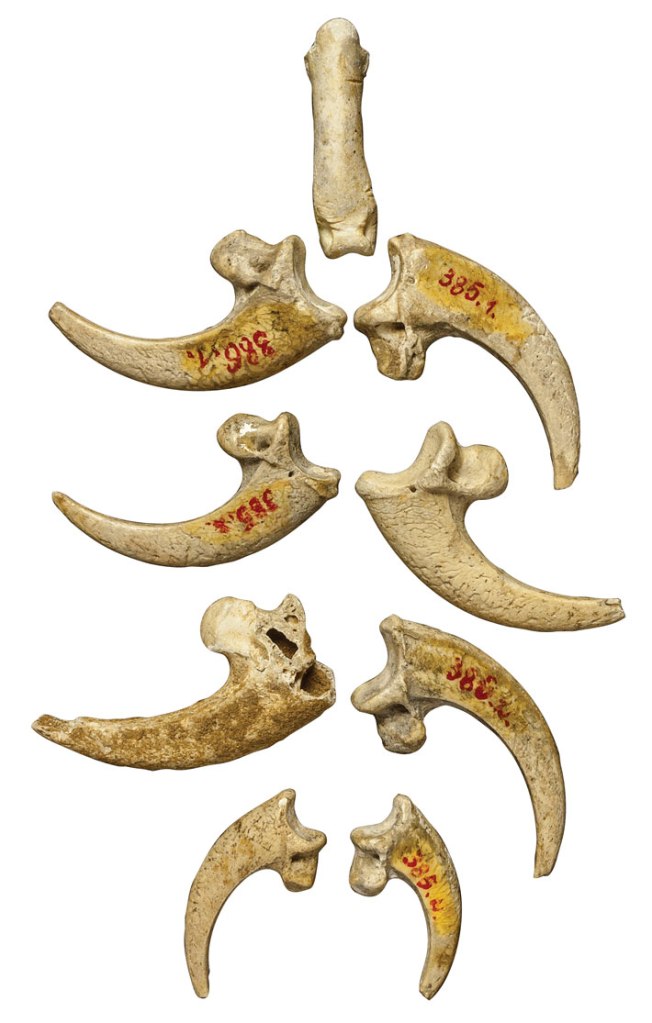
Other forms of body decoration aside from clothing have been used by hominins before clothing was ever a thing however. Individual talons belonging to white-tailed eagles have been found in the Krapina Neanderthal site, Croatia, with modifications that suggest they were used in bracelets or necklaces, from about 130,000 ya. This one of the many examples of early human jewelry.
Studying the divergence of human head and body lice can also give an idea of when humans began wearing clothes.
The body louse (Pediculus humanus humanus) exclusively nests and lays their eggs in clothes, so when humans began wearing clothes, it would have provided new nesting space, allowing them to diverge. The loss of fur in humans would have isolated Pediculus humanus to the head, and they would have further speciated with the introduction of a new habitat, clothing.
Genetic studies show that there was a genetic bottleneck event in Pediculus humanus, likely due to the loss of fur in humans, narrowing their habitat. A large portion of Pediculus humanus living on the head rapidly diversified to take up the newly introduced habitat, which is consistent with post-bottleneck expansions.
Other genetic evidence suggests that head and body lice diverged around 190 kya, and molecular clock analysis shows that at the youngest possible date for the evolution of body lice is 72 kya. This puts the origin of clothing in modern humans at about 190-72 kya.
Conclusion
Lice may be small, annoying, and downright harmful pests, but we can’t rule them out as an important part of our evolution because of this. Despite their small size and obscure, annoying nature, they are very important for understanding our evolutionary story. Two crucial aspects of human evolution, the loss of our fur, and when we began producing and wearing clothes are much more well understood now because of lice, however unexpected and underwhelming that may be.
Sources
- “Head Lice”. Centers for Disease Control and Prevention. 09-11-19, https://www.cdc.gov/parasites/lice/head/biology.html
- “Body Lice”. Centers for Disease Control and Prevention. 09-12-19, https://www.cdc.gov/parasites/lice/body/biology.html
- Bonilla, L. D., Durden, A. L., Eremeeva, E. M., Dasch, A. G. (2013). The Biology and Taxonomy of Head and Body Lice-Implications for Louse-Borne Disease Prevention. PLOS PATHOGENS, 9(11): e1003724. 10.1371/journal.ppat.1003724
- Veracx, A., Raoult, D. (2012). Biology and genetics of human head and body lice. Trends in Parasitology, 28(12), 563-571. https://doi.org/10.1016/j.pt.2012.09.003
- Dinulos, H. G., James. “Lice Infestation”. Merck Manuals, 2022.
https://www.merckmanuals.com/home/skin-disorders/parasitic-skin-infections/lice-infestation
- El-Showk, S. “Learning from Lice”. Accumulating Glitches, 09-28-15. https://www.nature.com/scitable/blog/accumulating-glitches/learning_from_lice/
- Reed, L. D., Light, E. J., Allen, M. J., Kirchman, J. J. (2007). Pair of lice lost or parasites regained: the evolutionary history of anthropoid primate lice. BMC Biology, 5, 7. https://doi.org/10.1186/1741-7007-5-7
- Kang, S. J., Cho, Y., Kim, H. J., Kim, H. S., Yoo, S., Noh, S., Park, J., Yoon, S. K., Clark, M. J., Pittendrigh, R. B., Chun, J., Lee, H. S. (2015). Comparison of the genome profiles between head and body lice. Journal of Asia-Specific Entomology, 18(3), 377-382. https://doi.org/10.1016/j.aspen.2015.04.010
- Herd, E. K., Barker, C. S., Shao, R. (2015). The mitochondrial genome of the chimpanzee louse, Pediculus schaefii: insights into the process of mitochondrial genome fragmentation in the blood-sucking lice of great apes. BMC Genomics, 16, 661. https://doi.org/10.1186/s12864-015-1843-3
- Amanzougaghene, N., Fenollar, F., Raoult, D., Mediannikov, O. (2019). Where Are We At With Human Lice? A Review of the Current State of Knowledge. Frontiers, 9. https://doi.org/10.3389/fcimb.2019.00474
- Boutellis, A., Abi-Rached, L., Raoult, D. (2014). The origin and distribution of human lice in the world. Infection, Genetics and Evolution, 23, 209-217. https://doi.org/10.1016/j.meegid.2014.01.017
- Amanzougaghene, N., Fenollar, F., Davoust, B., Djossou, F., Ashfaq, M., Bitam, I., Raoult, D., Mediannikov, O. (2019). Mitochondrial diversity and phylogeographical analysis of Pediculus humanus reveals a new Amazonian clade “F”. Infection, Genetics and Evolution, 70, 1-8. https://doi.org/10.1016/j.meegid.2019.02.006
- Amanzougaghene, N., Mumcouglu, Y. K., Fenollar, F., Alfi, S., Yesilyurt, G., Raoult, D., Mediannikov, O. (2016). High Ancient Genetic Diversity of Human Lice, Pediculus humanus, from Israel Reveals New Insights Into the Origin of Clade B Lice. PLOS ONE. https://doi.org/10.1371/journal.pone.0164659
- Phadungsaksawasdi, K., Sunantaraporn, S., Seatamanoch, N., Kongdachalert, S., Phumee, A., Kraivichian, K., Sawaswang, V., Payungporn, S., Brownell, S., Siriyasatien, P. (2021). Molecular analysis of mitochondrial cybt of Pediculus humanus capitis in Thailand revealed potential historical connection with South Asia. PLOS ONE. https://doi.org/10.1371/journal.pone.0257024
- Naddaf, R. S. (2018). Lice, Humans, and Microbes. Iran Biomed J, 22(5): 292-293. PMID: 29802698; PMCID: PMC6058184.
- Reed, L. D., Smith, S. V., Hammond, L. S., Rogers, R. A., Clayton, H. D. (2004). Genetic Analysis of Lice Supports Direct Contact between Modern and Archaic Humans. PLOS BIOLOGY. https://doi.org/10.1371/journal.pbio.0020340
- Johnson, P. K., Allen, M. J., Olds, P. B., Mugisha, L., Reed, L. D., Paige, N. K., Pittendrgh, R. B. (2014). Rates of genomic divergence in humans, chimpanzees and their lice. Proceedings of the Royal Society B, 181(1777). https://doi.org/10.1098/rspb.2013.2174
- Daley, Jason. “Why Did Humans Lose Their Fur?” Smithsonian Magazine. 12-11-18, https://www.smithsonianmag.com/science-nature/why-did-humans-evolve-lose-fur-180970980/#
- Dávid-Barrett, T., Dunbar, M. I. R. (2016). Bipedality and hair loss in human evolution revisited: The impact of altitude and activity scheduling. Journal of Human Evolution, 94, 72-82. https://doi.org/10.1016/j.jhevol.2016.02.006
- Brown, G. J. (2021).Ticks, Hair Loss, and Non-Clinging Babies: A Novel Tick-Based Hypothesis for the Evolutionary Divergence of Humans and Chimpanzees. Life, 11(5), 435. https://doi.org/10.3390/life11050435
- Light, E. J., Reed, L. D. (2008). Multigene analysis of phylogenetic relationships and divergence times of primate sucking lice (Phthiraptera: Anoplura). Molecular Phylogenetic and Evolution, 50(2), 376-390. https://doi.org/10.1016/j.ympev.2008.10.023
- Keen, Cathy. “Human pubic lice acquired from gorillas gives evolutionary clues”. Florida Museum, 03,07, 2007. https://www.floridamuseum.ufl.edu/science/human-pubic-lice-acquired-from-gorillas-gives-evolutionary-clues/
- Weiss, A. R. (2009). Apes, lice and prehistory. Journal of Biology, 8, 20. https://doi.org/10.1186/jbiol114
- Das, Monalisa. “Origin and History of Clothing”. Textile School, 02-14-22, https://www.textileschool.com/4639/origin-of-clothing/
- Davies, Bethan. “The Global Last Glacial Maximum”. Antarctic Glaciers, 06-15-17, https://www.antarcticglaciers.org/2017/06/global-last-glacial-maximum/
- 09-23-16. “Denisova Cave Yields a 50,000- year-Old Needle”. Archaeology Magazine, https://www.archaeology.org/news/4784-160823-denisova-cave-needle
- Shunkov, V. M., Fedorchenko, Y. A., Kozlikin, B. M., Derevianko, P. A. (2020). Initial Upper Paleolithic ornaments and formal bone tools from the East Chamber of Denisova Cave in the Russian Altai. Quaternary International, 559, 47-67. https://doi.org/10.1016/j.quaint.2020.07.027
- d’Errico, F., Doyon, L., Zhang, Shuangquan, Z., Baumann, M., Lázničková-Galetová, M., Gao, X., Chen, F., Zhang, Y. (2018).The origin and evolution of sewing technologies in Eurasia and North America. Journal of Human Evolution, 125, 71-86. https://doi.org/10.1016/j.jhevol.2018.10.004
- Radovčić, D., Sršen, O. A., Radovčić, J., Frayer, W. D. (2015). Evidence for Neandertal Jewelry: Modified White-Tailed Eagle Claws at Krapina. PLOS ONE. https://doi.org/10.1371/journal.pone.0119802
- Zorich, Zach. “Neanderthal Necklace”. Archaeology Magazine, 07, 2015. https://www.archaeology.org/issues/182-1507/trenches/3366-trenches-neanderthal-eagle-talon-necklace
- Toups, A. M., Kitchen, A., Light, E. J., Reed, L. D. (2011). Origin of Clothing Lice Indicates Early Clothing Use by Anatomically Modern Humans in Africa. Molecular Biology and Evolution, 28 (1), 29-32. https://doi.org/10.1093/molbev/msq234
- “What can lice tell us about human evolution”. The Smithsonian Institution’s Human Origins Program, 08-01-2020, https://humanorigins.si.edu/education/fun-facts/what-can-lice-tell-us-about-human-evolution
- Kittler, R., Kayser, M., Stoneking, M. (2003). Molecular Evolution of Pediculus humanus and the Origin of Clothing. Current Biology, 13(16), 1414-1417. https://doi.org/10.1016/S0960-9822(03)00507-4
 World of Paleoanthropology
Excellent, detailed, engaging….I thought I “knew” about this topic but I learned a lot. Thank you!
LikeLiked by 1 person
Thank you for the kind words! It is certainly a fascinating topic. This article took a long time to finish and took a lot of research so I am glad it was informative to you. The work always pays off when I can teach others about the interesting origins of our species and lineage, and all the details within it.
LikeLike