Hearing the Ancient World
Imagine stepping into the world of our ancestors—not through vision alone, but through the constant stream of sounds that framed daily life. Long before written symbols or cave paintings, sound was a primary medium through which early humans understood, navigated, and interpreted their environments. The creak of firewood, the rustle of prey in tall grass, the sudden hush that signaled danger—these auditory cues were not background noise but essential signals for survival, communication, and cultural expression. In this essay, we examine the prehistoric soundscape and its profound influence on human evolution and social life.

Sound has often been overshadowed by visual culture in archaeological interpretation, yet it was arguably more fundamental. Auditory stimuli surround individuals from birth to death, shaping cognition, attention, and collective identity. Reconstructing these soundscapes allows us to appreciate how auditory perception structured the lived realities of early humans.
The Earliest Human Soundscapes
For the earliest hominins—Australopithecus afarensis, Homo habilis, and Homo erectus—the natural environment was a dynamic soundscape. The calls of predators, the wingbeats of birds, and the crash of coastal waves carried ecological information critical for survival. Paleoecological research demonstrates that these habitats were saturated with ambient noise, from insect choruses to seasonal rainstorms (Dunbar, 2017). In this context, attentiveness to subtle differences in pitch, rhythm, or intensity could distinguish life-threatening signals from harmless background sounds.
The fossil record supports this emphasis on auditory acuity. Studies of the bony labyrinth—the structures of the inner ear—indicate that species such as Homo erectus possessed auditory ranges optimized for detecting higher frequencies compared to non-human primates (Quam & Rak, 2008). This physiological adaptation enhanced the ability to parse complex soundscapes, setting the stage for the eventual emergence of language.
Ethnographic data strengthen these interpretations. For example, the San of southern Africa can identify dozens of animal calls, while the Hadza of Tanzania interpret bird sounds as guides to honey sources. These practices reveal continuities in the adaptive significance of sound. Sound did not merely accompany human activity; it structured it, from hunting coordination to territorial recognition. Early humans lived in worlds defined as much by what they heard as by what they saw.

The First Instruments and Music
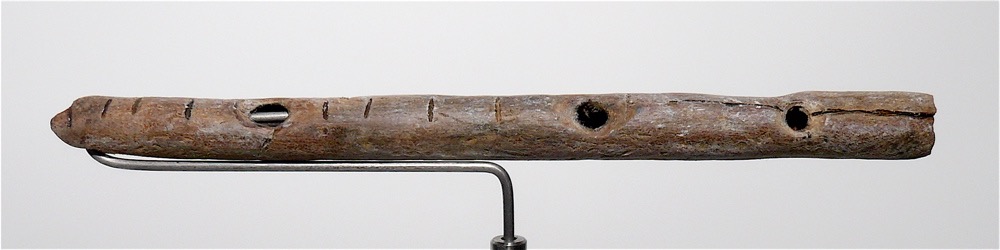
Material traces of music emerge in the archaeological record tens of thousands of years ago. The Divje Babe bone, possibly a Neanderthal flute, dates to over 50,000 years ago and suggests that music-making may have extended beyond Homo sapiens (Turk et al., 1997). Though its interpretation remains contested, the artifact underscores the antiquity of musical behavior.
More definitive evidence comes from Aurignacian Europe, where flutes crafted from vulture bones and mammoth ivory, such as those from Geißenklösterle, date to approximately 40,000 years ago (Conard et al., 2009). These instruments required technical knowledge and intentional design, highlighting music’s social value.
Music functioned as more than entertainment. Ethnographic and cognitive studies demonstrate its role in social bonding, emotional regulation, and ritual cohesion (Cross, 2001). Lullabies soothed infants, rhythmic drumming synchronized group labor, and communal singing reinforced identity. The production and performance of music were therefore adaptive behaviors that contributed to group stability and cooperation. Far from a peripheral activity, music was central to human survival strategies.
The Acoustics of Caves and Ritual Spaces
Recent interdisciplinary studies demonstrate that Paleolithic peoples were acutely aware of the acoustic properties of caves. At sites such as Lascaux, Chauvet, and Altamira, researchers have documented correlations between decorated chambers and zones of unusual resonance (Reznikoff & Dauvois, 1988). These locations amplify voices, echo percussion, and create acoustic effects that heighten sensory experience.
It is plausible that such spaces were intentionally selected for ritual activity. The interplay of flickering firelight, painted figures, and resonant sound transformed caves into immersive ritual environments. Chanting, drumming, and vocalizations could induce altered states of consciousness, reinforcing spiritual or communal experiences (Morley, 2013). These caves were not inert shelters; they were interactive theaters where sound and image combined to create meaning.
This perspective reframes cave art not only as visual expression but as an element in a broader multisensory cultural system. The cave was simultaneously a gallery and a performance hall, shaping the emergence of symbolic thought.

The Voice as the First Instrument
Before flutes and drums, the most versatile instrument was the human voice. The anatomical evidence of the hyoid bone, preserved in Neanderthal specimens such as Kebara 2, indicates the potential for complex vocalization (Arensburg et al., 1989). Coupled with respiratory control and changes in the vocal tract, this anatomy enabled a wide repertoire of sounds.
Vocalization likely served multiple adaptive purposes. Beyond language, early humans may have used chanting, pitch modulation, and call imitation in both functional and symbolic contexts. Parental vocalizations—lullabies, cooing, rhythmic humming—strengthened bonds between caregiver and child, a crucial mechanism for infant survival.
The human voice carried authority in ritual contexts, guided collective hunting, and mediated social negotiations. Its ability to move fluidly between practical and symbolic functions made it indispensable. Moreover, the ubiquity of song, chant, and prayer across cultures suggests deep evolutionary roots. In evolutionary anthropology, the voice represents the original interface between biology, society, and spirituality.
Reconstructing Prehistoric Soundscapes Today
Contemporary archaeology increasingly turns to sound reconstruction to recover this neglected dimension of prehistory. Experimental archaeology reproduces Paleolithic instruments and explores their acoustic capacities, while musicians perform within reconstructed cave environments to simulate ancient experiences. The resulting sounds are often haunting, emphasizing both continuity and distance between past and present.
Advances in digital technology allow even greater precision. Virtual reality and 3D acoustic modeling have been applied to caves to replicate resonance patterns and auditory experiences (Ellerbroek et al., 2019). Museums and heritage projects now incorporate these reconstructions into exhibitions, offering visitors immersive encounters with prehistoric soundscapes.
These reconstructions are not mere demonstrations but research tools. They prompt new questions: How did music support memory and oral tradition? In what ways did soundscapes influence symbolic thought and mythology? By situating sound at the center of inquiry, we restore a neglected dimension of human history and cognition.
Conclusion: Listening to the Past
The prehistoric soundscape reveals that auditory experience was not peripheral but foundational to human evolution. Sound facilitated survival, reinforced community, and mediated the sacred. From lullabies to cave chants, auditory practices bound individuals to each other and to their environments. In the absence of writing, sound was a repository of knowledge, identity, and meaning.
To reconstruct these soundscapes is to acknowledge that human history is not only visual but acoustic. By listening to the echoes of prehistory, we uncover the rhythms that shaped cognition and culture. The prehistoric world was alive with resonance and rhythm, reminding us that to be human has always meant to hear as well as to see.
Works Cited (APA 7th)
Arensburg, B., Tillier, A. M., Vandermeersch, B., Duday, H., Schepartz, L. A., & Rak, Y. (1989). A Middle Palaeolithic human hyoid bone. Nature, 338(6218), 758–760.
Conard, N. J., Malina, M., & Münzel, S. C. (2009). New flutes document the earliest musical tradition in southwestern Germany. Nature, 460(7256), 737–740.
Cross, I. (2001). Music, cognition, culture, and evolution. Annals of the New York Academy of Sciences, 930(1), 28–42.
Dunbar, R. (2017). Human evolution: Our brains and behavior. Oxford University Press.
Ellerbroek, J., van Opstal, A. J., & Peters, R. J. (2019). Acoustic modeling of prehistoric caves: Reconstructing auditory environments. Journal of Archaeological Science, 105, 12–23.
Morley, I. (2013). The prehistory of music: Human evolution, archaeology, and the origins of musicality. Oxford University Press.
Quam, R., & Rak, Y. (2008). Auditory ossicles from southwest Asian Mousterian sites. Journal of Human Evolution, 54(3), 414–433.
Reznikoff, I., & Dauvois, M. (1988). La dimension sonore des grottes ornées. Bulletin de la Société Préhistorique Française, 85(8), 238–246.
Turk, I., Turk, M., & Otte, M. (1997). The Neanderthal flute from Divje Babe I cave (Slovenia). Antiquity, 71(272), 39–49.

