
Introduction
A common misconception about biological anthropology and human evolution is that ancient hominins are purposefully reconstructed to appear more ‘human-like.’ Many creationist organizations, such as Answers in Genesis, claim that scientists give reconstructions of hominins specific traits, in a dishonest effort to make them look more human, to make them appear as if they evolved.
A common example of this is the color of the sclera. It is often claimed that hominin reconstructions are given white sclera (the whites of the eyes) to make them appear more friendly and human-like. It is said that this is dishonest as they claim white sclera is exclusive to humans, and no apes possess this feature. This however, is untrue.
What is the Sclera?
Sclera are the surface of the outside of the eye (excluding the pupil and iris), making 85% of this portion of the eye. It is composed mostly of water and collagen, and is the main connective tissue of the eye, giving more support to the eye wall.
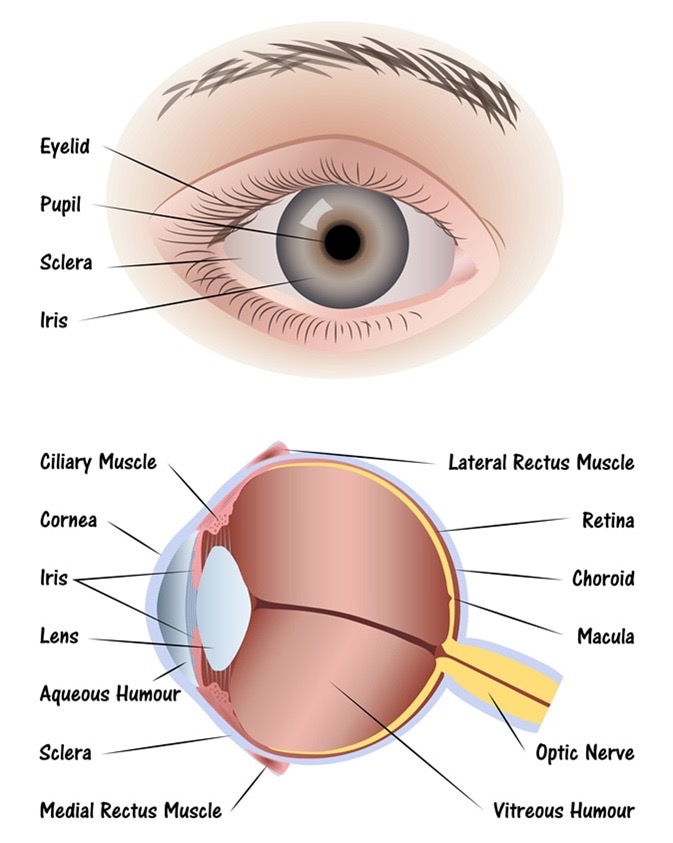
All humans (except for rare cases, such as melanosis) possess depigmented sclera, making them appear white in color. Most other apes, such as chimpanzees and gorillas, typically have pigmented sclera, making them appear more brown, but this isn’t always the case.
White Sclerae in Nonhuman Apes
White sclerae is indeed a part of the normal variation of other apes. In a chimpanzee population in Kibale National Park, Uganda, 34 out of 250 individuals possessed white sclera, making up roughly 15% of the population. Depending on the species or population, it may be more common. For example, bonobos typically have brighter sclera than chimpanzees, lowland gorillas have brighter sclera than mountain gorillas, and sumatran orangutans have brighter sclera than bornean orangutans.
Just like any other trait, white sclera naturally occur in certain populations of apes, depending on whether the mutation for it is present and positively selected for. In this case, there are several benefits for white sclera.

Benefits of Scleral Depigmentation
Having white sclerae allows for gaze following, being able to see the direction of a conspecifics gaze from far away. This is known as the cooperative eye hypothesis, or the gaze signaling hypothesis. Young children use gaze following to locate certain items and interact with their parents, and adults of both humans and other apes find it easier to follow gazes when the other individuals have brighter sclera. Because humans are such a social species, it would make sense why this would be so beneficial for us. It also explains why it is beneficially selected for when it appears in the gene pool of other ape species.
Along with this, white, brighter sclerae have been shown to make an individual appear more friendly, young, and trustworthy, which is also beneficial for social ape species. It has also been shown that young children prefer to be around other children with brighter sclera.
It has been often considered that darker sclera is beneficial for other apes however, as it conceals their gaze from conspecifics. This is known as the gaze camouflage hypothesis. However, in recent years this idea has become much less common. New studies show that darker sclera does not effectively conceal one’s gaze, and the gaze is still visible up to 10 meters, effectively ruling out this hypothesis.
Did Hominins Have White Sclera?
Hominins are very often reconstructed with white sclera. From everything shown in research on this topic, that is very reasonable. As it is a part of the natural variation of modern nonhuman apes, it is very likely our own ancestors possessed this as well. Considering how close these animals were to us, in behavior, genetics, and morphology, it very well could have been the norm. Though it likely wasn’t seen in every ancient hominin, it was likely very common.

Conclusion
Despite what is often claimed by creationist organizations, many nonhuman apes do indeed possess white sclera. It is a part of their natural genetic variation, and is positively selected for when it appears in a population. This is because it allows for an individual to follow a conspecific’s gaze from far away, and makes individuals appear more friendly and trustworthy.
Because of how closely related and similar extinct hominins, such as Australopithecus, were to modern humans, it is very likely that the majority of individuals had white sclera. It is for this reason that reconstructing hominins with white sclera is not dishonest.
Sources
- Henderson, Doug. “Bringing Lucy to Life”. Answers in Genesis, 01-01-13. https://answersingenesis.org/human-evolution/lucy/bringing-lucy-to-life/
- Boote, C., Sigal, A. I., Grytz, R., Hua, Y., Nguyen, D. T., Girard, A. J. M. (2020). Scleral structure and biomechanics. Prog Retin Eye Res, 74: 100773. 10.1016/j.preteyeres.2019.100773
- Patel, HH. “Anatomy of the Human Eye”. Medical Life Science, 06-07-23. https://www.news-medical.net/health/Anatomy-of-the-Human-Eye.aspx
- Belden, Shannon. “Ocular Melenosis”. All About Vision, 09-14-22. https://www.allaboutvision.com/conditions/ocular-melanosis/
- Clark, R. I., Lee, C. K., Poux, T., Langergraber, E ,K., Mitani, C. J., Watts., D., Reed., J., Sandel, A. A. (2023). White sclera is present in chimpanzees and other mammals. Journal of Human Evolution, 176, 103322. https://doi.org/10.1016/j.jhevol.2022.103322
- Funnell, Rachael. “Side-Eye May Be More Common Among Primates Than We Realized”. IFL Science, 01-30-23. https://www.iflscience.com/side-eye-may-be-more-common-among-primates-than-we-realized-67312
- Wacewicz, S., Perea-García, O. J., Lewandowski, Z., Danel, P. D. (2022). The adaptive significance of human scleral brightness: an experimental study. Scientific Reports, 12, 20261. https://doi.org/10.1038/s41598-022-24403-2
- Kano, F., Kawaguchi, Y., Hanling, W. (2022). Experimental evidence that uniformly white sclera enhances the visibility of eye-gaze direction in humans and chimpanzees. eLife, 11:e74086. https://doi.org/10.7554/eLife.74086
- Tomasello, M., Hare, B., Lehmann, H., Call, J. (2007). Reliance on head versus eyes in the gaze following of great apes and human infants: the cooperative eye hypothesis. Journal of Human Evolution, 52(3), 314-320. https://doi.org/10.1016/j.jhevol.2006.10.001
- Caspar, R. K., Biggemann, M., Geissmann, T., Begall, S. (2021). Ocular pigmentation in humans, great apes, and humans, and gibbons, is not suggestive communicative functions. Scientific Reports 11 12994. https://doi.org/10.1038/s41598-021-92348-z
- Perea-García, O. J., Kret, E. M., Monteiro, A, Hobaiter, C. (2019). Scleral pigmentation leads to conspicuous, not cryptic, eye morphology in chimpanzees. PNAS, 116(39), 19248-19250. https://doi.org/10.1073/pnas.1911410116
- Morgan, Hope. “Scleral Pigmentation”. Center for Academic Research and Training in Anthropology, 2023. https://carta.anthropogeny.org/moca/topics/sclera-pigmentation
- Perea-García, O. J., Danel, P. D., Monteiro, A. (2021). Diversity in External Eye Morphology: Previously Undescribed Traits and Their Potential Adaptive Value. Symmetry, 13(7), 1270. https://doi.org/10.3390/sym13071270
- “Chimps and bonobos may track eye gaze like humans”. Research Impact, 09-04-19. https://news.nus.edu.sg/chimps-and-bonobos-may-track-eye-gaze-like-humans/
- Kano, F., Furuichi, T., Hashimoto, C., Krupenye, C., Leinwand, G. J., Hopper, M.,L,., Marin F. C., Otsuka, F., Tajima, T. (2022). What is unique about the human eye? Comparative image analysis on the external eye morphology of human and nonhuman great apes. Evolution and Human Behavior, 43(3), 169-180. https://doi.org/10.1016/j.evolhumbehav.2021.12.004
- “Australopithecus afarensis”. Smithsonians Institute of Human Origins, 06-30-22. https://humanorigins.si.edu/evidence/human-fossils/species/australopithecus-afarensis


Thanks for thoughtful piece.
It’s amazing how often we find folks grabbing onto a hint of possible deception as proof of a theory.
In this case, there really was no deception, but it has been presented as such.
Deception or not, it does not prove anything about lineage.
LikeLike