Ever since humanity first began to think, we have always had an interest in where we first began as a species. Cultures throughout the entire world invented myths and legends to explain our origins, while science has steadily gathered evidence to address the question in an objective and provisional way.
During the Enlightenment Period, early scientists had a number of different ideas based on the evidence available at the time. Carolus Linnaeus invented his taxonomic system to organize life in a systematic way, presenting certain patterns of biodiversity that he struggled to explain at the time. Charles Darwin and some of his contemporaries used biogeography to explain Linnaeus’ patterns, postulating that human beings must have evolved from Africa, based on where the other primates are most concentrated in. Today, there are numerous lines of evidence that all point to Africa as the birthplace of mankind, and three of those lines will be discussed in this article: linguistic diversity, fossils, and genetics.
Written by — Gabriel Stroup (updated: 12 July 2024)
Linguistic Diversity
Linguistics, the study of human languages, is one area in the humanities that benefits from an understanding of evolutionary theory, and in this case, it can be used to highlight the linguistic diversity in Africa, which may help to collaborate other lines of evidence later on.
Africa is among the most linguistically diverse continents. Its ~3,000 known indigenous languages fall into many different categories (language families), such as Niger-Congo, Afro-Asiatic, and smaller families unique to Africa. This is in addition to a good number of language isolates (languages not believed to be related to any other languages), including some of the “click” languages that were once classified together. Clicks, tones, and other linguistic features are not necessarily unique to Africa, but nonetheless contribute to Africa’s unique lingual diversity.
These languages are spoken by various cultures across Africa, some representing pre-ploughing agriculture, making them among the oldest, continuously-spoken languages. Linguistic methods unfortunately do not provide strong dates or timelines over a certain time period; languages in any area would have changed over time due to both common ancestry and close-contact borrowing, leaving little traces of their ancestral forms, especially without writing systems. Even so, linguistic diversity can be a decent starting point for assessing Africa as the origin of humankind, and it lends itself well to be corroborated by archaeological/paleontological/genetic data, as we shall see.

Fossils
Since the rise of paleoanthropology, fossil material has been incredibly important in hypothesizing the origin of human beings, controversy notwithstanding. At the time of this writing, there is an innumerable amount of fossil material that have been scrutinized for what they can tell us about human evolution and migration. Amid a wide variety of fossil primates that show transitions from basal primates to basal apes, Sahelanthropus and Ardipithecus show the earliest signs of habitual bipedalism. Australopithecus, a genus that contains many distinct species, shows even more prevalent signs of not habitual, but obligate, bipedalism. These two ape groups are exclusive to Africa, and so are the earliest species of Homo. Homo habilis and similar species show an increased use of tools and a gradually-increased braincase as they diversified into later Homo species.
Homo erectus, a later species of Homo, was among the first to venture out of Africa, leaving fossils as far east as Indonesia. Throughout its temporal and geographic ranges, it exhibited a suite of characteristics that show an adapted lifestyle on the ground, compared to the arboreal lifestyle that prior species indicated. These characteristics varied to a degree; a degree that has led to scientists believing that several later Homo species evolved from different H. erectus populations at different times and areas, and even coexisting with these species at some point.
Despite H. erectus‘ presence across the Old World, the earliest Homo sapiens fossils occur in Africa, while neanderthals (Homo neanderthalensis) are believed to have evolved from H. erectus in Europe. This would indicate not just that our own species originated in Africa, but also that humans have migrated out of Africa more than once! As we approach modern times, human fossils become more widespread and homogenous, which reduces their ability to tell us about our evolutionary history. Genetics, thankfully, continues to reveal so many details about both our prehistoric history and our recent history alike.

Genetics
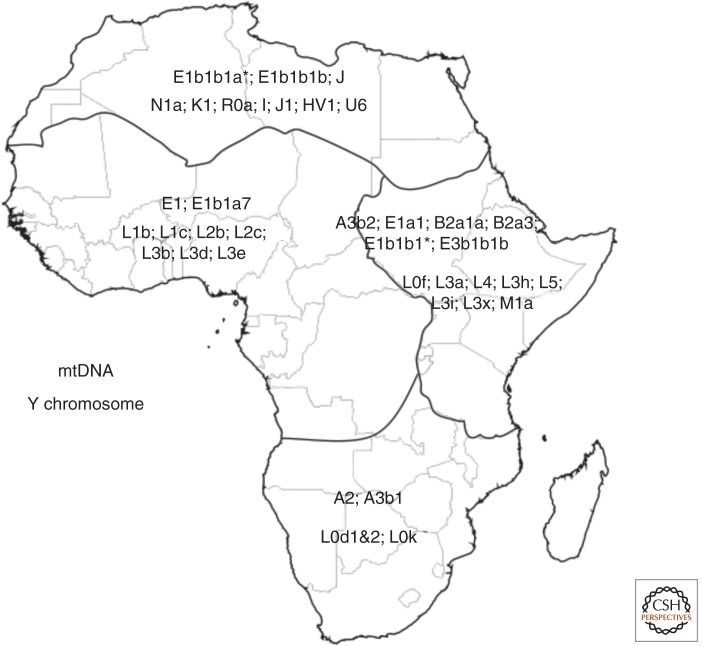
Genetics alone provides a strong case for an African origin for all human beings, as if the previous sections didn’t already do so. Indigenous African people show the most diversity in their genomes compared to the rest of humanity, which would imply that if humans had any evolutionary history at all, Africa would be the place to start.
Indeed, genetics can elucidate evolutionary changes in the human genome over time, based on established rates of mutation. Specific mutations in specific parts of the genome are shared only by people who share a common lineage. These lineages are typically called “haplogroups.” By tracking how these haplogroups diversify into others, we can learn patterns of human migrations.
There are different haplogroups for different types of lineages, particularly depending on which DNA sequences are being considered. Mitochondrial DNA, for example, has different haplogroups from Y-chromosomal DNA. Mitochondrial DNA is DNA passed down from mother to child, while Y-chromosomal DNA is passed from father to son. As it happens, both DNA groups can be traced to an origin in Africa (referred to as “mitochondrial Eve” or “Y-chromosomal Adam”), although not simultaneously with each other. Looking at both show interesting patterns over time, tracing how an individual’s maternal and paternal lineages evolved over time and space.
Indigenous Africans in various areas appear to have unique mitochondrial and Y-chromosomal haplogroups that are not shared by humans outside of Africa. This would indicate that 1) all non-African humans share a common ancestor from a specific region in Africa (East Africa), and 2) that indigenous Africans from East Africa have more genetic similarities with non-Africans than they do with Africans from other regions! This could overall only indicate that the height of human genetic diversity (and therefore the most likely place of origin for humans as a whole) occurs squarely within Africa.
Looking beyond modern human genomes, genetics has also confirmed that humans are nestled among the great apes (Hominidae), sharing about 98% of our genetic material with chimpanzees. Beyond this, the other great apes not only share a high fraction of genetic material among each other compared to other mammals, but they also show a tendency for “incomplete lineage sorting (ILS).” This is a genetic phenomenon where certain gene sequences are conserved in their ancestral states, despite the species holding them having already speciated. This is the reason why, for example, a certain percentage of human genes share more commonality with gorillas than with chimps; the common ancestor between humans and chimps had speciated so quickly that the gene sequences between humans and gorillas hadn’t had the time to establish changes in their respective populations. Why this speciation occurred quickly is not yet known, but it would indicate a quick establishment of these species squarely within Africa.
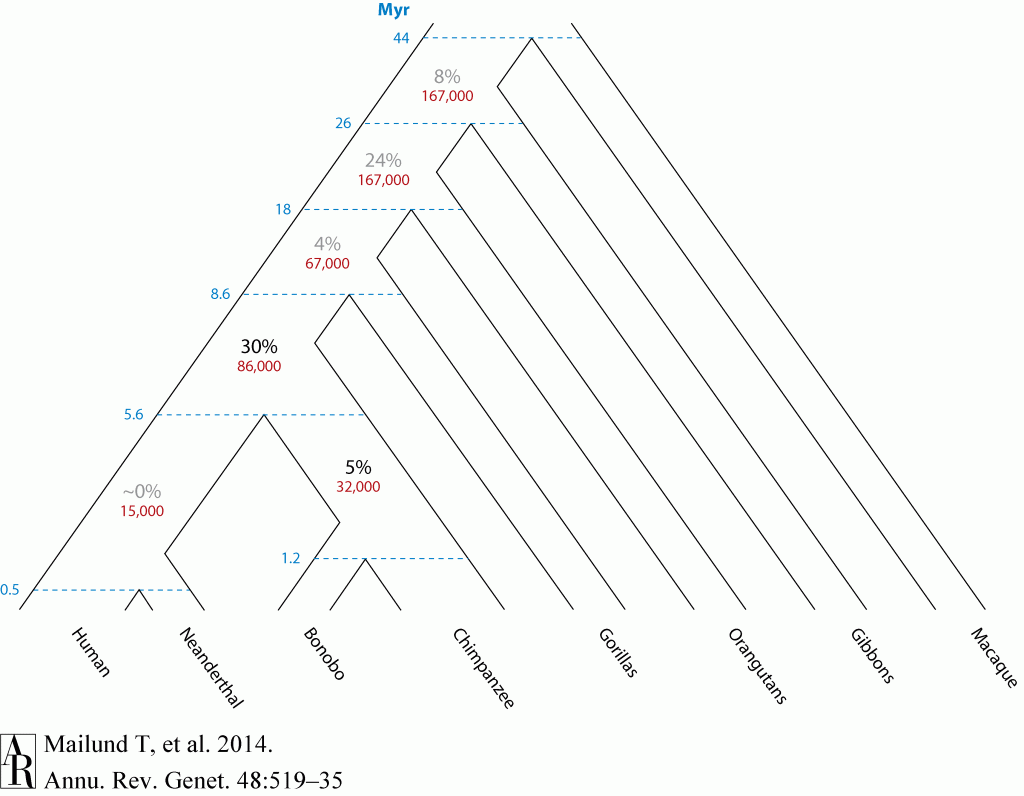
All this to say, the fact that the majority of great apes (gorillas, chimps and humans) likely arose in Africa, would corroborate all the prior lines of evidence from separate scientific fields, which all indicate that Africa is most likely the cradle of humankind. Studying human evolution from numerous different angles provides the clearest picture of where humans came from, and the picture becomes ever-more clear as new evidence is constantly discovered and old ideas constantly being updated, which is what makes science a self-correcting process.
Bibliography
Gomez, Felicia, Jibril Hirbo, and Sarah A. Tishkoff. “Genetic variation and adaptation in Africa: implications for human evolution and disease.” Cold Spring Harbor perspectives in biology 6.7 (2014): a008524.
Mailund, Thomas, Kasper Munch, and Mikkel Heide Schierup. “Lineage sorting in apes.” Annual review of genetics 48 (2014): 519-535.
Pereira, Luisa, et al. “African genetic diversity and adaptation inform a precision medicine agenda.” Nature Reviews Genetics 22.5 (2021): 284-306.


As a linguist specialized in Africa I am afraid the linguistic evidence does not corroborate an African origin for humankind at all. First of all, African linguistic diversity is much lower than in areas colonized by humans much more recently such as South America or New Guinea. Africa hosts maybe some 20 different genetic lineages whereas South America and New Guinea are each home to at least more than a hundred.
It is true that most African languages are tonal, but this feature does not tell us anything about an African origin for humans. Tone is a feature of probably the majority of languages in the world, and is found in all areas of the world, especially in Asia. Tone is something that languages can develop quite easily, a process that is quite well-studied, and which, together with loss of tone, accounts for languages of the same families differing in their use of tone.
Clicks, too, are a feature of a small minority of African languages, and African languages are the only languages in the world to make use of phonemic clicks, meaning clicks as consonants used to build words, rather than clicks as utterances in themselves, which is something that occurs in languages outside of Africa as well. This has often been taken as evidence that clicks are “old”, or even part of the first human languages, but there is no linguistic evidence for this. Linguistic methods allow us to go back in time not much more than 10,000 years, which is probably far more shallow than the origin of human language.
All of this does not mean that an African origin for humans is unlikely, because evidence from other disciplines unequivocally supports this. It also does not mean that the linguistic evidence is wrong, or irrelevant. It’s rather an interesting mismatch that suggests that some of the linguistic diversity originally present in Africa has disappeared, possibly quite recently, as the result of large language expansions, especially of the Niger-Congo phylum.
LikeLiked by 1 person
I appreciate your input. I do want to clarify that I was just comparing the amount of language families on each continent, which is how I came up with Africa being the most linguistically diverse, but I clearly didn’t closely consider South America in that comparison.
Indeed, tone (and clicks) on its own is not really a marker of age; I was just using it as an example because it’s one feature of many different features that one may not expect to coexist in one area.
As a hobbyist in linguistic study, I just wanted to highlight the linguistic diversity in Africa as a starter for this article, but I appreciate you taking the time to provide clarification. I will make some edits to reflect what you’ve mentioned here.
LikeLike
Great write-up for the most part, but I thought the last common ancestor we shared with the Neanderthal/Denisovan lineage was Homo heidelbergensis, not Homo erectus.
LikeLiked by 1 person
As far as I am aware, H. heidelbergensis is itself a descendent of European H. erectus populations, so I was just skipping it for the sake of brevity.
LikeLike