Introduction
Paleolithic cave art often occupies deep, hard-to-reach chambers where light is scarce, surfaces vary, and the air itself feels different from the outside world. Traditional explanations for motif placement emphasize visibility, surface suitability, pigment access, and preservation bias. In recent decades, researchers have added a complementary, measurable factor to that list: acoustics. Echoes, resonances, and long low‑frequency decay change how a space feels and how sound behaves within it, and these sonic properties may have influenced where people sang, drummed, performed, and painted (Fazenda et al., 2017; Till, 2019). This article synthesizes the core empirical work, explains the methods used to measure a cave’s “voice,” surveys key case studies, and outlines interpretive frameworks linking acoustics with ritual practice, memory, and symbolic cognition.
Why acoustics matter

Spaces invite action through their sensory affordances. A chamber that produces strong low‑frequency resonance creates a bodily sensation — a chest‑filling vibration and a long decay — that differs markedly from the sonic experience in an open shelter or a shallow alcove. Echoes and reverberation alter intelligibility, change the perceived emotional weight of voice, and reshape the perception of rhythm and pitch. Across many cultures, resonant spaces are central to ritualized sound-making: drumming structures time, chant synchronizes groups, and acoustics amplify presence (Till, 2019). If Paleolithic people noticed these affordances, they may have preferred acoustically rich niches for performance and then marked those places visually; thus image and sound could have been co‑produced in ritual contexts (Fazenda et al., 2017; Miyagawa et al., 2018).
The state of evidence
Archaeoacoustics has moved from anecdote to systematic inquiry. Earlier observational notes documented curious coincidences between motifs and acoustic quirks; subsequent work introduced standard acoustic measures and larger sampling strategies. The strongest empirical work comes from grid‑based impulse‑response surveys carried out in decorated caves, where dense acoustic sampling has been paired with precise mapping of motifs. These studies report a modest but repeatable pattern: abstract marks (dots, lines, punctuations) are disproportionately found at positions with moderate reverberation and measurable low‑frequency resonances (Fazenda et al., 2017). Reviews and comparative studies corroborate that acoustics are a plausible variable influencing motif placement (Till, 2019; Díaz‑Andreu & García Benito, 2012).
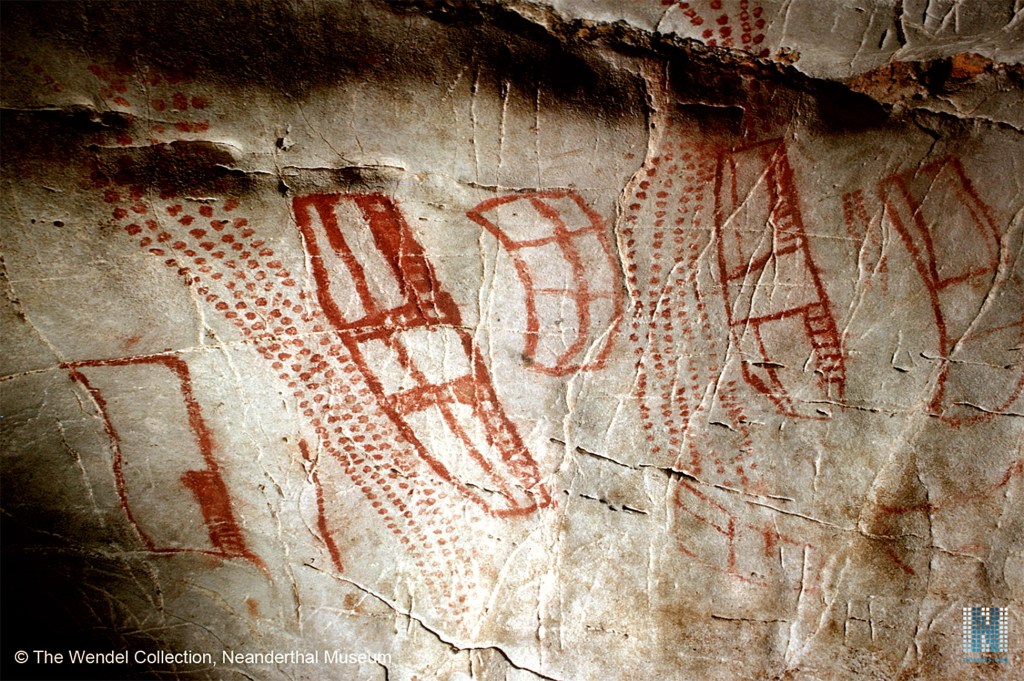
Important caveats remain. Acoustic measurements are highly sensitive to microphone position, environmental conditions (humidity, water flow), and human presence. Taphonomic processes filter which motifs survive for us to sample, and deep chambers may have been chosen for reasons (privacy, initiatory control) that correlate with acoustic traits. Consequently, observed correlations do not amount to proof of intentional sonic selection. Instead, acoustics provide an independent, testable axis for evaluating competing explanations of where and why people decorated caves (Fazenda et al., 2017; Reznikoff & Dauvois, 1988).
Methods: measuring a cave’s voice
Field archaeoacoustics adapts tools from architectural acoustics to fragile archaeological contexts. Researchers map decorated surfaces, establish measurement grids, and record impulse responses that describe how a space reacts to a short, broadband input. The modern standard is a sine‑sweep played through an omnidirectional speaker, recorded with calibrated microphones and deconvolved to produce high‑fidelity impulse responses across frequency bands (Till, 2019).
From those impulse responses researchers extract metrics such as reverberation time (T30/T60), early decay time (EDT), speech‑transmission indices approximating intelligibility (STI), clarity indices (C80), and spectral analyses that reveal low‑frequency peaks or modal behaviour. Good practice pairs acoustic metrics with archaeological variables — distance from the entrance, wall smoothness, motif type and density, hearths, and artifact concentrations — and uses matched control points and spatial statistics to test whether motif placement is associated with specific acoustic signatures (Fazenda et al., 2017). Perceptual experiments in which listeners judge recordings or simulations help link measurable acoustics to emotional and mnemonic responses (Miyagawa et al., 2018).
Because acoustic fields are condition‑sensitive, reproducible research requires careful logging of temperature, humidity, and water flow, as well as open data so other teams can verify patterns across seasons and sites (Till, 2019).

Case studies and comparative notes
La Garma and several Spanish sites offer some of the clearest empirical evidence. Dense grid sampling paired with meticulous archaeological mapping found that abstract marks clustered in acoustically distinctive niches; the study stands out for its sample size and transparent controls (Fazenda et al., 2017). In Cantabria, including El Castillo, several of Europe’s oldest motifs occur in deep chambers with long decay times and pronounced low‑frequency energy; these patterns are testable against preservation and access explanations (Fazenda et al., 2017; Reznikoff & Dauvois, 1988).
The Hal‑Saflieni Hypogeum in Malta—Neolithic rather than Paleolithic—demonstrates that subterranean spaces can exhibit discrete spectral peaks and that architecture can be used to create or exploit resonant properties (Wolfe, Swanson, & Till, 2020). Comparative research that systematically contrasts decorated and undecorated caves of similar geology, accessibility, and surface quality remains a priority. If acoustic hotspots persist as a distinguishing feature after careful control, the case for intentional or opportunistic use of sound strengthens (Díaz‑Andreu & García Benito, 2012).
Interpretive frameworks
Three overlapping frameworks help translate acoustic observations into behavioral hypotheses. The performance and ritual framework proposes that resonant chambers supported communal sound‑making—drumming, chanting, low‑pitched vocalization—and that visual marks served as backdrops, sequence markers, or durable traces of ritual events (Till, 2019). The mnemonic mapping framework suggests that visual marks anchor fleeting sonic episodes into spatial memory, providing cues for recalling sequences, songs, or actions associated with a place (Miyagawa et al., 2018). The cross‑modal practice framework argues that translating auditory experience into visual tokens exercises abstraction and symbolic mapping; repeated cross‑modal practices could, over generations, scaffold representational capacities and contribute to the emergence of symbolic thought (Miyagawa et al., 2018).
These frameworks are compatible rather than exclusive: ritual performance may lead to mnemonic marking, and repeated cross‑modal practice may gradually foster symbolic cognition. Present data support plausibility and point to testable predictions rather than definitive conclusions (Fazenda et al., 2017; Till, 2019).

Conclusions and research priorities
Archaeoacoustics contributes a measurable sensory dimension to debates about parietal art. Quantitative studies show modest, repeatable associations between motifs and acoustic features in several decorated caves, and theoretical work links these patterns to ritual practice, memory, and symbolic cognition (Fazenda et al., 2017; Miyagawa et al., 2018; Till, 2019). Practical and conceptual challenges remain: acoustic measures are condition‑sensitive and require standardized protocols, and researchers must avoid single‑factor explanations that marginalize taphonomy, access, or surface suitability.
Near‑term priorities include building cross‑regional datasets that compare decorated and undecorated caves with robust archaeological controls, running controlled perceptual experiments to quantify human responses to resonant soundscapes, and creating open repositories for impulse‑response data paired with archaeological metadata. Longer‑term work should integrate acoustic data with cognitive neuroscience and ethnographic analogues to test whether repeated cross‑modal practice plausibly supports the emergence of symbolic behaviors. Treating caves as multisensory contexts moves archaeology toward a more embodied understanding of prehistoric practice.
References (APA 7th edition)
Fazenda, B., Scarre, C., Till, R., Jiménez Pasalodos, R., Ontañón Peredo, R., Watson, A., Wyatt, S., García Benito, C., Drinkall, H., & Foulds, F. (2017). Cave acoustics in prehistory: Exploring the association of Palaeolithic visual motifs and acoustic response. The Journal of the Acoustical Society of America, 142(3), 1332–1349. https://doi.org/10.1121/1.4998721
Miyagawa, S., Clark, A., Blasi, D., & Cysouw, M. (2018). Cross-modality information transfer: Cave art as cross-modal mapping. Frontiers in Psychology. https://doi.org/10.3389/fpsyg.2018.00077
Díaz-Andreu, M., & García Benito, C. (2012). Acoustics and Levantine rock art: Auditory perceptions in rock art landscapes. Journal of Archaeological Science: Reports.
Till, R. (2019). Sound archaeology: A study of the acoustics of three world heritage sites, Spanish prehistoric painted caves, Stonehenge, and Paphos Theatre. Acoustics, 1(3), 661–692. https://doi.org/10.3390/acoustics1030039
Wolfe, K., Swanson, D., & Till, R. (2020). The frequency spectrum and geometry of the Hal Saflieni Hypogeum appear tuned. arXiv. https://arxiv.org/abs/2010.13697
Reznikoff, I., & Dauvois, M. (1988). La dimension sonore des grottes ornées. Bulletin de la Société Préhistorique Française.
 World of Paleoanthropology
Interesting! Maybe the dots are sheet music 😉
LikeLiked by 1 person
Terrific article; thanks for posting!
Mickie Murin, MA, RPA
LikeLiked by 1 person