Introduction: Why Burials Matter
Across the deep past of our lineage, few questions generate as much debate as whether a hominin buried its dead. The practice is often seen as a hallmark of humanity: a line crossed into symbolic thought, planning, and perhaps even ritual. Yet the truth is more complicated. What counts as a burial? How do we distinguish intentional placement from natural processes such as sediment collapse or animal activity? And why does this matter so much—for both how we interpret our ancestors and how we see ourselves?
This feature explores three major players in the burial debate: Homo naledi, Neanderthals, and our own species, Homo sapiens. Each presents tantalizing evidence, controversy, and significant implications. Along the way, we examine how scientists differentiate graves from accidents and consider the ethical questions around handling the dead.
Homo naledi: Burials in the Rising Star Cave?
In 2013, explorers entered South Africa’s Rising Star Cave system and retrieved fossils unlike any seen before: small-brained, primitive-bodied hominins that lived around 250,000 years ago. Named Homo naledi, they rewrote textbooks by surviving contemporaneously with early modern humans.
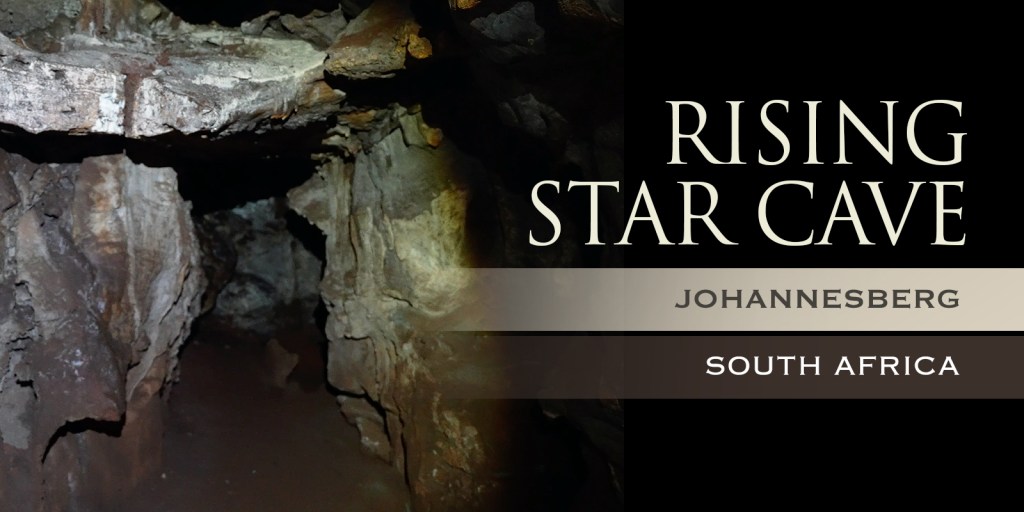
Soon after, a bold claim emerged: the fossils were not scattered by floods or predators but deliberately placed in deep chambers, perhaps covered with sediment—suggesting intentional burial. This made global headlines. A small-brained hominin, with a cranial capacity of 465–610 cc, engaging in behaviors once thought unique to humans? The idea shocked the field.
The most recent updates, published in eLife (2025), describe articulated skeletal regions preserved in matrix, interpreted as rapid covering prior to decomposition. To the excavators, this pattern indicates intentional burial, repeated multiple times.
Not everyone agrees. Critics, including a 2024 Journal of Human Evolution paper, argue that the sedimentology remains inconclusive, clear grave cuts have not been demonstrated, and natural deposition has not been ruled out. Skeptics also note the caves’ inaccessibility and question whether bodies could have arrived without deliberate action.
The debate boils down to this: if naledi buried their dead, mortuary behavior may have evolved independently across hominins, uncoupled from brain size. If they did not, naledi still present a fascinating depositional mystery, and the debate itself strengthens archaeological methods.
Neanderthals: From Flowers to Skepticism
Few images are as enduring as the “flower burial” of Shanidar Cave in Iraq. In the 1960s, pollen clumps near a Neanderthal skeleton inspired romantic reconstructions of mourners laying blossoms on a grave. Later work showed the pollen could have been introduced by rodents—an early reminder of the risks of overinterpretation.
Even so, Neanderthal burials remain compelling. At Shanidar, reanalysis has revealed multiple individuals placed in shallow pits, some with flexed body positions. Across Europe and Western Asia—from La Chapelle-aux-Saints in France to Kebara in Israel—articulated skeletons appear in grave cuts, occasionally with ochre or objects.
Critics such as Paul Gargett have long urged caution. Yet the weight of evidence suggests that by 60–70,000 years ago, Neanderthals were consistently burying their dead. While less elaborate than later human rituals, these practices demonstrate repeated, intentional interment.
The question remains: why? Were burials practical—to deter scavengers or manage hygiene—or did they express grief, memory, and care? The most plausible answer is both.
Homo sapiens: Early Burials in the Middle Paleolithic
For our species, the record is equally intriguing. At Qafzeh and Skhul in Israel, burials from 100–120,000 years ago reveal deliberate interments, some with ochre and objects. Children and adults alike were carefully placed, sometimes in flexed positions.
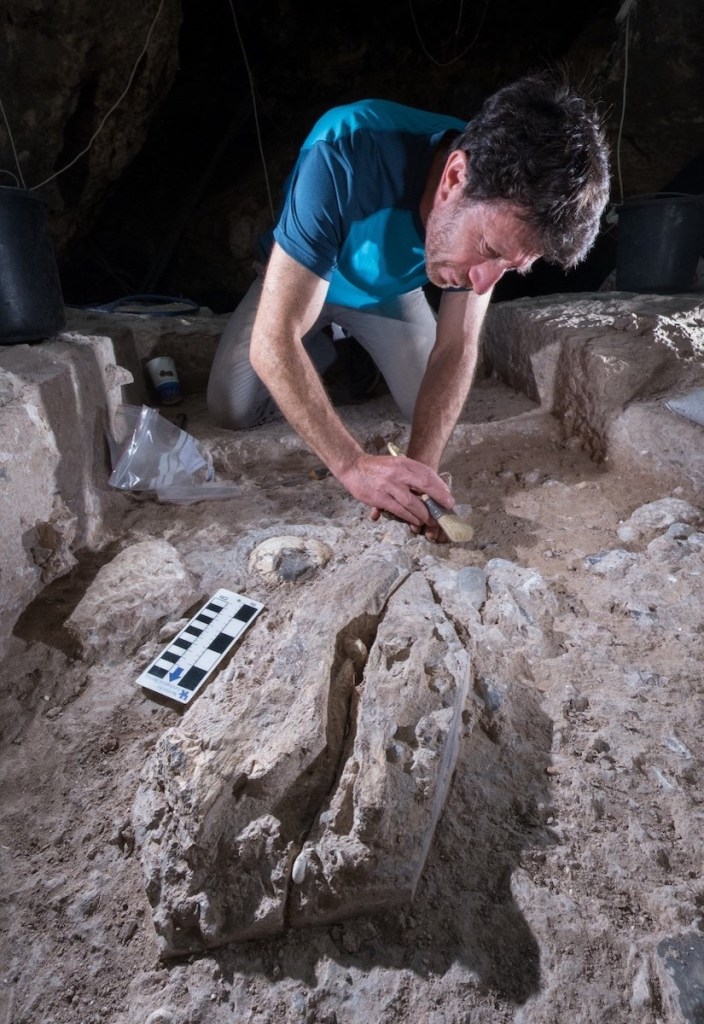
In 2025, discoveries at Tinshemet Cave in Israel added further weight. Multiple burials dating to roughly 100,000 years ago were found with bodies in fetal positions and ochre staining. Researchers argue this represents a true burial tradition among early Homo sapiens in the Levant.
Unlike Neanderthals, sapiens burials often show symbolic associations—pigments, objects, and consistent placements. This does not prove Neanderthals lacked symbolism, but it highlights how early sapiens may have invested more heavily in ritual as part of their cultural identity.
Methods: How Do We Know It’s a Burial?
Distinguishing intentional burials from accidents requires multiple lines of evidence:
- Sediment micromorphology: identifying cut edges, backfill, or disturbed layers.
- Body articulation: determining whether bones stayed connected in ways requiring rapid covering.
- Taphonomic context: checking for carnivore gnawing, water sorting, or collapse versus deliberate placement.
- Geochemistry: analyzing phosphate concentrations, ochre traces, and mineral profiles.
- Dating precision: ensuring deposits are contemporaneous and not mixed by later disturbance.
These methods explain why naledi remains are controversial—several indicators are disputed, and independent replication is needed.
Ethics: Whose Dead Are These?
The burial debate is not just scientific; it is ethical. Labeling something a “burial” implies intention, ritual, and meaning. That symbolism can shape how modern societies view both the past and themselves.
Treatment of remains also matters. Should hominin skeletons remain in labs and museums indefinitely? Should some be reburied, particularly where descendant communities or cultural connections exist? Many anthropologists today emphasize collaboration with local groups, transparency in excavation, and avoiding sensationalism.
The naledi case underscores how headlines can outpace peer review. Declaring symbolic burial by a small-brained species is not just academic; it reshapes public narratives about intelligence, humanity, and dignity.
Synthesis: A Graded Emergence
Taken together, the evidence suggests burial was not a single “spark” but a mosaic emerging across our genus:
- Homo naledi — if deliberate, shows mortuary behavior in a small-brained species; if not, remains a cautionary case in interpretation.
- Neanderthals — consistent yet simple burials, reflecting social care and possible symbolic meaning.
- Early Homo sapiens — embedding burial within ritual, pigment use, and tradition.
The boundary between “us” and “them” blurs. Burial was not a uniquely modern human invention, but part of a deeper, more complex story of how hominins made sense of death.
References
Berna, F., Goldberg, P., Horwitz, L. K., Brink, J., Holt, S., Bamford, M., & Chazan, M. (2012). Microstratigraphic evidence of in situ fire in the Acheulean strata of Wonderwerk Cave, Northern Cape province, South Africa. Proceedings of the National Academy of Sciences, 109(20), E1215–E1220. https://doi.org/10.1073/pnas.1117620109
Dirks, P. H., Berger, L. R., Roberts, E. M., Kramers, J. D., Hawks, J., Randolph-Quinney, P. S., … & Elliott, M. (2017). The age of Homo naledi and associated sediments in the Rising Star Cave, South Africa. eLife, 6, e24231. https://doi.org/10.7554/eLife.24231
Hovers, E., & Belfer-Cohen, A. (2013). On variability and complexity: Lessons from Levantine Middle Paleolithic burial practices. In N. J. Conard & J. Zeidi (Eds.), The Paleolithic of the Levant (pp. 395–418). Tübingen: Kerns Verlag.
Pomeroy, E., Soficaru, A., & Trinkaus, E. (2020). The human burial record of the Middle Paleolithic. Journal of Human Evolution, 146, 102867. https://doi.org/10.1016/j.jhevol.2020.102867
Rendu, W., Beauval, C., Crevecoeur, I., Bayle, P., Balzeau, A., Bismuth, T., … & Tillier, A. M. (2014). Evidence supporting an intentional Neandertal burial at La Chapelle-aux-Saints. Proceedings of the National Academy of Sciences, 111(1), 81–86. https://doi.org/10.1073/pnas.1316780110
Reich, D., Green, R. E., Kircher, M., Krause, J., Patterson, N., Durand, E. Y., … & Pääbo, S. (2010). Genetic history of an archaic hominin group from Denisova Cave in Siberia. Nature, 468(7327), 1053–1060. https://doi.org/10.1038/nature09710
Shea, J. J. (2011). Homo sapiens is as Homo sapiens was: Behavioral variability versus “behavioral modernity” in Paleolithic archaeology. Current Anthropology, 52(1), 1–35. https://doi.org/10.1086/658067
Zaidner, Y., Weinstein-Evron, M., Yeshurun, R., & Hershkovitz, I. (2025). A Middle Paleolithic burial ground at Tinshemet Cave, Israel. Nature Human Behaviour. https://doi.org/10.1038/s41562-025-02016-9
 World of Paleoanthropology
I think that focusing on burials is analogous to focusing on stone tools and rock art. On the one hand, you have no choice because these are the items that survived in the record. On the other, it runs the risk a skewing the interpretations: they only had stone tools, they only did art on rock, burials are the only significant way to ritually deal with death.
We know the first two examples are not true, and I’m guessing by a significant margin. In modern times there are many options beyond burials. Cremation, burial at sea, ritual exposure to vultures, even composting. I think that dismemberment and even consumption have been practiced.
I guess the point is: Even if there is no evidence of burials, we can’t rule out a different cultural practice in early hominids.
LikeLike