Listen to a podcast version of this post!
Reconstructing the daily life of a Neanderthal is more than an exercise in imagination—it is an endeavor grounded in decades of archaeological research, paleoenvironmental reconstruction, and microscopic analyses of artifacts and remains. From isotope studies that reveal dietary preferences to wear patterns on tools that show how they were used, each piece of evidence helps build a clearer picture of what it meant to live in Ice Age Europe 50,000 years ago. This narrative draws on that science to bring a single day into focus, inviting the reader to step into a world both alien and deeply familiar.

A faint orange glow clings to the limestone overhang as embers from last night’s hearth breathe their last warmth into the cool morning air. You stir beneath a patchwork of hides—reindeer, bison, perhaps a scrap of cave bear—and push yourself up, feeling the stone’s imprint through the bedding of dried grasses while the air fills with smoke and damp earth. Around you, kin shift in their nests of skin and fur, and one rises, crouching at the fire pit to coax flame from coal with kindling and practiced breath.
The morning unfolds with deliberate purpose. Hands find flint scrapers laid out on a nearby stone slab, their edges worn from yesterday’s work. Hide-scraping begins almost without thought, the rhythm learned in youth—arms and shoulders moving in patterns repeated for generations. Birch bark, warmed and pressed, yields a tarry adhesive—dark, pungent, and sticky. This resin will secure a spear point to its shaft, a union of stone, wood, and fire that transforms raw material into hunting weapon (Kozowyk et al., 2017). The mingled scents of resin and char fill the air.
Food preparation follows. From a woven pouch comes a fistful of gathered seeds and nuts, their shells cracked with stone to reveal dense energy. A roasted root passes hand to hand, its sweetness recalling yesterday’s foraging. Far from the stereotype of a meat-only diet, the Neanderthal menu was broad. Dental calculus from El Sidrón and Spy Cave reveals starch grains from grasses and legumes, traces of mushrooms, and poplar bark rich in salicylic acid—a natural pain reliever (Henry et al., 2011; Weyrich et al., 2017). Some starches bear microscopic scarring from heat, evidence that fire served as both hearth and kitchen. Food is shared in a quiet circle, the act as much social glue as sustenance.
By midmorning, hunters prepare. Spears are hefted and their balance tested. These are not meant for distant throws; hafted stone points, shaped by the Levallois technique, are built for close work—drives and ambushes requiring the group to act as one (Soressi et al., 2013). Out on the plain, wind carries the scent of grazing animals: fallow deer, red deer, wild horse. A low whistle signals movement; feet find silent purchase on soil and stone. The strike is sudden, brutal, efficient. Blood steams in the cold air. Meat and bone are carried back, marrow-rich shafts treasured for the calories they hold (Bocherens, 2011).
In camp, tasks fall naturally into place. Children trail adults, imitating the motion of a flint strike or learning which roots are safe to dig. Injuries are tended; a man with a badly healed leg fracture sits by the fire, weaving cord from plant fibers. His survival is no accident—skeletal evidence from Neanderthal sites shows long-healed trauma that would have required sustained care (Spikins et al., 2019). Compassion is not exclusive to our species.
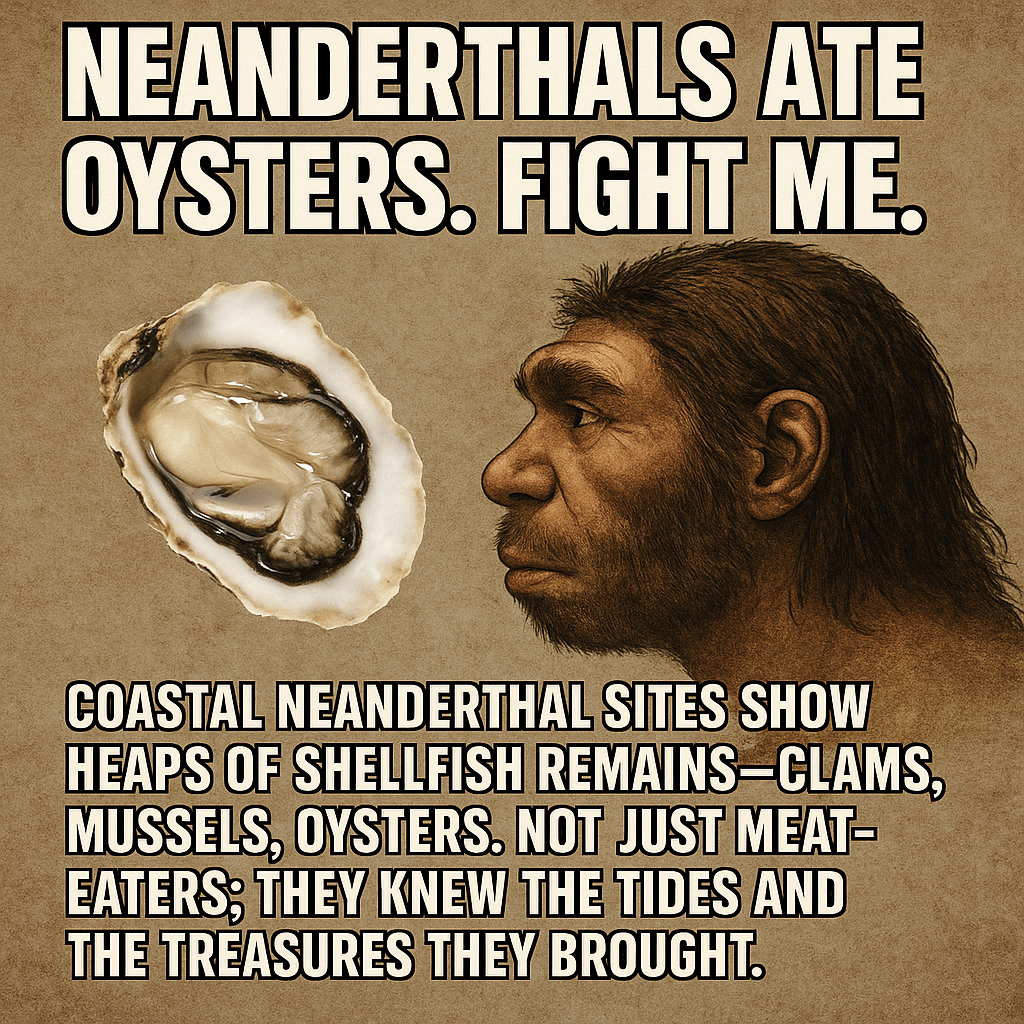
As the afternoon wanes, someone produces a lump of red ochre, grinding it to powder against a flat stone. The pigment stains hands and hide, perhaps used to tan leather or to mark skin and objects with meaning known only to the group (Roebroeks et al., 2012). Shells—some brought from far coasts—are drilled and strung. A child turns one in her fingers, watching light dance across its curved surface (Zilhão et al., 2010).
Dusk brings the scent of roasting meat, fat hissing into the coals. Conversation hums in low tones; the flicker of flames throws shifting patterns across the limestone walls. In some caves, such walls bear more than shadows—at La Pasiega, Maltravieso, and Ardales in Spain, red lines, dots, and hand stencils date back more than 66,000 years, painted when only Neanderthals lived here (Hoffmann et al., 2018). Whether the markings in this shelter are fresh or imagined, the impulse is the same: to leave a trace.
Night gathers. Bellies are full. Skins are drawn close against the chill. Beyond the fire’s reach, darkness swallows the world, and stars wheel over a landscape of ice, forest, and plain. Life here is not an abstract struggle—it is the scrape of hide under a stone blade, the warmth of shared food, the safety of sleeping bodies close together. It is ingenuity, endurance, and a web of care woven through kin, place, and time.
Stepping into such a day offers no caricature of “other” humanity—only a version of ourselves attuned to the texture of the world, to the immediacy of need, and to the enduring truth that survival depends as much on connection as on strength.
References
Bocherens, H. (2011). Diet and ecology of Neanderthals: Implications from C and N isotopes. Comptes Rendus Palevol, 10(4), 275–282. https://doi.org/10.1016/j.crpv.2011.03.009
Henry, A. G., Brooks, A. S., & Piperno, D. R. (2011). Microfossils in calculus demonstrate consumption of plants and cooked foods in Neanderthal diets. Proceedings of the National Academy of Sciences, 108(2), 486–491. https://doi.org/10.1073/pnas.1016868108
Hoffmann, D. L., Standish, C. D., García-Diez, M., Pettitt, P. B., Milton, J. A., Zilhão, J., … & Pike, A. W. (2018). U-Th dating of carbonate crusts reveals Neandertal origin of Iberian cave art. Science, 359(6378), 912–915. https://doi.org/10.1126/science.aap7778
Kozowyk, P. R., Langejans, G. H. J., & Poulis, J. A. (2017). Laboratory replication of a Palaeolithic adhesive production method. Scientific Reports, 7, 8033. https://doi.org/10.1038/s41598-017-08106-8
Roebroeks, W., Sier, M. J., Nielsen, T. K., De Loecker, D., Pares, J. M., Arps, C. E. S., & Mücher, H. J. (2012). Use of red ochre by early Neandertals. Proceedings of the National Academy of Sciences, 109(6), 1889–1894. https://doi.org/10.1073/pnas.1112261109
Soressi, M., McPherron, S. P., Lenoir, M., Dogandžić, T., Goldberg, P., Jacobs, Z., … & Dibble, H. L. (2013). Neandertals made the first specialized bone tools in Europe. Proceedings of the National Academy of Sciences, 110(35), 14186–14190. https://doi.org/10.1073/pnas.1302730110
Spikins, P., Needham, A., Wright, B., Dytham, C., & Gatta, M. (2019). Living to fight another day: The ecological and evolutionary significance of Neanderthal healthcare. Quaternary Science Reviews, 217, 98–118. https://doi.org/10.1016/j.quascirev.2019.06.012
Weyrich, L. S., Duchene, S., Soubrier, J., Arriola, L., Llamas, B., Breen, J., … & Cooper, A. (2017). Neanderthal behaviour, diet, and disease inferred from ancient DNA in dental calculus. Nature, 544(7650), 357–361. https://doi.org/10.1038/nature21674
Zilhão, J., Angelucci, D. E., Badal-García, E., d’Errico, F., Daniel, F., Dayet, L., … & Villaverde, V. (2010). Symbolic use of marine shells and mineral pigments by Iberian Neandertals. Proceedings of the National Academy of Sciences, 107(3), 1023–1028. https://doi.org/10.1073/pnas.0914088107

