Top Ten Modern Paleoanthropology Reading List!!!

Suggested Reading List for Paleoanthropology Enthusiasts!
These are in no particular order but are all great, modern books on the subject that, at the time of their publication (which I am only listing recent books) were the most updated at the time.

Check out our audiobook list!

Of course, the thing about our field is that it is ever-changing and what we know and learn changes every day!


So please, if you’re interested, check out these books by these awesome authors, researchers, and professors!


Many of them we have had on our show, and you can find our interviews on our Youtube Channel! (Just search, World for Paleoanthropology on YT).

  1. Almost Human by Lee Berger and John Hawks
  2. 7 Skeletons by Lydia Pyne
  3. Sediments of Time by Meave Leakey
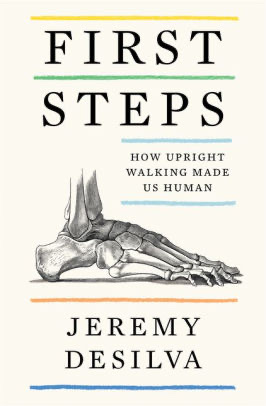
  4. First Steps by Jeremy DeSilva
  5. Creative Spark: How Imagination Made Humans Exceptional by Agustin Fuentes
  6. A Most Interesting Problem edited by Jeremy DeSilva
  7. Sapiens: A Brief History of Humankind by Yuval Noah Harari
  8. The Third Chimpanzee: The Evolution and Future of the Human Animal by Jared Diamond
  9. Kindred by Rebecca Wragg-Sykes
  10. Lone Survivor: How We Came to Be the Only Humans on Earth by Chris Stringer

There are of course plenty more, and just because some books are a little older, does not mean they are not filled with great and valuable information! Some of my favorite books are about Lucy, and Olduvai, the Leakeys, etc. It may not be the most updated info, but it’s important for a strong foundation, so be sure to check those out too!
For now, this should be a good, up to date and modern list of books that will get you started, educate you (hopefully), and help you on your path to learning about Human’s Deep History.


What are your suggested reads? Comment below (include a link to be super helpful!)
Enjoy!

Seth Chagi

Interview #20: Dr. Marina Elliott

Join myself and Dr. Marina Elliott today as we sit down and discuss some awesome topics. From her stunning travels, work and involvement in the 2013 Rising Star Expedition.

A proud female STEM educator and promoter, Dr. Elliot has written a detail book on the localities all over the Cradle of Human Kind in South Africa,(you can purchase it here.) and is featured, along with many other extraordinary women, in a new book published by National Geographic for Kids called Girls Can! You can grab a copy here.

We had a great chat, and cant wait for you to see it, enjoy it, and hopefully learn a great deal about Dr. Elliott and her work, and discover the amazing tale of Homo naledi!

Enjoy

Roberto Sáez, Interview: #19 A Compassionate Human?

We had the great pleasure of interviewing Dr. Sáez the other day and we had a blast!

We learned alot from talking to him and we hope you can glean some of that yourself by watching!

From Neanderthals to the Complete Human Package, we discuss his book, his work, and his views on Anthropology.

Check out our latest interview here, and please like and comment if you enjoy =)

If you would like to be on the show, contact us at worldofpaleoanthropology@gmail.com

Chris Stringer, is that you? Interview: 18

Hello fellow enthusiasts, students, professors, and more!


Join us today for an amazing talk on Neanderthals and so much more, listen to an if not the world’s leading experts on Neanderthals for the past 40 years!
Learn all about Neanderthals and more in this great interview!


To watch the rest of our interviews, check out our YouTube channel and our website at http://www.worldofpaleoanthropology.org.


If you would like to appear on our show, email Seth at worldofpaleoanthropology@gmail.com!

Academia.edu (Link Fixed)

So! I now have an account on Academia.edu, which is AWESOME! It was a graduation present and I am very happy!

I have two papers up, both of which came from this website, the best one and one id love opinions on is this one:

There will be no changes to this website, any articles and posts will be made here, blog posts and such etc. if its worthy, it will also go on the Academia account, but EVERYTHING will still be here on this website.

Be sure to check out all our interviews, book reviews and articles!

If you want to get involved email me at worldofpaleoanthropology@gmail.com and we can see what we can get going!

Have a great evening!


First Steps: How Upright Walking Made us Human-A Review

Well, its time for another book review! There are just so many great books out there that have been published in the last year, let alone decade and beyond. Recently I created a “Top 5 Books” list, that you can view here. But today we are going to be talking about one book in particular, and a mighty fine book at that.

This book, like many books on Human Evolution goes over the basics of Human Origins, explaining our ever so complicated braided stream of a family of hominids all the way to modern day runners. The thing that this book does so differently than other books on Human Origins, is that it is almost exclusively viewed by one point of view. And that is that of Upright Walking.

Bipedalism is something that we only find in Modern Humans, we are not the only humans or humanoid species to do it, not by far, but we are the last mammal to do so. This, to us at least, makes us feel special, we think it makes us unique and different from all other beasts of the land.

And maybe it does. There are many theories on how Bipedalism first came about, whether we started in the trees, or eventually adapted to move in and out of them, its a complicated story. But Jerry does a great job of exploring multiple hypothesis without showing bias towards one or another. For the most part, there are some ideas out there that are just too other worldly to consider.

Jerry DeSilva goes to great lengths to help the reader understand that we, are a product of our biology, which has evolved over millions of years to make us bipedal. While he does not know the answer that, or at least not yet, he definitely is on the right track, and is brining all of us along the journey with him.

“First Steps” by Jeremy DeSilva is a very digestible, intellectual and well sourced book on how upright walking made us human. You will learn a lot from this book, about things you may or may not have been expecting. But as with his other recent title released, “A Most Interesting Problem, What Darwin’s Decent of Man Got Right and Wrong about Human Evolution” we begin to see where Professor Desilva’s mind is, and it is a glorious place to be.

Do yourself a favor, if you want to learn about why we walk upright, what makes us different from other animals, or plainly what makes us Human, grab your copy here.

Check out our interview with Prof. DeSilva here!

Race, Gender and Sex

There is a consistent and persistent misunderstanding of many things in todays day and age. And that’s ok because there are a lot of things going on in this big, wide and wonderful world of ours.

Some of these misconceptions can be, and are very harmful. Such as negative biases towards what many people call “race” and the differences, and or similarities of sex and gender.

Today we will be discussing the very crucial to know, interrelated subjects of Race, Sex, and Gender. Join myself, Seth Chagi and Molly Selba, a doctorate student and HS Anatomy teacher, and Prof. Agustin Fuentes from Princeton Univ.

We cover this topic from a wide range of angles, and try to bring it to a level that anyone, can understand. In this day and age there is no room for ignorance, hate and bigotry, so we must enlighten, educate and spread the hope of the new age.

We hope you enjoy!

Louis Leakey and a Fun Story

I got emailed this wonderful little tale the other day and thought I’d share it with all of you so we can all enjoy it together!

First, my name is Wilson Crook, although I go by “Dub”, which is short for my initials (“WW”). I am an archeologist with a passion for paleoanthropology instilled by my late Father. I have published 195 peer-reviewed papers and four books to date.

My first story is the interesting connection between the Leakey and the Crook families. My Father was the discoverer and excavator of the Lewisville site near Dallas. At the time of its discovery, its anomalous radiocarbon dates made it one of the oldest sites in North America. As such, Louis Leakey became interested and he and Dad struck up a correspondence which culminated in Louis visited our home when I was a small boy. I remember him coming into the house and being introduced to him and then Dad took him to the Lewisville site to show him the geology of the occurrence.

Later, I struck up a letter exchange with Richard Leakey in the 1970s regarding his discovery of the famous 1470 skull and we had a spirited debate on the age of Indonesian Homo erectusfossils. I knew basic Indonesian geology based on the presence of my company in that country and Richard was adamant that they could not be any older than 1.0 Mya whereas I argued for 1.7-1.8 Mya. Later discoveries and newer dating have proved me correct but I never told Richard that.

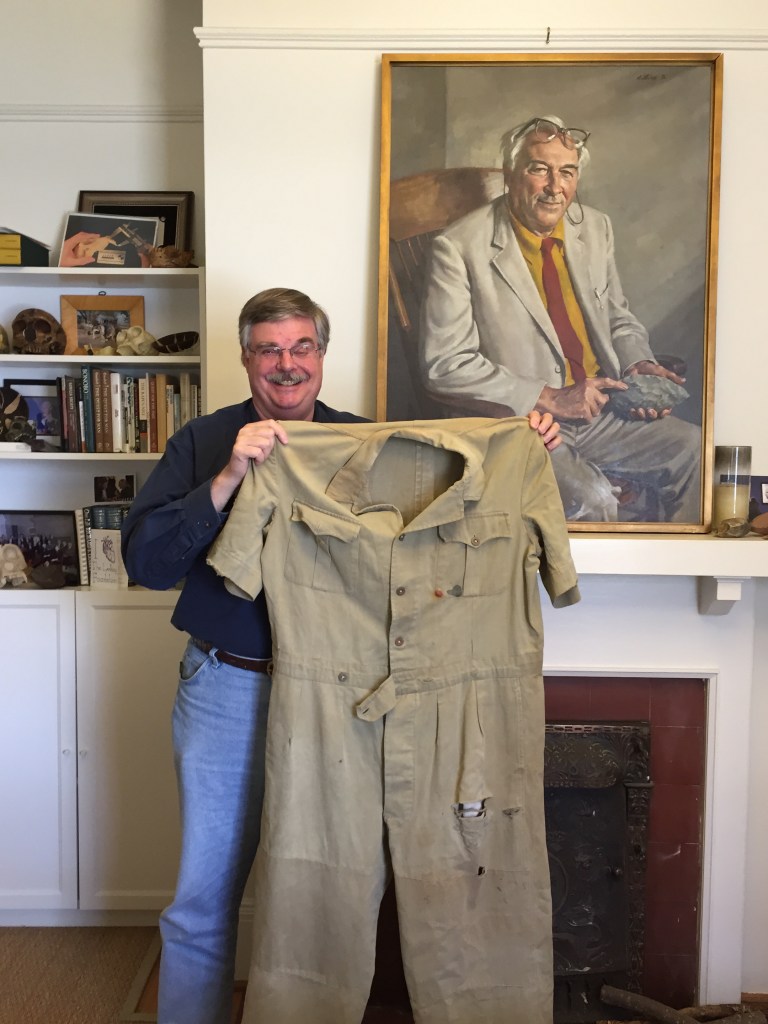
As a Leakey Foundation Fellow, I was invited to attend the 2009 presentation at the American Museum of Natural History in New York between Don Johanson and Richard Leakey. By sheer luck, I got to spend the evening sitting next to Richard’s daughter, Louise, and we became good friends which we have maintained ever since. On a visit to the Leakey Foundation’s headquarters several years ago, Sharal Camisa the Executive Director, knowing the story said I must pose with their prize artifact, Louis Leakey’s old field coveralls which he always wore. I attach a photo of me holding same.

My second story is while visiting my best friend, Bennie Lategan in South Africa, he took me to see a number of his properties in the Eastern Cape Province. On one known as Dalmanutha, I walked across a small pan which was littered with lithic artifacts. Immediately I noticed blades and blade cores as well as Levallois flakes and crude projectile points. Our visit stopped as I spent the rest of the week working on the site. The artifacts are an absolute look-alike to the Kathu Pan Fauresmith Industry as described by Jayne Wilkins at Cape Town. I have since excavated that site as well as two others on his Father’s properties as well as a pure Acheulean age site complete with classic tear-drop shaped hand axes. The Dalmanutha Fauresmith Industry sites have some of the world’s oldest projectile points which have been dated to be roughly 500-600 years old. Sites of this culture have come from the northern part of South Africa as well as the southwestern part but nothing in between. Thus these sites in the Eastern Cape Province help to “fill in the gap”. The moral of the story is to always walk with your eyes on the ground because you never know what you may find!

Dub Crook

Top 5 Modern Books on Anthropology

One thing that we get asked alot here, and myself in particular, is what are good books to read? So many people are used to science books being like text books, and hard to understand. The following books have all been written to be read by anyone, from armchair anthropologist to PhD researchers.

These books are not listed in any particular order, but constitute my top five modern day anthropology books.

I HIGHLY recommend purchasing each one, and will provide a hyper link to where you can get it.

Please use this as a resource to help you on your journey.

  1. Almost Human: The Astonishing Tale of Homo naledi and the Discovery That Changed Our Human Story by Lee Berger and John Hawks
  2. First Steps: How Upright Walking Made Us Human by Jeremy DeSilva
  3. The Sediments of Time: My Lifelong Search for the Past by Meave Leakey
  4. Sapiens: A Brief History of Humankind by Yuval Noah Harari
  5. The Creative Spark: How Imagination Made Humans Exceptional by Agustin Fuentes

Picking these five was difficult as there are so many other great books out there such as ones by Brian Hare and Svante Paabo, Chris Stringer, and so many others.

This may be the first of “Seths Top Five” ill give everyone time to read through those five, and you’ll have to let me know when you want more, but for now, here are my top five anthropology books for anyone at any level who wishes to learn about about what Paleoanthropology and Anthropology is.