My Birthday & the Leakey Foundation

Hello one and all!

I am very excited to tell you all that I am doing something special for my birthday (which is March 2nd) this year.

I am starting a fundraiser on Facebook to raise money to donate to none other than the Leakey Foundation!

The mission of The Leakey Foundation is to increase scientific knowledge, education, and public understanding of human origins, evolution, behavior, and survival.

This institute is world renown for their work in the field of human origins. So it is in that spirit and the spirit of furthering science that I decided to do this. I am very excited!

Just wait I have not even gotten to the beat part! When the Leakey Foundation got wind of this one of their donors decided to match all my donations! So every dollar donated becomes two!

Don’t pass up this great opportunity to contribute to education and the world of science donate today: https://www.facebook.com/donate/641850339695658/?fundraiser_source=external_url

Interview Two: John Bavaro

Welcome to our second interview in our new interview series! We have a-lot of great organizations and individuals coming forward wanting to participate!

Today we are graced by the presence of Paleo Artist John Bavaro.

John Bavaro, teaches illustration at Edinboro University of Pennsylvania. He’s published works that have appeared in BBC, BBC El Mundo, The Guardian, Current Biology,  Science Source, Science Photo Library and at nutcrackerman.com.

His art can be seen here, and here.

  1. What has been your favorite hominid to work on? 

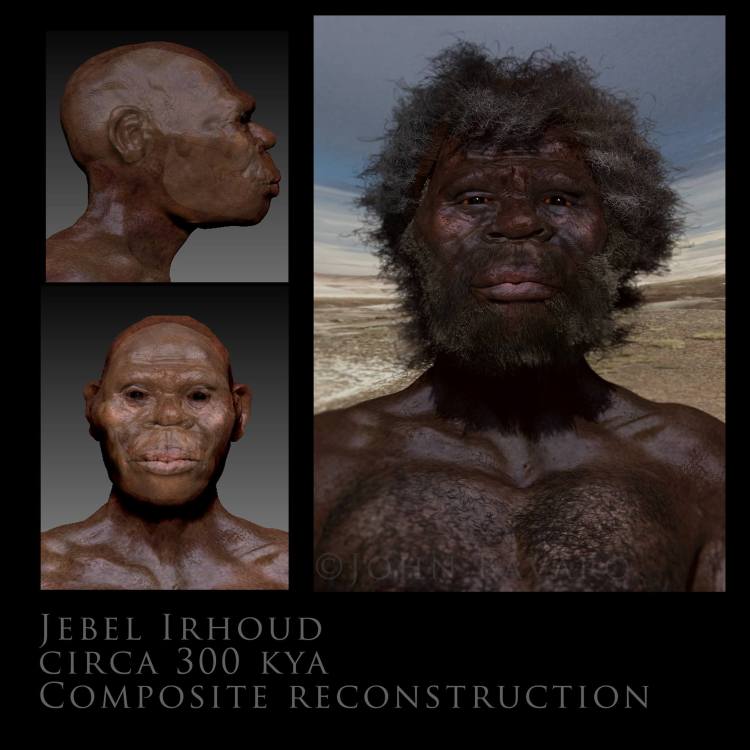
I loved doing the archaic Homo sapiens from Jebel Irhoud which was just revealed last year.


Because first of all I had to construct the (skull imperfectly I might add), but what it revealed to me was incredible because I immediately saw a connection with the with the earliest Homo sapiens which were the first modern humans, the Australia Aboriginals. Maybe it’s just me wanting to read connections in faces, but I seriously saw a connection when I began to construct the face, the hair etc. between the ancient and modern. For me it spoke of the diversity of humanity. A lot of people respond to this image (Jebel Irhoud), I don’t know why but it seems to resonate with people on some level.

2. Which has been the most difficult?

Believe it or not Turkana Boy, because he was young but “almost human”. Obviously, humans lost body hair by then, contrary the historical descriptions and images of Homo erectus and how they been envisioned in the last half century. Like the famous image of the “progress of man”. You know the one that starts with a monkey and ends with a human with modern sapiens? Artists have, till recently, a pre-conception about what these species looked like and they tend to do them all into the same light pigmented skin tones, losing hair gradually, even though light-skinned people didn’t come about until very recently. And their gait didn’t change so radically like in the picture. I think generally with the knowledge base of today’s artists, we collectively have a “responsibility” to get it right.

At least that’s what I tell myself. I know that a lot Paleoanthropologists think even trying to depict them is folly, and maybe they have a point, but people are hard-wired to imagine a face with the bones. At least in the popular imagination

For me, with Turkana Boy, I took an informed guess at it. It’s was a challenge, but it’s also a burden to get it right because once I’ve published it then it’s out there. Turkana boy was eight years old. What was the did an eight-year-old Homo erectus look like? Is it the same as us or not? There’s various schools of thought about that and I studied hard to find out the truth about it and I decided on both the skin tones, the what he would have truly looked like, the hair etc. But I don’t know exactly.

3. What is something they all have in common?

Their hips, which is quite remarkable and that’s what sets as a part as proto-humans-the ability to walk upright. I think that people have misunderstood evolution “that we came from apes”, which is ignorant and understandable at the same time because we did have a common ancestor, one which was so far removed from apes. Think about it, orangutans are 16 million years removed from humans, chimps are 7 million. So we were much closer to Australopithecus’ then we are to chimps. I think that’s something that layman, (myself included) tend to forget. That’s why human evolutionary studies are so important yet sadly so neglected. I think it is fascinating and why we don’t care where we came from or have an issue with human evolution because of biblical myth. That is ignorant.

4. In short, what is your process?

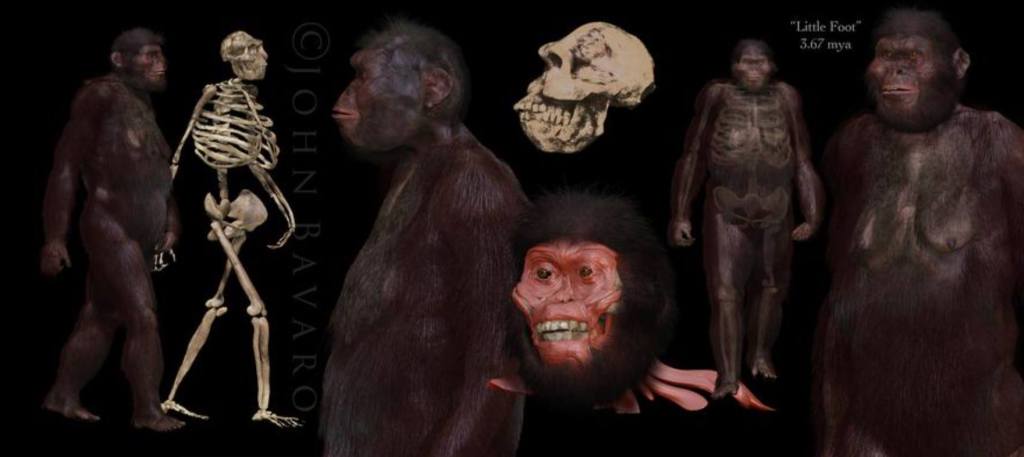
I work in a program called Zbrush which I am self-taught. I am getting better but there’s a lot to learn and a lot goes into it especially in the hair. It’s funny that sometimes I have a template that I can stretch the forms around a pre-existing model. Like Lucy and “Little Foot”, but it still takes me a week or two if I really want to focus on the proper dimensions and research the climate, their milieu, research about currently scholarship. It’s not the same as for instance as John Gurche, Kennis and Kennis, Elisabeth Daynes whose works are all is incredible. Because they construct the forms muscle by muscle over the skull. It’s quite remarkable and humbling for me when I look at their work. What takes me a week do took them six months or year. That’s the gift and the curse of working digitally.

5. Can we get any hints to your next project?

I’m currently doing a diorama of two Neanderthals hunting Wooly Rhinos. That’s taking me a lot of time because I had research the position they took when they threw a spear, like the stretch and the strain of the muscles etc. Which is more dynamic than a simple standing pose. Also the focus that I wanted to put on it, such as the depth of field, the environment that I used which was Alaska from a picture that I took. I’m also a painter and the time that I spent on doing this piece I could’ve painted it just as quickly. But I’ve also had my dominant hand compromised by a stroke I suffered from a ruptured carotid artery. While I can draw quite well now using my left hand, painting for me is still a challenge. Luckily, even with my struggles with aphasia and my compromised hand skills, I still can do digital art quite well.

6. Where do you see the field in the next decade?

Wow, that’s difficult to say. I am a teacher first and an illustrator second. Although I teach at the college level so it’s not mutually exclusive (publish or perish) they say. But I am also teaching graphic novel so I’m currently working on a graphic novel at the same time. Too many projects! It’s funny that when a Paleoanthropologist reveals discovery, there’s suddenly a “buzz”. I try to respond to it responsibly and quickly to the best of my abilities. I am currently represented by Science Library. They send me a request and sometimes its up to people to pick it up and use it and sometimes they don’t. Even though I say, “Oh this one’s going to be great”. It’s almost random how the internet picks something up and runs with it one image that I thought was really going to takeoff didn’t, piece that I was hoping to go viral didn’t. Right now I’m just enjoying doing models and sharing it with people. About the field, it’s a remarkable time to live with new groundbreaking discoveries are revealed almost weekly, churning up the old order with discoveries that revealed maybe were older than we think or maybe Neanderthals did have DNA coming out of Africa or first humans actually migrated from Eurasia. This just is a sample of the current dialogue. For my part I just “bring the popcorn” and draw. Science is by definition positing a thesis and setting out to prove it or disprove it. I like to think that my work is the same way. Even if it’s wrong I’m still following the scientific method- exploring, observing, and answering questions.

Stay tuned for the next interview! If you’re interested in being interviewed, or know someone who is, have them contact me at sethchagi@icloud.com and we will see what we can do! 

Thank you! 

A little Story

One of my biggest hobbies, aside from learning and reading is writing. I love writing on all kinds of subjects from the scientific to the political. But despite all that, at heart I am a creative writer.

I have had writers block for a while now when it comes to the creative side of things until tonight. Here is chapter one of a story that I just started. I have no plans to work on it more or continue it, but if I do I am just going to go where the writing takes me.

If you like this and think its good, be sure to let me know by liking this post so it gives me motivation to continue it!

If you dont like it, well oh well. You can deal with it.

This has not been edited for grammar or spelling mistakes so go easy on it.

Let me know what you think and if I should continue this or not!

Chapter One: 

The dark gloomy clouds moved overhead as the small band of hunters made their way through the valley. As the day wore on and as the great flame began to sleep the small group found shelter and made camp for the night. 

It had been two days since they had left the tribe, and it had been a rough two days at that. Storms and wild animals causing unpredicted delays. They should be days from here already, and the tracks of the caribou grow old and the path harder to follow.

“What should we do?” Asked Kankut, the advisor and best friend of the chief of the village, the one who led the hunt, Tactum. He looked grim, and likely knew the options that lay at hand but just did not want to mention them. They needed this hunt to be a success, the survival of the entire tribe depended on it. It had been a rough winter and as the snows thawed the flowers sprung, the hunger began to arise once again. 

“What we always do,” Tactum grumbled. “We will go on”. There was nothing else for it, either they turned back and empty handed to slowly starve with their families, or they pushed on until they found a suitable supply of food to bring back. While the journey was dangerous and some o them would not make it back, and they all accepted this, it was still more honorable than leaving ones family to fall to the dark grip of hunger.

“But we can barely follow the tracks, which way are we to go?” A man asked, Rikoo, it was his first hunt. Brave, and full of himself at the ripe age of thirteen Rikoo thought the world was under his foot, little did he know how small he was in the scheme of things. Something he would learn soon. 

As they got the fire started and got sleeping furs spread around it, light but big drops of rain began to fall. Making a soft, and soothing sound among the trees that surrounded them. While winter had just ended it was still very cold out at night, especially with how high up in the mountains they are, but with the fire, their sleeping furs and regular clothing, they would stay warm enough until the great flame rose once more. 

Tonight the hunters would be sharing a feast of three conies and two salmon caught from the river. For the ten of them, it was enough. Nothing special, but it was enough. The moon shown bright, as it was near its zenith and the men stayed up late into the night guided by the light of the great moon god, carving and telling stories. 

This group of ten was a tight knit group, ones who did everything together, and went on these long hunting trips, together with nothing to rely on but themselves, they quickly would become like brothers, despite the womb who bore them. A link that only hunters understood would form, and there was nothing else like it. 

“Tomorrow we will follow the river farther west, and then go north, that is where it think the heard is headed, I know of good feeding grounds up in that area, it will take us about two days to get there,” suggested Timuk, the star tracker who guided the men on where to go and when. 

“Agreed Timuk,” Tactum said, “I know of this hunting ground and I agree the caribou have made their way up the there.” He continued nodding.

A branch cracked, and all of the men immediately stood up, spears in hand and put their backs towards the fire, towards each other. One of them made a shushing sound. 

It was silent, not a noise to be heard in the woods, it was eerie, too eerie.

The men began to relax, one of them sat back down. A bolt of lightening ripped across the sky as the rain intensified. Others began to sit back down but not Tactum or Timuk, no they stood as silent sentinels guarding their men from what lurked in the darkness. Eventually they too sat back down, and eventually after designating a set of men to watch over the hunters for the night, found some hard earned sleep. 

The men rose with the great flame, gathering all of their things they were ready to go shortly after rising. Just as planned they began to follow the river, and after a half a days journey the came upon something that gave them all hope. Tracks. The caribou tracks had returned! They made the right decision! Soon just as their ancestors had done for beyond memory, they would hunt the great beasts to bring food and skins back to their people to prepare them for the next winter.  

On the night before they would come before the great heard, the spirit talker Nanak did a great ritual. To bless the men and keep them from harm. He invoked the names of the great spirits of earth and sky, and asked them for their blessings. Slicing each others hands, they all made a blood sacrifice to the great spirits, to protect one another, and to die for one another if need be. No hunter left behind. The ritual lasted a good part of the night, but left them plenty of time to sleep and prepare for the great hunt in the morning.

While some of them slept easily, others tossed and turned, anxious and afraid or too excited to sleep the men patiently waited for the sun to rise, and for the rest of their lives to begin. 

Darwin Day 2020!

Today, February 12th 2020 is a day that should be celebrated around the world but is unfortunately pushed under the rug.

Today is Darwin Day! Now most if not all of you should know who Charles Darwin, the father of evolution is, but just in case you do not, here is a link to a bio for him, we wont be spending time going over his whole story as there is just too much to tell!

Charles Darwin is the creator of the Theory of Natural Selection and the greatest champion of evolution the world has ever known. Through his various works we have gained an understanding of the natural world that we were completely blind to before.

Not only how all the plants and animals found their ways beside us through evolutionary paths, but even our own origins can be discovered within the pages of his works. Darwin stated that the origin of man would be from Africa, and low and behold look what we have found. All from comparative analysis and critical thinking.

Without Charles Darwin we would not understand evolution as we do today, and we must keep his spirit alive in order to keep his lessons in our schools. Evolution is not going anywhere, and neither is Darwin, but we must keep it this way and promote his work in and outside of our educational institutions.

Teaching about Darwin helps to show that the natural world is so wild and beautiful, that there is so much out there to acknowledge and respect, to understand how something came to be is to truly know its essence. It is through this that all efforts of conservation and rehabilitation of natural habitats comes from.

Without Darwin, our respect for the natural world, as it is today, would be drastically different. There was a time when nature was all that mattered to us, but as we moved into towns and cities we lost our way. Darwin helped us start to find our way back.

So here is to remembering Darwin, and continuing his work, some of the most important work of our time, or of any time. Lets keep his thoughts and ideas alive and remember him not only each year on his day, but each time we observe the world around us, and just remember, we are apart of nature not the master of it.

Interview One: Molly Selba

Here we go! Our very first, of what is hopefully going to be a long interview series! I am happy and proud to say that Molly Selba will be our first guest! A big thank you to her!

So lets get started!

  1. To start off, why don’t you tell us a little about yourself and what you do?

My name is Molly Selba and I am a PhD student in the anthropology department at the University of Florida. My research interests include comparative anatomy and cranial morphology. I am most interested in how cranial morphology (or the shape the skull) varies within and between species. 

2. What drew you to this field? 

I have always wanted to be an anthropologist! I think humans are fascinating and I enjoy studying everything about them… including their diverse and complex family tree! 

3. What do you personally hope to accomplish? 

My goal is to make human evolution more accessible to teachers across the US. Many teachers want to teach evolution but don’t necessarily have the materials or background information they need to do it… that is where I come in! I help teachers generate 3D models of hominin fossil crania and provide accompanying lesson plans in order to increase access to ‘hands-on’ learning materials for their classroom. 

4. Where do you see yourself in five years? 

In five years, I hope to have graduated with my PhD and have a job where I can still teach others about anthropology and human evolution! 

5. What is your favorite discovery and why?

I personally love the story of the discovery of Taung child. You can read more about the discovery here: https://www.press.uchicago.edu/Misc/Chicago/284158_brain.html

6. Favorite Anthropologist? 

I really admire the work of the whole Leakey family… they made many amazing discoveries and paved the way for the field of paleoanthropology as we know it today. The Leakey Foundation continues to support anthropological research and they have a wonderful podcast called Origin Stories. You can find more information on the Leakey family here: https://leakeyfoundation.org/about/the-leakey-family/

7. What advice would you give to budding anthropologists? 

Keep asking questions! Read articles and books, visit museums if you can… there is so much to learn about what it means to be human!

8. What is your favorite project that you have worked on?

I was able to plan and host a teacher workshop for 20 educators to come to the University of Florida to learn about human evolution over the course of four days. It was an amazing experience getting to connect with these educators and help them bring human evolution into their classrooms.  

9. Do you have any suggested books? 

Thinking Big: How the Evolution of Social Life Shaped the Human Mind by Robin Dunbar, Clive Gamble, and John Gowlett is a really interesting book about the role of neuroanatomy in human evolution. 

10. What is your favorite hominid and why? 

My favorite hominid is Homo heidelbergensis – specifically, the cranium Kabwe 1. This cranium is notable for its robust facial features and the fact that it is one of the oldest known to have cavities!

Stay tuned for the next interview! If you’re interested in being interviewed, or know someone who is, have them contact me at sethchagi@icloud.com and we will see what we can do!

Thank you!

Big Data and Open Access

We live in an ever-changing world, one where new mysterious appear every day while answers to old questions are edited and changed. Sometimes it can be very hard to keep up with all of the changes. Esp if those changes are not widely known or talked about.

Traditionally in the field of Paleoanthropology, this is how it works. Someone discoverers something, it is then their job, and their duty to take it back to their labs, study it, describe it, and make multiple hypotheses to further the understanding of the field.

This can take decades and is a huge brick wall to come across when one wants to study something that has not yet been made public. It is almost impossible. One must wait until the original founder is done with their work and returns the fossils to the country of origin.

As one can imagine, this makes the progression of Paleoanthropology very slow. As new discoveries are hoarded, there is simply not enough work for everyone to do, despite the fact that there is far too much work for one team to do on anyone fossil. This is how its been for over a hundred years.

Enter Professor Lee Berger at Wits University and the era of Big Data. When A. sediba was discovered, Prof. Berger did something different than any other anthropologist, he made his work publicly available to teachers and students around the world, and again in even greater fashion with the discovery of H. naledi.

This was unprecedented. A researcher showing off his discoveries before he himself even completed or even started his research. This was a dramatic shift in the way the field works.

Sharing the massive amounts of data that was collected, and in an open way, has allowed students and teachers around the world of all grades and levels to get involved with the research and play an active role in the discoveries concerning these specimen.

As of the writing of this article, I the author can at anytime go to a website (Mophosource) and download 3D Printing files of these fossils and print them myself, have my own casts and do all of my own research based off of real specifications from the actual fossils.

While casts are not new, the availability of them is something entirely new, 3D Printing is a new and exciting way to get involved in the field.

This can only be beneficial to all those involved and it is thanks to Professor Lee Berger and his progressive thinking team. Thanks to them the world of paleoanthropology will never be the same, and not even because of the massive contributions made, but because of the way in which they were handled afterward.

Thank you, Prof. Berger, and your entire team for all the hard work you have done to bring open access and education to all. The field of paleoanthropology has room for a lot of changes left to go, but we are definitely headed in the right direction.

The Greatest Discovery of the Decade

As the 2010’s come to a close, we reflect back on the last ten years. All over the world in every discipline new and important discoveries have been made. We as a collective race have leaped forward in some ways and fallen behind in others. One area in which we have made great strides of progress is that of Anthropology. Specifically in this case, Biological or Paleoanthropological Anthropology. There have been so many important discoveries in the last decade, filling in missing holes, creating new branches and streams and the like. We thought we knew alot but what we learned has only shown us that there is so much more out there to explore.

Today we will be going over what I think is the most significant discovery of the field in the last decade. While this was a tough decision, and there are many that were tied for final place, the chosen event that we are going to be discussing today is just too perfect and fascinating to not be the greatest discovery of the decade. So lets get talking about Homo naledi.

Let’s start with the facts of the discovery and then go into my opinions (and others) on why its so important.

H. naledi first discovered in South Africa in 2013 by Prof. Lee Berger and his team in the Rising Star Cave System outside of Johannesburg is a first of its kind for many reasons. This discovery was unlike any other that we had made before, and the way in which it was handled changed the field forever.

Dating to about 250,000 years ago, these skeletons were unlike anything we had seen before.

Here is the full story:

So now we have this new species of human ancestor. Not only that, we have them in a range and number never seen before in the field. In addition to that we have the unique disposition of the bodies. Buried. Laid down with care. Not just washed into the cave.

A creature with such a mosaic of features could find its stem at the start of the Homo lineage, and yet we find them so late in the fossil record. Were they around the entire time? We may never know.

But how amazing could that be, that a creature so primitive could be observing a concept that is so advanced. Burial is something only observed in modern humans, and our closest relatives the Neanderthals, all of which were around as late as forty thousand years ago, having burial by non advanced species 250,000 years ago is just astonishing, it is nothing we felt we would observe.

Finding an animal in such quantity, buried in a cave, with no other animal remains present, or signs of flooding or other entrances, H. Naledi seems to be the earliest candidate for ritualized burial. This changes everything that we know of and think about human culture and evolution. Along with that, we have the fact that every age group is represented and well.

Fifteen individuals were discovered, as of the writing of this article, (more could be found any day), finds like this are near unprecedented. Nothing since the First Family has been found like this. Each individual opens up a window into the past to show us all that we can glean from these ancient treasures.

So why is all of this so important? Well, first of all finding a new hominid is always a critical moment for anthropology, finding one in such a remote, and desolate place is extremely rare, not even considering the fact that there were over fifteen individuals found that could have been buried by their relatives. This is just all so unprecedented.

To top it all off, how all of this information was divulged, shared and explored by the scientific community was something new. The discoverer, Lee Berger is a strong believer in open education. No more anthropologists finding fossils to keep them hidden for twenty years while they study them and no one else. Mr. Berger is about sharing that information from the get go to cast the widest web and bring in the most opinions expert or otherwise.

This new method of education in the field is something that has been a long time coming but took a great push to finally roll out. It is thanks to these discoveries that the future is laid out for the next discovery of a hominid fossil.

There you have it! Brief and to the point. There is alot more to this story but we can save that for another time. The discovery of Homo naledi is the most important in the field of paleoanthropology of the decade because of how rare, unusual, and important the find was.

What do you think was the most important discovery of the 2010’s?

The Missing Link?

April 24, 2019

The Missing Link

Who, or What is it?

There are those of us that are on the search for something so valuable that there cannot be price placed upon it. What we are talking about are the fossils of early hominids. The beings that came before us but put us on the evolutionary path that we know today. But who are these individuals and institutions that are searching for these extremely rare finds? Well, they would be Paleoanthropologists.

It is the Paleoanthropologists job to not only find fossils, but to get the most complete picture of them as possible, identifying the species, the date, practically everything they can about the discovery. The way they lived, and sometimes more importantly how they died.

There have been many discoveries the past ten years, and the naming of at least two new species of ancient hominid. These finds led to the timeline of our evolution to be filled out more, but of course not completely.

Each time we find a new fossil hominid, we think well this must be it, there are no more out there to be found. Well, as Prof. Lee Berger who made the Rising Star discoveries, likes to say, “Never Stop Exploring”. And what a true statement, there are probably more and more fossils out there to be found, but only the future will tell exactly what those finds are.

So what is this famous missing link that has been the greatest question for Anthropologists for hundreds of year? Well the idea behind it is that we have all these fossil hominids, save the one that changed us from “ape to man”. Many such finds have had this moniker, until a new, more fitting specimen was found. For years this is how the Paleoanthropology world was shaped.

But where was the missing link to be placed? At the start of the species Homo, or farther back in time between our last common ancestors with chimps? Is there such a species to be found that just makes it all make sense?

It is this missing link, that is the secret to all of human origins, finding this being, or examining what has already been found; is the dream of all young Paleoanthropologists. But will we ever find it? Only the future holds that truth. Funny we must look to the future to see more clearly in the past

Perhaps the missing link has already been found and is just not identified yet, or is it lost in the Cradle of HumanKind, who knows where else!

Okay, now it’s time to be honest with you. There is no such thing as a missing link. There, I said it. You’re probably asking yourself now, “so why am I reading this paper?” Well there are many reasons for the tale of the missing link to be told, and we are going to go over those today. From misconceptions to down right trickery, the tale of the missing link is one that continues on today.

So now we will discuss why there is in fact, no missing link and then go into some of the shenanigans that have taken place in the field. So why is there no missing link, in fact it makes perfect sense, we have chimpanzees which share 98% of their DNA with us, then there is a big gap and then there is us. Now things start to unravel. So there is supposed to be one being that bridges the gap between our last common ancestor and us. How could only one being exist?

It turns out that it does not. We in fact have an entire tree of familial relations vs. just one was never the answer. There are many hominids in our past that show a distinct line of evolution. From the Australopiths, to the early beginning of Homo, and a few here and there. While of course we cannot know with certainty how many species there were, when they lived, and even if they had interactions with modern humans. Now are you beginning to see how there is not a single missing link? It’s more of a chain, each link connected to each other, but more than that, there are chains sprouting outwards like the branches of a tree or a braided stream.

“Well hold on, Ive heard stories about the missing link being found last century, what happened to that?”

Ah yes, the wonderful Piltdown Man, possibly the greatest hoax in scientific history. As we all should know, human evolution sprouted and continued on from Africa, but a hundred years ago this answer was not sufficient for many European scientists who wanted to find the missing link in their own backyard.

“When Piltdown Man was unveiled before a meeting of London geologists in 1912, he was heralded as paleoanthropology’s “missing link,” the long-sought transitional form between modern humans and our great ape ancestor. He had a smallish skull, a chimp-like jaw, and a mixture of primitive and modern teeth to boot. Plus, he was a local; to this gathering of Brits, it would have seemed completely right and proper that humankind got its start just down the road in Sussex.

There was just one problem, he was fake.”-The Washington Post. Who would go to such lengths fo create this lie? Well there were a few culprits, and it was in 2016 that scientists made a announce,meant that they think they know who the culprit was. Long dead of courses there is not much to do about it, and the mystery will never be completely resolved.

While Piltdown Man was a fake. He did teach the scientific community a great deal. That everything is not always as it seems, and thorough investigation should be done into anything that seems odd or out of place.

It turned out that Pilddown Man was actually one of the greatest forgeries in scientific history, leading people to believe early man started out in Britain, for 40 years., Consisting of a Homo Sapiens skill, and an orangutan mandible munch work was done on the fake to make it all appear as realistic as possible. And it sure worked.

So what does the future hold for the missing link? Hopefully nothing, its an idea that needs to stop being spread around and shared. All those in the scientific community at this point know that there is no such thing. But that does not mean there is nothing to learn from it.

From hoaxes, to true science we have learned a lot about the missing link today, you are of course free to make up your own mind, but one cannot ignore the evidence.

From H. Habilis to H.Naledi and a few scattered here and there, our picture of human origins grows clearer each day, but at the same time more questions arise with each new discovery. While there may be no missing link, there is still a lot out there to discover, and the best way to do that, in the words of Paleoanthropologist Lee R. Berger, once again “never stop exploring!”

Cave of Forgotten Dreams a Review

Cave of Forgotten Dreams is a documentary created and led by Werner Herzog in 2011. It is one of if not the only documentary films about the glory that is Paleolithic art especially those of Chauvet Cave in France.

This is a documentary for all kinds of people, but the most targeted audience would have to be A. Filmmakers and B. Anthropologists of all kinds as well as curious individuals.

a. The cinematography found in this documentary is jaw draping. The music paired with the scenes, (with or without the camera crew in them) meld so perfectly together you feel as if you are there in the cave with them, seeing through their eyes. It is a remarkable experience, although it is one that compares not at all to the real thing. The camera work, and editing is fantastic, any documentary film maker would do good to watch this and use it as a template for their own documentaries.

B. The historical and cultural importance of this documentary is one that should be shown in every classroom across the world. This history pertains to our history, our shared human history dating back to near 40,000 years ago. (The documentary says 30 but new research has revealed some of the cave paintings are even older than perviously thought).

The chance to see these paintings, even in 2D on a monitor is worth more than never seeing them at all, as unfortunately most of us never will. It is awe inspiring and dare I say soul touching to see these paintings, and think, “What was going through their mind? Why here?” and so many other questions. The documentary goes into the details of the why’s and how’s, and explains in detail the artistic, and cultural importance.

This documentary is a must see for those of all interests and aspects. If you’re a human, you should see this film at least one time. To learn something about yourself you never knew.

The beautiful film will occupy your mind days after watching it, there are just so many questions and so few answers that come up when one is presented with such information. But through this film, there is so much to be seen, heard, learned, and almost felt.

IF you have not seen this film, I highly recommend watching it today, I know its on iTunes, I’m not sure about other streaming services, it did used to be on Netflix but not any longer.

If you have any questions please feel free to comment below! Here or the on the post you are seeing this on!

Ten Thousand Likes

Welcome one and all scientists alike!

We at The World of Paleoanthropology are having a give away once our Facebook Page reaches Ten Thousand Likes.

We are less than 50 likes away! Lets do this today and reach our goal!

Once we have reached our goal, a winner will be chosen at random to receive a Zinj keychain courtesy of The Leakey Foundation.

Help us get 50 likes today and enter for your chance to win!

Here is the link to our Facebook page: https://www.facebook.com/paleoanth/

Don’t forget to check out The Leakey Foundation either at https://leakeyfoundation.org.

Have a great and Happy Thanksgiving!