
Written by Emily M
The paleo diet is a term which has been thrown around for years as a way to eat cleaner and achieve better health. Its core principles are to only eat food items which would also be available during the palaeolithic, that period in time where we were anatomically modern humans, but before we started farming and cultivating crops. At a glance, this essentially means eating more fruit and vegetables, and no processed food, which is hard to argue against.
But delving further into the specifics can reveal interesting concepts and plenty of flaws. Our ancestors across the globe would have eaten wildly different diets to each other. Should we eat just like our own ancestors, or any human from that time period? Is that a healthy way to live?
To create the initial paleo diet, its creator Dr Cordain studied the diet of modern day hunter gatherers. In some ways, this is as close as we can get to real samples, as diets in the fossil record are patchy, and hunter-gatherer societies are often used to fill in the blanks. But these modern hunter-gatherers live a lot further from the equator than our ancestors, meaning their diets and specific foods they consumed will be different. But it did give the creators an idea of the balance of macronutrients that our ancestors might have consumed. The answer was a lot more fibre and protein to match the game and gathered plants which would have made up most of a palaeolithic diet.
However, there are inconsistencies and flaws within the messaging and marketing of this diet. One of the main messages from the instigators of the paleo diet is that we should eat as our ancestors did because we are not “adapted” to eat like we do today; that we have only evolved to be able to eat what was available before 10,000 years ago.

There are a couple of issues with this.
The main issue with this statement, is that it assumes evolution is complete, and we will never move beyond this final form. As anyone who studies evolution will know, this will never be the case, and we can still see the evolution of man and his diet through the iron and bronze ages. Dairy is an ideal example of how we are still evolving to process new foods.
Like all mammals, for thousands of years humans could not process lactose after childhood. The lactase which breaks down the lactose in dairy products is no longer produced past the age of weaning.
However, tapping into the supply from a separate species, and using these new large brains to come up with an innovative solution, became a new way to increase our nutrition. We can’t eat the scrubby grass present in the arid environments of the middle east, but we can process it through cattle or sheep and consume their by-product. As we started to cultivate these animals, their milk provided a great new food supply, for those that could process it that is.
It became such an important part of a person’s diet in that area of the world, that soon it was strongly selected for, and now four separate gene sites can code for lactase persistence. It is a dominant trait, which made it easier for populations to develop higher instances of this ability to produce lactase and break down lactose. Now, 35% of the world is lactose tolerant, and this is centred around populations who historically used sheep or cattle for dairy.
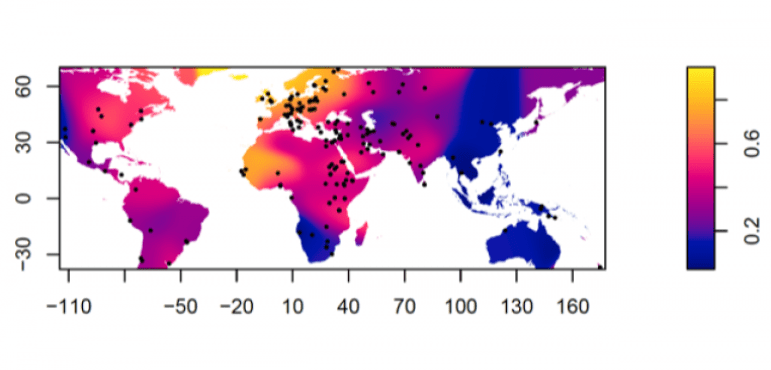
This was only 10kya – 9kya years ago, and we now have populations which are genetically adapted to be able to eat this new food. The story of dairy is a clear example of how we as a population can evolve in response to new diets in a relatively short amount of time.
The claim that we are not “adapted” to eat certain foods also negates the idea of gut plasticity, especially around the consumption of high fibre. Those who eat high fibre diets as children will be much better at digesting a diet of fibre rich foods when they are an adult, compared to someone who did not experience this when they were young.
A second issue with the messaging around the paleo diet is that it assumes nutrients derived from one food are superior over the same nutrient derived from another source, which is mostly thought to not be the case. For instance, dietician Sophie Medlin speaking to the BBC says that “Nutritionally speaking, sugar is sugar, no matter whether it has come from a maple tree, a coconut, sugar cane or beets”. While people may use coconut sugar instead of cane sugar, because it is “uncultivated”, not many ancestors would have had access to coconuts regardless unless they lived in very specific regions.
Related to this question of food vs nutrition, is that several processed foods, like oils, make it onto the paleo approved list, just because they contain a lot of nutritional value. The lists provided by thepaleodiet.com and eatingwell.com are full of inconsistencies in the name of nutrition.
Red wine is fine because it contains resveratrol, but white wine is off the list. Cultivated crops, primarily grains and legumes, are off the table, but domesticated animals are fair game (grass fed of course). Flaxseed oil is defined as a processed food, but it’s ok because of its content of high alpha-linolenic acid.
On the other hand, the paleo diet promotes eating red meat, which while it does contain key nutrients, have been proven to cause other issues like heart disease, diabetes and certain types of cancer. It seems to be a case of concept over health in this instance.
These inconsistencies become irritating when it sometimes becomes less about eating like our ancestors and more about eating healthily, and at other times more about the catchy name and buzzwords to sell a concept. Especially when you take a closer look at what humans from different parts of the world were eating during the paleolithic period.
There is evidence that as early as 80kya, humans and neanderthals were consuming grains and other starches, something which staunch supporters of the paleo diet would never allow. Analysis of dental calculus gathered from the teeth of ancient humans in the Fuyan cave in South China revealed that acorns, roots, tubers, grass seeds, and more made up their diet. In this case, the eating of grains and starch is assumed to have actually helped these early humans to eat enough to support the energy requirements of their increasingly large brains.
However, all this boils down to one key fact picked up by the paleo diet’s founder Dr Cordain, that once communities settled and began farming, eating more grains and starches, there is evidence that health actually declined. And there is. Poorer stature, bone deformities and susception to pathogens can be seen in the fossil record, coinciding with this dietary development around 10kya.
This may come as a surprise, as thoughts of farming bring thoughts of consistency, storage, contingency plans and continued health. But it seems that these early communities, and communities throughout the next few thousand years, moved from a varied diet of meat and seasonally gathered plants, to only 20% of their diet coming from gathered plants, and the remaining 80% from cultivated grains.
But to look at this data and claim increasing cultivated grain consumption declined the overall health of a population would be a wild oversimplification of the data. A better way to interpret it would be to look at this as more of a lack of diversity in the diet. Getting 80% of your energy from a single type of grain does not mean that these grains are “bad’, it’s that we are in need of a wider variety of nutrients than one crop can provide.
So is the paleo diet really a way to improve our health in the modern world? In some cases, cutting out the pop-tarts and replacing them with vegetables I would say absolutely. Are we only adapted to be able to eat certain foods? Well yes, but if we can retrieve enough nutrients without ill effects, then I’d say we are adapted to eat them. And is it healthier to increase your protein and fibre and cut out all grains? The jury is still out on the long term effects of this diet, but if you want to experience it and eat like a palaeolithic human for a day, why not give it a try?
Sources
The Paleo Diet. The strong and healthy diet (2024, April 19). . The Paleo Diet®. https://thepaleodiet.com/
Ldn, L. Y. M. R. The complete Paleo diet food list: what to eat and what to avoid. (2023, July 12) EatingWell. https://www.eatingwell.com/article/290612/the-complete-paleo-diet-food-list-what-to-eat-and-what-to-avoid/
What is a paleo diet and should I try it? (2020, February 28). BBC Food. https://www.bbc.co.uk/food/articles/paleo_diet
Armelagos G.J. , Cohen M.N. Paleopathology at the origins of agriculture, Academic Press, Orlando, FL (1984)
Cordain L, Miller JB, Eaton SB, Mann N, Holt SH, Speth JD., Plant-animal subsistence ratios and macronutrient energy estimations in worldwide hunter-gatherer diets. Am J Clin Nutr. 2000 Mar;71(3):682-92.
Cordain L Cereal grains: Humanity s double-edged sword Evolutionary Aspects of Nutrition and Health, Vol. 84, Karger Publishers (1999), pp. 19-73
Eaton, S.B. and Konner, M.J., 1997. Review paleolithic nutrition revisited: a twelve-year retrospective on its nature and implications. European journal of clinical nutrition, 51(4), pp.207-216.
Henry, A. G., Brooks, A. S., and Piperno, D. R. (2014). Plant foods and the dietary ecology of neanderthals and early modern humans. J. Hum. Evol. 69, 44–54. doi: 10.1016/j.jhevol.2013.12.014
Ingram C.J., C.A. Mulcare, Y. Itan, M.G. Thomas, D.M. Swallow Lactose digestion and the evolutionary genetics of lactase persistence Human Genetics, 124 (6) (2009), pp. 579-591
Ingram C.J. , T.O. Raga, A. Tarekegn, S.L. Browning, M.F. Elamin, E. Bekele, D.M. Swallow Multiple rare variants as a cause of a common phenotype: Several different lactase persistence associated alleles in a single ethnic group Journal of Molecular Evolution, 69 (6) (2009), p. 579
Ingram,C.I, Montalva, N and Swallow, D.M. 2022 ‘Lactose Malabsorption’, in Advanced Dairy Chemistry, Volume 3: Lactose, Water, Salts and Minor Constituents McSweeney et al eds. ISBN 978-3-030-92584-0
Paques, M., & Lindner, C. (n.d.). Lactose: Evolutionary Role, Health Effects, and Applications. Academic Press.
Revedin A, Aranguren B, Becattini R, Longo L, Marconi E, Lippi MM, Skakun N, Sinitsyn A, Spiridonova E, Svoboda J., Thirty thousand-year-old evidence of plant food processing. Proc Natl Acad Sci U S A. 2010 Nov
Walker, C. and Thomas, M.G., 2019. The evolution of lactose digestion. In Lactose (pp. 1-48). Academic Press.
Wu Y, Tao D, Wu X, Liu W, Cai Y. Diet of the earliest modern humans in East Asia. Front Plant Sci. 2022;13:1–10.:
 World of Paleoanthropology