Introduction
Rock art is one of the most enigmatic yet expressive forms of communication preserved from the Palaeolithic. Meanings remain debated, but the places and conditions in which images were made offer disciplined clues. This paper examines a spiral engraving in the Ocreza Valley in Portugal, set above a stretch of river where the rapids form a visible and audible swirl. I advance a working hypothesis: the Ocreza Spiral records a local soundscape, a river mark that draws attention to the turbulent flow below and may have carried a cautionary or mnemonic role. Rivers have distinctive acoustic signatures shaped by hydraulics and bedforms, and rapids produce stable roars that carry over distance (Pijanowski et al., 2011; Tonolla et al., 2011; Geay et al., 2019; Tatum et al., 2023). Comparative work shows that images and monuments often occupy places with unusual acoustic response, whether echoing gorges or roaring falls (Díaz-Andreu and García Benito, 2012; Mattioli et al., 2017; Goldhahn, 2002). Grounding the discussion in the Tagus and Ocreza corpus keeps the interpretation regionally anchored (Danelatos, 2022; Nash and Garcês, 2023). While the spiral is not the only engraving at the locality, its abstract form invites a sensory reading tied to water motion and sound. The paper introduces soundscape ecology, sets out parallels between rock art and watery acoustics, and proposes testable predictions for further study.


Background: Listening to landscapes
To ground the argument, a soundscape is the experienced acoustic environment of a locality, shaped by geophony, biophony, and anthrophony, and sometimes anchored by distinctive soundmarks (Schafer, 1994; Pijanowski et al., 2011). People often represent such place-specific sounds in marks or monuments in deep history and in living cultures. The Ocreza Spiral may be one of these records. Its form mirrors the eddy below the panel, and its placement overlooks a reach of river where rapids produce a persistent roar. Read this way, the spiral works as a river mark, a visual cue to a distinctive sound that signalled turbulence and focused attention on a memorable stretch of water (Tonolla et al., 2011; Tatum et al., 2023). Rapids and riffles create recognisable acoustic spectra that carry over distance, and their loudness and timbre vary with slope, bed roughness, air entrainment, and discharge (Geay et al., 2019; Tatum et al., 2023). A rapid can be heard before it is seen, which helps explain why such places invite marking. Studies of temperate freshwater soundscapes show a diverse acoustic milieu that would have framed such experiences (Rountree, Juanes and Bolgan, 2020). Archaeoacoustics shows that images and monuments often occupy locations with striking acoustic responses, including echoing gorges and roaring water, which suggests that what was heard helped decide where people made and used marks (Díaz-Andreu and García Benito, 2012; Mattioli et al., 2017; Goldhahn, 2002). A sensory reading is a complement, not a replacement, for other interpretations. Spirals and circles can also mark paths, altered states, or solar ideas. The claim here is modest. If spiral and circular signs tend to cluster near water features with distinctive acoustic qualities, then a river mark reading gains plausibility and becomes testable in the Tagus and Ocreza system and beyond.
Acoustic setting in rock art
By acoustic setting I mean the way a site’s sound behaviour shapes where images are placed and how they are experienced. Many rock art locales show pronounced resonance and echo. Studies in painted caves report that images concentrate in places with marked resonance, which implies that acoustic properties helped guide placement (Reznikoff and Dauvois, 1988). In open air gorges and along cliff lines, field measurements likewise show that panels coincide with strong reflections. Work in La Valltorta and the Central Mediterranean identified echo hotspots that match the distribution of imagery (Díaz-Andreu and García Benito, 2012; Mattioli et al., 2017).
Watery places are especially potent acoustically. Rapids, falls, and lake cliffs produce powerful geophony that draws attention and activity. Scandinavian and Finnish datasets show dense imagery at sites where water roars or echoes, which supports the idea that water sound helped structure where people made and used marks (Goldhahn, 2002; Rainio et al., 2025). These conditions aid audibility at distance, create rhythmic cues for performance, and produce call and response effects that make places memorable. Archaeoacoustic work applies repeatable measurements and modelling to such settings, from on site impulse responses to physical and digital reconstructions (Watson and Keating, 1999; Cox, Fazenda and Greaney, 2020). Not every cluster is acoustically driven, and present day acoustics may differ from past ones, so these links should be proposed as testable rather than assumed. Within this frame, the Ocreza spiral sits above a turbulent reach that produces a persistent roar, which makes an acoustic reading plausible and worth testing in the Tagus system.
Spirals, eddies, and water symbolism
Spiral motifs occur across Atlantic and Iberian traditions, yet meanings vary. I ask whether the Ocreza spiral indexes a local water phenomenon, specifically the eddy visible and audible from the panel. Regional syntheses set out the range of readings in Portugal and the Tagus basin and help anchor this discussion in local corpora (Bradley, 1997; Nash and Garcês, 2023; Danelatos, 2022).
Spirals, concentric circles, and cup and ring designs form a related family that supports several interpretations. Any water reading should remain a working hypothesis alongside solar, path, and trance explanations, and it should be weighed against site context and motif associations (Bradley, 1997; Nash and Garcês, 2023).
Why consider water here. Eddies generate rotating foam lines that trace a spiral planform. From the stance above the rapids the visible swirl matches the carved geometry, and the same reach produces a persistent roar that people could hear before they saw the water. That kind of recurrent sound functions as a soundmark and helps explain why such places invite marking (Schafer, 1994; Pijanowski et al., 2011; Tonolla et al., 2011; Tatum et al., 2023).
Comparative evidence shows that makers sometimes shaped grooves or basins so that water could enter or pass across carvings, and several authors link circular marks to water behaviour and watery places, though not in every case (Wikman, 2022; Bradley, 1997). This does not prove that spirals equal water everywhere, but it makes a cautious water reading reasonable when a motif sits beside turbulent flow that is both seen and heard.
There is also a performative angle. Carving a spiral asks for a continuous turning motion that echoes the gesture used when pointing out a swirl. The motif can be indexical of flow and meaningful in practice, linking body, water, motion, and memory during making and use.
The water reading should be tested with simple criteria. Support would include proximity to hydraulic turbulence, orientation toward the flow, and association with channels or basins that interact with rain or spray. Further support would be a local cluster of similar signs at other rapids in the Tagus system. Counter indicators would include consistent pairing with solar motifs far from water or panel orientations that ignore the river. These checks align with methods used to test acoustic siting in open air contexts (Díaz-Andreu and García Benito, 2012; Mattioli et al., 2017).
With these criteria in view, the Ocreza spiral’s position above a turbulent reach makes a cautious water reading plausible and worth testing against the wider Tagus corpus (Danelatos, 2022; Nash and Garcês, 2023).
Ocreza and Tagus case study
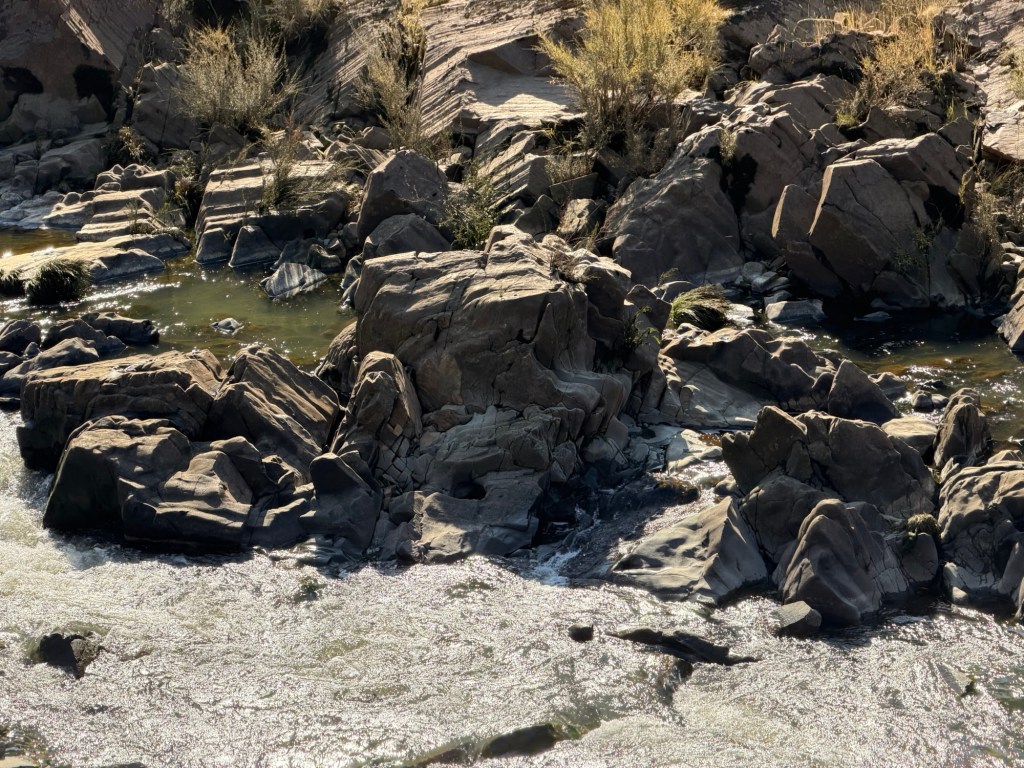
The Ocreza Valley is a tributary setting within the middle Tagus basin in central Portugal, where steep schist and granite walls confine a fast reach of river. Near the municipality of Mação, the engravings sit off the beaten path on private land above the channel. The reach below the panel is confined, and the water accelerates as it passes bed irregularities. You can hear the rapid before you see it, even from the height of the ledge where the engravings are.
The river in this sector is usually slow compared with true white water, but the increase in speed at the constriction is obvious. Foam rises to the surface where turbulence breaks through, and a small eddy forms below the obstacle. Modern dams on the Tagus have altered discharge and seasonality, so present sound levels are likely lower and less variable than they would have been in Palaeolithic times. Even so, the audible character of the reach remains clear enough to consider how sound may have structured attention here. This is a suitable place to test the working hypothesis. See Figure 4 for the wider reach.
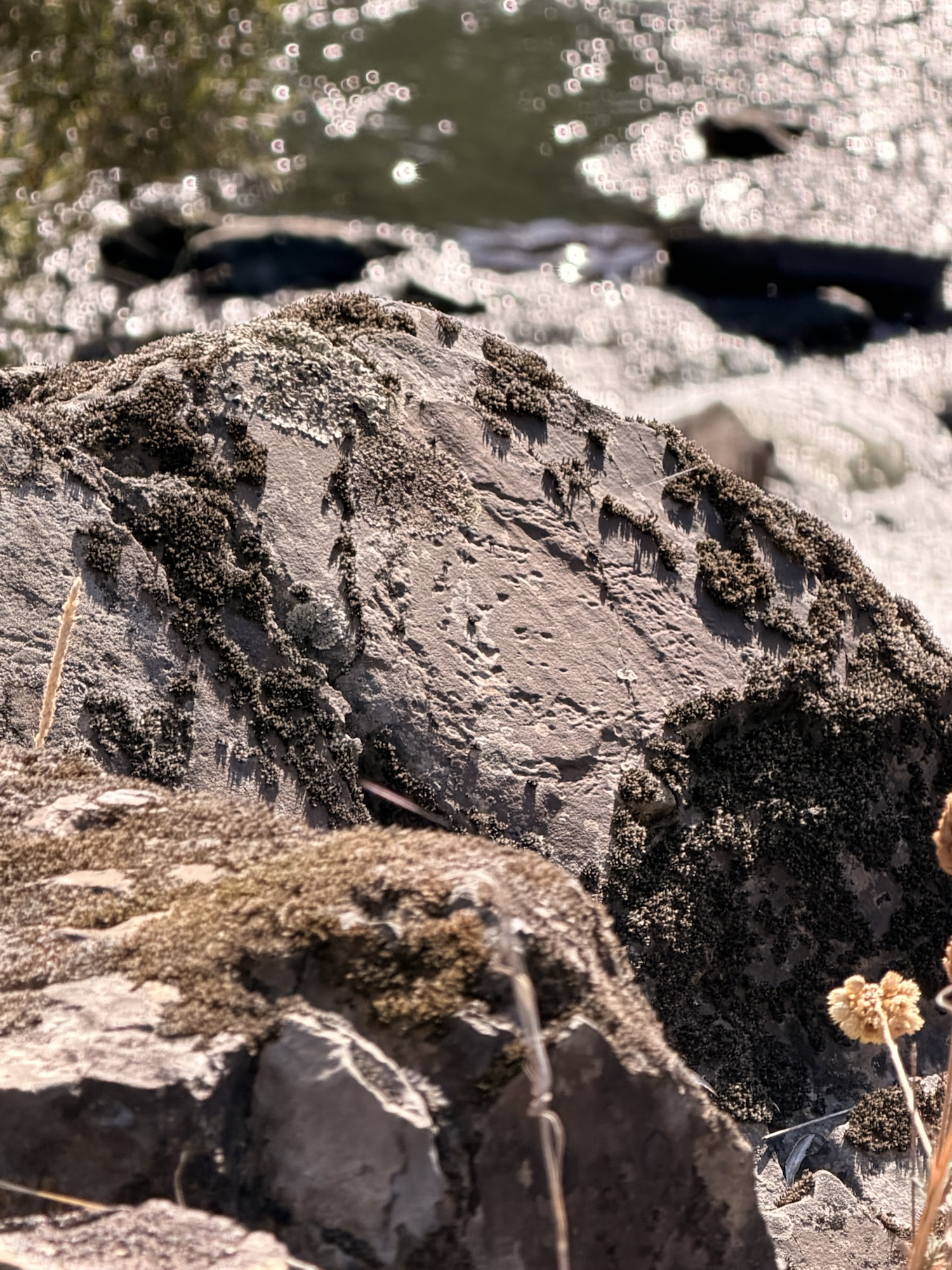
The spiral sits on a lightly weathered panel above river level. In good light the carving is readable; in flat or overcast light it recedes and becomes difficult to see without knowing where to look. The panel has a view over the river and the rapid. The incision is shallow but continuous, and the motif is a simple single spiral rather than a nested set. The rock surface shows age and exposure, yet the line remains coherent in favourable light. See Figure 1 and Figure 2.
Viewing and approach matter. To see the motif clearly a person stands on the ledge facing the panel with the river sound in the background. From this stance the eddy below is visible, and the carving sits at a natural pause point along the slope. The motif is therefore more likely to be a description or locator than a distant warning. It reads as a record that makes sense to people who already know the bend and its behaviour. See Figure 3.
The rapid’s turbulence and entrained air produce a broadband roar that carries across the valley, with intensity expected to rise under higher discharge. The present feature is not ferocious, but the same morphology under greater flow would have produced a louder, more emphatic sound. The combination of a visible swirl and a persistent roar gives the place a distinctive acoustic identity.
Method note: doing archaeoacoustics with light fieldwork
This study is desk based with observations from a single site visit. Extrapolation from analogues and literature is justified here because the acoustic behaviour of rivers is well described at reach scale and because similar rock art settings have been measured in caves, gorges, and at monuments. Where possible I lean on published methods and findings rather than new instrumentation in order to minimise impact and to respect property and conservation limits (Kolar, 2018; Till, 2019; Cox, Fazenda and Greaney, 2020).
The approach has three tracks. First, a literature and analogue track. I treat the Ocreza reach as a confined rapid where turbulence, roughness, and air entrainment produce a broadband roar that is audible at distance. This is consistent with river soundscape studies and with acoustic siting observed at open air panels elsewhere. The aim is to use what is already known about river noise and echo rich settings to frame the Ocreza spiral in a way that can be tested against the Tagus corpus.
Second, a minimal field protocol that could be added later with permission and without intrusive methods. A short soundwalk would log one to two minute recordings at a few stances that matter for viewing and listening. Basic metrics like LAeq can be extracted from smartphone recordings offline. A simple impulse response can be captured with a hand clap or balloon pop if this is safe and allowed. Short hydrophone snapshots can document underwater turbulence if access is straightforward and conditions are stable. Each clip should be paired with clear metadata that notes date and time, weather, water level if known, stance location, and camera view to the river. No chalking or contact tracing would be used. Photogrammetry of the panel may be added only under permit and in ways consistent with conservation guidelines (Kolar, 2018; Till, 2019).
Third, a light modelling and auralisation track for communication rather than proof. Existing impulse responses from comparable gorges and generic rapid recordings can be convolved to create short audio illustrations of what a listener might experience from the stance. Physical scale modelling is a powerful technique at monuments like Stonehenge, but it is not required here and is noted mainly as a precedent for rigorous reconstruction when direct measurement is restricted (Cox, Fazenda and Greaney, 2020). The emphasis in this paper remains on clearly stated criteria that others can test in the Tagus basin.
Desk based mapping supports these tracks. Known spirals and circular signs in the Tagus can be plotted against channel confinement and likely hydraulic features. Simple measures include distance to nearest rapid or eddy, panel orientation relative to flow where photographs allow it, and the presence of grooves or basins that might interact with rain or spray. A first pass can compare frequencies near turbulent reaches to those along quiet runs. Even coarse results will show whether the Ocreza spiral is an outlier or part of a repeatable pattern. Figure 6 shows a simplified schematic of panel, stance, flow, and eddy.
All of this sits under a simple rule. Offer testable claims, accept the limits of present conditions, and keep the work traceable. The goal is not to force a meaning but to set out a path that allows the water reading to gain or lose weight as new data are added.
Discussion: what the spiral does
If the Ocreza spiral sits above a turbulent reach with a visible swirl and a persistent roar, the motif can be read as a local soundmark. It would draw attention to the bend and encode what listeners already knew. It may have served a cautionary role or acted as a mnemonic that fixed a story to a place. The carving also invites a performative reading. A maker stands at the ledge, turns the wrist in a continuous motion, and traces a curve that echoes the rotating foam below. Body, water, and mark align in a way that makes the place memorable.
Alternative readings remain viable. A solar reading is possible because the motif becomes clearer in strong light and can brighten when the sun is low. A path reading is possible if the ledge served as a natural pause along a local route. None of these roles exclude the others. A single mark can be polysemous and work in more than one register.
The test is at the landscape scale. If similar spirals cluster near rapids and eddies more than they do near calm pools, if they face toward flow, and if they tend to coexist with grooves or basins that interact with rain or spray, then a water reading carries more weight. If the opposite pattern holds, the reading weakens. The point is not to win an argument now but to show exactly what evidence would move the needle.
Conclusion: hearing deep history
This paper sets out a cautious case that the Ocreza spiral records a local soundscape. The reach below the panel is confined and noisy. The eddy is visible from the stance and the roar is audible at distance. Rivers are known to produce stable acoustic signatures, and rock art is often placed where sound behaviour is striking. The water reading is not exclusive and it does not displace other interpretations. It gains plausibility only if it holds up across the Tagus basin and beyond. That is a tractable task. The steps are clear and the methods are light. The broader value is simple. Listening belongs with looking when we try to understand how and why people made marks in places like this.
Works Cited
Bradley, R. (1997) Rock Art and the Prehistory of Atlantic Europe: Signing the Land. London: Routledge.
Cox, T. J., Fazenda, B. M. and Greaney, S. E. (2020) ‘Using scale modelling to assess the prehistoric acoustics of Stonehenge’, Journal of Archaeological Science, 122, 105218. https://doi.org/10.1016/j.jas.2020.105218
Danelatos, D. (2022) The Upper Palaeolithic Rock Art in the Tagus Valley Rock Art Complex: Context, Style and Chronology. Master’s thesis, Instituto Politécnico de Tomar.
Díaz-Andreu, M. and García Benito, C. (2012) ‘Acoustics and Levantine rock art: Auditory perceptions in La Valltorta Gorge (Spain)’, Journal of Archaeological Science, 39(12), pp. 3591–3599. https://doi.org/10.1016/j.jas.2012.06.034
Geay, T., Gervaise, C., Roulund, A. and Perret, C. (2019) ‘On the origin of acoustic waves generated by water flows in rivers’, Earth Surface Dynamics, 7, pp. 301–316. https://doi.org/10.5194/esurf-7-301-2019
Goldhahn, J. (2002) ‘Roaring rocks: An audio-visual perspective on hunter-gatherer engravings in northern Sweden and Scandinavia’, Norwegian Archaeological Review, 35(1), pp. 29–61.
Kolar, M. A. (2018) ‘Archaeoacoustics: Re-sounding material culture’, Acoustics Today, 14(4), pp. 28–37.
Mattioli, T., Farina, A., Armelloni, E., Hameau, P. and Díaz-Andreu, M. (2017) ‘Echoing landscapes: Echolocation and the placement of rock art in the Central Mediterranean’, Journal of Archaeological Science, 83, pp. 12–25. https://doi.org/10.1016/j.jas.2017.04.008
Nash, G. and Garcês, S. (eds) (2023) The Prehistoric Rock Art of Portugal. Abingdon: Routledge.
Pijanowski, B. C., Villanueva-Rivera, L. J., Dumyahn, S. L., Farina, A., Krause, B. L., Napoletano, B. M., Gage, S. H. and Pieretti, N. (2011) ‘Soundscape ecology: The science of sound in the landscape’, BioScience, 61(3), pp. 203–216. https://doi.org/10.1525/bio.2011.61.3.6
Rainio, R., Aro, A., Lahelma, A., Äikäs, T., Lassila, M. and Oikkonen, J. (2025) ‘Reflected encounters at hunter-gatherer rock art sites’, Public Archaeology, 24(1), online first.
Rountree, R. A., Juanes, F. and Bolgan, M. (2020) ‘Temperate freshwater soundscapes: A cacophony of undescribed biological sounds now threatened by anthropogenic noise’, PLOS ONE, 15(3), e0221842. https://doi.org/10.1371/journal.pone.0221842
Schafer, R. M. (1994) The Soundscape: Our Sonic Environment and the Tuning of the World. Rochester, VT: Destiny Books.
Tatum, T. A., Anderson, J. F. and Ronan, T. J. (2023) ‘Whitewater sound dependence on discharge and wave configuration at an adjustable wave feature’, Water Resources Research, 59(8). https://doi.org/10.1029/2022WR033802
Tonolla, D., Lorang, M. S., Heutschi, K., Gotschalk, C. C. and Tockner, K. (2011) ‘Characterization of spatial heterogeneity in underwater soundscapes at the river segment scale’, Limnology and Oceanography, 56(6), pp. 2319–2333. https://doi.org/10.4319/lo.2011.56.6.2319
Watson, A. and Keating, D. (1999) ‘Architecture and sound: An acoustic analysis of megalithic monuments in prehistoric Britain’, Antiquity, 73(280), pp. 325–336.
Wikman, V. (2022) ‘The water symbolism that is filling up the cupules and flowing through the cup and ring marks’, Adoranten, pp. 126–145.
 World of Paleoanthropology
Interesting
LikeLike