Kindred: Neanderthal Life, Love, Death and Art; A Review

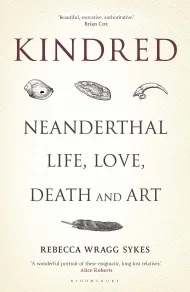
So we are finally here! Launch day in the United States! October 27th is the day that Kindred: Neanderthal Life, Love, Death and Art finally comes available in hardcover and paperback to readers across the U.S.

While available on kindle and audible for some time, the book was not officially available until now.

In preparation for the books launch, we interviewed the author, Rebecca Wragg Sykes, which we had a great time doing. You should check out that talk here:

But now that the book is out, lets talk about it! How is it? Should you get it, and whole role does it play in the future of anthropology?

First off lets start off with the basics, if you are looking for a book on Neanderthals, especially one that has by far the most up to date information based on the most recent findings and technology, then this is the book for you. Not only is all of the information top notch, and as up to date as you will find out there (besides any discoveries that come out after the publication of this article).

Each chapter starts with a look back into the past, with a glimpse through the eyes of our Neanderthal cousins, while some people complain about these anecdotes, I find that they add to the overall story and provide a more fulfilling and imaginary driving experience when imagining a world that no longer exists. After all, no matter how much archaeology is involved, there is still going to be guess work, might as well make it interesting and logical.

The book guides you through the basic lives of a Neanderthal, as the title suggests, from birth to death and everything in between we get a close glimpse at what it was like to live in a world no longer recognized. From how stone tools were made and used to the way in which a Neanderthal women would give birth, each aspect is touched upon, and in unique and intelligent ways.

At the time of writing this, it is a fact, that there are no more updated or more informed books on Neanderthals out there Rebecca Wragg Sykes has quickly made herself a name in the field of Paleoanthropology and Archaeology doing various works in STEM and science education. And for good measure, her charisma, love her work, and talent at bringing detailed and hard to understand concepts into view creates an entirely new perspective on creatures long dead.

From start to finish the book takes you on a long journey through time and explains each aspect of it, in a kind, understandable way that makes it enjoyable to read and learn even the harder, more dry topics.

For me, Im a biological anthropology kind of guy, the chapters on stone tool knapping were not my favorite, but they were still very informative.

So what is there to learn and take away from this book? First of all, let me say, if it is not clear, if you want to learn about Neanderthals this is a must read, simply put. This is the best modern book on Neanderthals.

But what is the main take away? To me, I think its an idea that many anthropologists have been trying to push for some time with little success, but maybe this book will change that. To change the idea that Neanderthals were not brutish ancestors who only lived in caves and ate each other. But that they were so much more, so much closer to our own species than we ever thought, both in thought, culture and anatomy. That these creatures were in fact us, and that our differences are far smaller than they ever seemed before.

Neanderthals were not “cavemen”, they were sophisticated hominids who lived dedicated and developed lives that were not so different than our own. Hopefully this message gets across to a new, and old generation, for we have so much to learn about those that came before us, and even during our own existence. We have no closer relatives, its time we start to recognize them for who and what they are and their importance in our daily lives, our health, and our future.

We have so much left to learn about Neanderthals, and while KINDRED is a great start and covers just so much information, it is just the tip of the iceberg, the taste to get you interested and involved in the on going research involving paleontology and Neanderthals.

You can order your copy of the book right here on your favorite format:

We highly recommend it, and suggest you watch our interview to go along with the book for added content!

We would like to go ahead and thank Rebecca again for her participation in our interview, and thank you for the wonderful years and hard work that she has put forth to bring us this great work on Neanderthals.

Until Next Time

Never Stop Exploring

Seth Chagi

CARTA Symposium COMPARATIVE ANTHROPOGENY: EXPLORING THE HUMAN-APE PARADOX


Our friends at CARTA – Center for Academic Research and Training in Anthropogeny are hosting a free public (virtual) symposium this Saturday October 24th! 

Learn about comparative anthropogeny and the human-ape paradox!

Learn more here: https://carta.anthropogeny.org/…/comparative-anthropogeny-e…

#carta #anthropology #human #ape

Youtube

Hello fellow scientists and enthusiasts!

I have some exciting news! Along the launch of our latest interview today, we are also announcing that we have created our very own Youtube account!

You will be able to find all of our video interviews there, as well as on Facebook, but the quality will be much better on YouTube! But we shall maintain both for user ease.

View our channel and please like and subscribe here!

Interview Eight: Rebecca Wragg Sykes

Author of the new book KINDRED, we take time to talk to Rebecca about Neanderthals and their lives, from how they could throw spears to Jean Auels Earth’s Children Saga.

Join us here, and let us know what you think about Neanderthals below!

Whats your favorite aspect about them?

Look forward to our full review of the book when it comes out at the end of the month, in the meantime be sure to get your pre order on Amazon right here!

We hope you have a great time and learn a lot!

Check out our review of her book here:

Review: Some Assembly Required by Neil Shubin

Some Assembly Required by Neil Shubin is a great look into the genetics of what makes us human. One of the newer books out there, the information contained therein is up to date and relevant to todays topics and discoveries. 

Focusing more on the mechanics of evolution and biology in general than specifically Human Evolution, this book will please a variety of scientists and enthusiasts alike. 

Discussing from what we are from our basic building blocks, to Homo sapiens, we explore an amazing journey through they eyes of a geneticist and scientist who’s goal is to find the center of it al through a detailed analysis of genetic, fossil, and theoretical remains. 

Neil Shubin does a great job of leading us down a path of exploration as we start at the beginning, the very beginning, 4 billion years ago at the start of life on earth up to where we are today. Not only is this done in great detail with in a way that is easy to understand but done so that it can be built upon by other scientists and enthusiasts. 

This may not be the best book for those just starting down the path of paleoanthropology as some of the topics are harder to understand than others, but they are explained well and in detail so that no one is left behind. 

All in all its a good book, nothing super special to say about it to be honest, but if youre looking for another book to pick up, anything relating to this subject, its a good addition to your library. 

Worth the read. 

Until next time. 

Interview Seven: Ian Tattersall

Hello and well met Prof. Tattersall!  How are you?:

Still ambulatory, fortunately.

Today we are lucky in the fact that we get the rare opportunity to interview someone who has made such a mark on the greater world of Paleoanthropology. Professor Ian Tattersall! 

To get started, I would love to give you a little space to tell us a little about yourself: 

Thank you for asking.  I am an emeritus curator at the American Museum of Natural History in New York City.  I have spent the last fifty years or so thinking about human evolution in the light of my early experience with the lemurs of Madagascar.  The lemurs are a very diverse group of primates; and this started me thinking in terms of natural diversity, which I soon realized also describes the pattern we find in the human fossil record.  I had been brought up to think of human evolution as a matter of gradual perfecting change, one species giving rise to the next in a slow transformation.  But looking more closely I saw that the story of human evolution has actually been one of vigorous experimentation with the hominid (hominin if you prefer) potential.  Many species were produced over the tenure of the hominids, and most of them became extinct.

Great!  Thanks so much for sharing that! Now, to get to the questions! 

  1. What is your favorite Hominid and why?

Wow, that’s a tough one.  I guess if pressed I’d have to say Homo heidelbergensis, if for no better reason than it is the main hominid species I’m still having to do battle about.  Today, pretty much everyone recognizes that Homo neanderthalensis is its own entity, one that needs to be understood in its own terms, even though it was a close enough relative of Homo sapiens to have done some minor interbreeding with it.  But Homo heidelbergensis is still very confused, and even though it is very distinctive my colleagues can’t even agree which fossils belong to it.  That’s an issue that won’t be resolved until the Atapuerca fossils, wrongly ascribed to Homo heidelbergensis, are given their own name and identity.

2. Twenty years ago, did you see us where we are today?

3. Where do you see us in another 20 years?

I will answer these two questions together, because basically I hadn’t, and haven’t, a clue. When I got into the field half a century ago, our understanding of human was radically different from our understanding today.  Back then we had a much thinner human fossil record, geochemical dating was still a novelty, the CT scanner was in the future, nobody in paleoanthropology was using electron microscopes, isotopic studies hadn’t been thought of, and paleoanthropology itself was in thrall to the Evolutionary Synthesis.  Now the world is a radically different place; and it would be total hubris to imagine that it will have not changed out of recognition again in fifty or even twenty years’ time.  To our successors, what we think today will appear just as quaint as what our teachers thought in 1970 does to us today.

4. Which of your hypotheses was the hardest to defend, and do you think you did it successfully?

I have tried all my career to break away from the hugely minimalist and linear notion of human evolution that Ernst Mayr imposed on paleoanthropology in 1950.  It is a very beguiling one, and it makes a great story; but clearly things in the real world were a lot messier than that.  Evolutionary change is potentially influenced by many different factors, and there is a lot more to evolution than just natural selection.  Paleoanthropologists today recognize many more extinct hominid species than they did a few decades ago; but this havs been imposed by the pressure of discovery, rather than by the rethinking of the fossil record that I would like to see done.  So no, I don’t think I have got very far.  But I comfort myself by reflecting that, in science, we are all ultimately wrong.  

5. What’s it like to travel the world to all of these exotic places and explore human origins?

It has been a blast.  I spent a good bit of my childhood in Africa and so got a taste for travel early on; and I have been privileged to indulge that taste in search of fossils both in the field and in museum drawers.  In the process I have met many wonderful people (and a few not so wonderful); and I have been able to appreciate first-hand that the world is a very big place, and that what it looks like depends entirely on where you are viewing it from.

6. What first got you interested in this subject?

I stumbled into it in college. 

7. What’s the hardest part of your job? 

I think the hardest thing of all in paleoanthropology is its most basic, and most necessary, operation: sorting the hominid fossil record into species.  The problem arises because there is no one-to-one correspondence between speciation and morphological shift.  That makes hypotheses in this area very hard to test, given the nature of the evidence we are dealing with.  But although some scoff that worrying about species is just “arguing about names,” there is no doubt in my mind that if you don’t know who the actors are, you’ll never understand the play.

8. What is one major misconception you would like to clear up?

Probably the notion that phylogenies are a matter of discovery.  The idea often seems to be that fossils are like links in a chain, and that if you crawl over enough outcrops and find enough fossils, you will find where the chain runs.  But in fact, phylogenies are typically very complex, with numerous speciations and extinctions.  Which means that unraveling them is essentially a matter of analysis, not of discovery.  Which doesn’t mean that more fossils are not better, of course. 

9. Who are some of your major inspirations?

Wow.  We are all standing on the shoulders of giants, starting well before Darwin.  But without David Pilbeam, Elwyn Simons, and Niles Eldredge, my career would never have developed as it did.

10. What are your thoughts on Homo naledi; especially possible interment of the dead?

Well, naledi is one of the great recent discoveries, though I am not sure it is appropriately placed in Homo. The algorithm that “If it isn’t Australopithecus it’s Homo, and vice versa” is a bit of a straitjacket for paleoanthropology at this point.  For me, naledi is an additional indication of just how diverse the hominids are.  As to the rumored interment, I am still waiting to see all the evidence, although hominids are so weird anything is possible.

11. What’s next for you? 

Over the last few years I have become increasingly interested in how Homo sapiens came to be the extraordinary creature it is, and I think I will extend my studies in that direction.  I am also working on the history of early zoological exploration in Madagascar (old guys always get interested in history).

12. Why is it important to understand where we came from?

It is crucial to know accurately how we Homo sapiens came about, because very often we have the notion that we have been perfected by nature: that we have been honed by evolution to be the creature we are.  Whereas in fact the record suggests otherwise.  It suggests that (like everything else) we are an adventitious product of nature, unperfected in any respect.  Knowing this helps us to understand not only why we are so creative, but also why we are so fallible.  And why we are responsible for what we do, and can’t just blame it on our genes or some imagined past.

13. If you could be present for any discovery, what would it be?

Tough to say.  I don’t know what discoveries will be made, and frankly I don’t want to guess.  But looking back, I know where I would like to have been, as witness to the first Neanderthal/Homo sapiens encounter.  There would have been no better moment to gauge the exactly what it is that makes modern humans different

14. How has the study of human origins changed the way you view the world?

Another tough one, since it has been so long since I viewed the world through any other lens.  Perhaps, though, it has most importantly placed our species in perspective for me.  We are one of many millions of species on this planet, each of which is unique and can do something no other species can.  We are unusual in many ways, notably in our symbolic cognitive style; but we are not special, and we do not have a special right to the world and its resources.

15. What advice would you give someone going into the field?

Be sure you are really motivated.  Getting into a good grad school is nowadays a lot easier than getting a good job at the end of it all.  But never lose your interest!

Interview Six: Chris Stringer

Hello Mr. Stringer! Thank you for joining us today, how are you doing? 

To start off I think I would just like to have you introduce yourself a little bit:

I’ve been working at the Natural History Museum since 1973, but I do also have a life, family and friends outside of the Museum! My research interests now are focused on reconstructing the last half million years or so of human evolution, collaborating with a range of colleagues in palaeoanthropology, archaeology, genetics, geochronology and palaeoclimates. I’ve also been very involved with the British part of the story over the last 20 years or so, directing the Leverhulme-funded Ancient Human Occupation of Britain projects, and then co-directing the Calleva Foundation-funded Pathways to Ancient Britain projects, with Nick Ashton at the BM.

Great! Now lets get to some questions: 

  1. How did you first get involved with Paleoanthropology? 

I was fascinated by fossils and human evolution as a school kid, but I had no idea that I could actually study the subject. I had a place at medical school lined up but by chance I was given University College London’s prospectus – it was arranged alphabetically, and Anthropology was at the beginning. The course offered archaeology, human evolution, genetics, and social anthropology. Suddenly medicine seemed less appealing, so I phoned UCL ( a letter would have been too slow!), was invited for an interview, and they offered me a place. Much to the amazement of my teachers and parents, I dropped medicine at the last minute and took up this study subject, which I had only just learnt existed. 

2. Do you have any tips for new adventurers starting their quest? 

Always try to keep an open mind and read/listen as widely as you can. There is so much online now, which is great, but it can be difficult for a beginner to sort the wheat from the chaff.

3.What’s your favorite fossil?

That’s a difficult one as I have so many favourites! It’s probably a choice between a Neanderthal like the type fossil skullcap from Germany which I studied for my PhD, or the Forbes’ Quarry skull (the first one I ever looked at for real), or something new and challenging like Liang Bua 1 (Homo floresiensis) from Flores. 

4.Hardest research you have done?

Probably dating the Broken Hill skull, which took over 20 years work with Rainer Grün to get published. Every time we added some new analysis to try and clarify the picture, it seemed to get even more complicated!

5. Most satisfying research that you have done?

That’s a tricky one – the 1988 Science paper “Genetic and Fossil Evidence for the Origin of Modern Humans” with Peter Andrews is probably the one I’m most proud of, and it came at a crucial time in the debate about our origins. But the 2005 and 2010 papers on Pakefield and Happisburgh 3 that pushed back the earliest-known occupations in Britain were great achievements of the Ancient Human Occupation of Britain team.  

6. What do you know now, that you wish you knew 20 years ago? 

That evidence would show that we not only interbred with Neanderthals (which I always thought was possible), but that we would also find traces of it widely and significantly today

7, Based on the most recent evidence, who do you think the most likely common ancestor for Neanderthals and H. sapiens? 

I don’t know but it’s probably something with a face more like Homo antecessor than Homo heidelbergensis

8. Do you think we have a direct common ancestor or is it more complicated than that?

It is more complicated because although we can reconstruct and look for a common ancestor in terms of morphology, our ancestry was added to subsequently by intermixture with Neanderthals, Denisovans and maybe other lineages

9.What’s other discipline best supports Paleoanthropology? Archaeology, Geology, Anatomy, etc. 

They are all important, depending on the questions you are trying to answer. Certainly, molecular anthropology and geochronology must be included there.

10. Since the writing of Lone Survivor (Which I am rereading now), when discussing the Out of Africa dispersal, you note the genetics and archaeology support multiple theories about the size and timing of the dispersal, has time cleared that up at all? 

It hasn’t got clearer because it looks like there were a number of pre-60 ka dispersals from Africa that had minimal impacts on present-day genetic patterns. Did those earlier populations all go extinct or were their genetic signals just over-written by the success of the ~60 ka dispersal?

11. What else do you think we are going to find? 

I think more new lineages and species will be uncovered, in Africa, Asia and Island South East Asia, maybe even in Europe

12. What technology are we waiting for to get further answers?

I think the advent and wider application of palaeoproteomics will allow us to test the relationships of fossils in areas that ancient DNA cannot reach

13. What Fossil are we dying to find to uncover specific secrets?

I’d certainly like to know what a whole Denisovan skeleton would look like!

14. Why do you think Chimpanzees and Bonobos did not continue on their evolutionary tract like we did, what caused us to have a cognitive revolution while they didn’t?

I think Jane Goodall put it so well – despite the rich repertoire of communication in chimps, without a human-like language “they are trapped within themselves”

15.What updates to the Out of Africa hypothesis do you have that you think we should all know?

That there was a not a single line of evolution in one region of Africa leading to us, and that there were several Out of Africa events in the last 500,000 years, as well as (no doubt) some Into Africa ones…

And there you have it! What a wonderful time with Mr. Stringer! A big thank you for doing this interview with us!

If you know someone or are interested in being interviewed, email me at sethchagi@icloud.com and we will see what we can do!

Thanks!

Lee Berger Interview Companion

Hello!

Hopefully at this point in time you have seen our interview with Prof. Dr. Lee Berger (if you have not please do so now) and noticed there were some audio issues with our interview. In order to mitigate that, and to provide more in depth information I am going to write up this companion article to explain not only what is going on in the interview, but to delve deeper into the information provided.

Read this while you watch, before or after either way it will make your interview watching experience that much better! So please use this guide as your resource, and make the interview that much more enjoyable.

You can find the interview here.

To start off the interview, Lee introduces himself, and we begin to discuss fossil sites that he is currently working on and things that are going on in that realm of his work.

We discuss the building and near completion of the new Malapa Museum which will hold discoveries from various localities including Gladysvale and all of the Malapa Hominins.

From there we discuss the Rising Star site, and the work that is going on there. specifically the augmented reality tour.

Then we learned more about some National Geographic expeditions over ten last few years, discovering 600 new cave sites, 200 new fossil sites, FOUR NEW HOMINID SITES AND 6 NEW HOMO NALEDI LOCALITIES!

You read that right! All those new locations and especially and most specially the 6 new H. naledi localities. Lee did not go into detail about what these new sites or localities reveal, but there are just so many possibilities its just an endless enigma. We will have to pay attention and look forward to these announcements coming from Lee and his team.

What has been confirmed, but we know little about, is that these new naledi discoveries give credence tot he deliberate ritualized body disposal of H,naledi, Lee would not go into detail so we do not know much, but when pushed on the subject he did admit there was more evidence to support this theory.

Going back to Rising Star, the team has discovered a new chamber, the Hill Anti-chamber where more discoveries have been made. There was going to be a new expedition to Malapa starting this month, but due to COVID19 it was cancelled.

Getting into the more genetic side of things we began talking about ancient DNA, the likelihood of finding naledi DNA or proteins from sediba. As it turns out we actually have a good chance of getting information from both of these sources.

With modern technology we are going to be able to better date and test the proteins found in the sediba fossils, and ongoing DNA studies are going on with the Homo naledi fossils, although delayed again due to the pandemic.

Nest we go on to discussing the idea of “there was no first for anything”, no first tool maker, no first fire maker, no first this or that. There was no “ah-ha” transitionary moment. We even discuss the idea that all hominids have been tool makers, and that not just Homo habilis was the first.

Are sediba and naledi going on more tours around the world? Well that remains to be seen, as this pandemic continues it is not known what will be safe for these invaluable objects, so only time will tell, but there were plans to send these guys to other places around the world to show them off.

And that about does it for our interview! We hope you enjoyed it as much as we did, it was an amazing experience and I am so thankful to Dr. Berger for participating in this interview. I look forward to many more in the future.