Interview Six: Chris Stringer

Hello Mr. Stringer! Thank you for joining us today, how are you doing? 

To start off I think I would just like to have you introduce yourself a little bit:

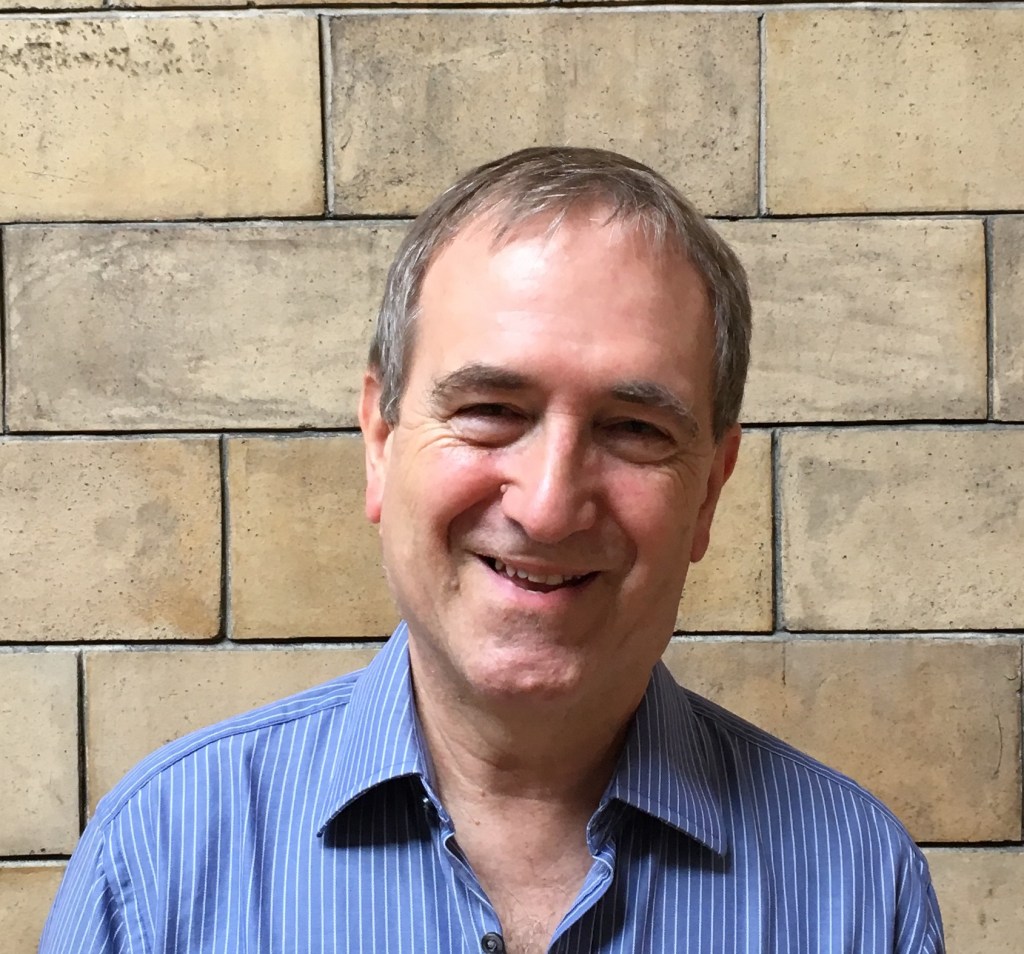
I’ve been working at the Natural History Museum since 1973, but I do also have a life, family and friends outside of the Museum! My research interests now are focused on reconstructing the last half million years or so of human evolution, collaborating with a range of colleagues in palaeoanthropology, archaeology, genetics, geochronology and palaeoclimates. I’ve also been very involved with the British part of the story over the last 20 years or so, directing the Leverhulme-funded Ancient Human Occupation of Britain projects, and then co-directing the Calleva Foundation-funded Pathways to Ancient Britain projects, with Nick Ashton at the BM.

Great! Now lets get to some questions: 

  1. How did you first get involved with Paleoanthropology? 

I was fascinated by fossils and human evolution as a school kid, but I had no idea that I could actually study the subject. I had a place at medical school lined up but by chance I was given University College London’s prospectus – it was arranged alphabetically, and Anthropology was at the beginning. The course offered archaeology, human evolution, genetics, and social anthropology. Suddenly medicine seemed less appealing, so I phoned UCL ( a letter would have been too slow!), was invited for an interview, and they offered me a place. Much to the amazement of my teachers and parents, I dropped medicine at the last minute and took up this study subject, which I had only just learnt existed. 

2. Do you have any tips for new adventurers starting their quest? 

Always try to keep an open mind and read/listen as widely as you can. There is so much online now, which is great, but it can be difficult for a beginner to sort the wheat from the chaff.

3.What’s your favorite fossil?

That’s a difficult one as I have so many favourites! It’s probably a choice between a Neanderthal like the type fossil skullcap from Germany which I studied for my PhD, or the Forbes’ Quarry skull (the first one I ever looked at for real), or something new and challenging like Liang Bua 1 (Homo floresiensis) from Flores. 

4.Hardest research you have done?

Probably dating the Broken Hill skull, which took over 20 years work with Rainer Grün to get published. Every time we added some new analysis to try and clarify the picture, it seemed to get even more complicated!

5. Most satisfying research that you have done?

That’s a tricky one – the 1988 Science paper “Genetic and Fossil Evidence for the Origin of Modern Humans” with Peter Andrews is probably the one I’m most proud of, and it came at a crucial time in the debate about our origins. But the 2005 and 2010 papers on Pakefield and Happisburgh 3 that pushed back the earliest-known occupations in Britain were great achievements of the Ancient Human Occupation of Britain team.  

6. What do you know now, that you wish you knew 20 years ago? 

That evidence would show that we not only interbred with Neanderthals (which I always thought was possible), but that we would also find traces of it widely and significantly today

7, Based on the most recent evidence, who do you think the most likely common ancestor for Neanderthals and H. sapiens? 

I don’t know but it’s probably something with a face more like Homo antecessor than Homo heidelbergensis

8. Do you think we have a direct common ancestor or is it more complicated than that?

It is more complicated because although we can reconstruct and look for a common ancestor in terms of morphology, our ancestry was added to subsequently by intermixture with Neanderthals, Denisovans and maybe other lineages

9.What’s other discipline best supports Paleoanthropology? Archaeology, Geology, Anatomy, etc. 

They are all important, depending on the questions you are trying to answer. Certainly, molecular anthropology and geochronology must be included there.

10. Since the writing of Lone Survivor (Which I am rereading now), when discussing the Out of Africa dispersal, you note the genetics and archaeology support multiple theories about the size and timing of the dispersal, has time cleared that up at all? 

It hasn’t got clearer because it looks like there were a number of pre-60 ka dispersals from Africa that had minimal impacts on present-day genetic patterns. Did those earlier populations all go extinct or were their genetic signals just over-written by the success of the ~60 ka dispersal?

11. What else do you think we are going to find? 

I think more new lineages and species will be uncovered, in Africa, Asia and Island South East Asia, maybe even in Europe

12. What technology are we waiting for to get further answers?

I think the advent and wider application of palaeoproteomics will allow us to test the relationships of fossils in areas that ancient DNA cannot reach

13. What Fossil are we dying to find to uncover specific secrets?

I’d certainly like to know what a whole Denisovan skeleton would look like!

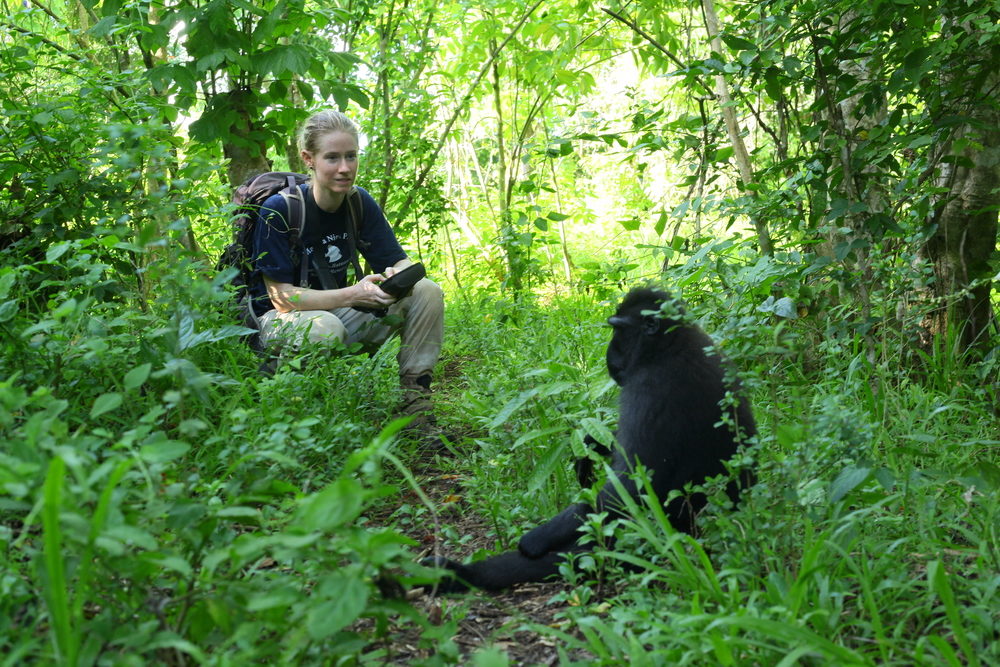
14. Why do you think Chimpanzees and Bonobos did not continue on their evolutionary tract like we did, what caused us to have a cognitive revolution while they didn’t?

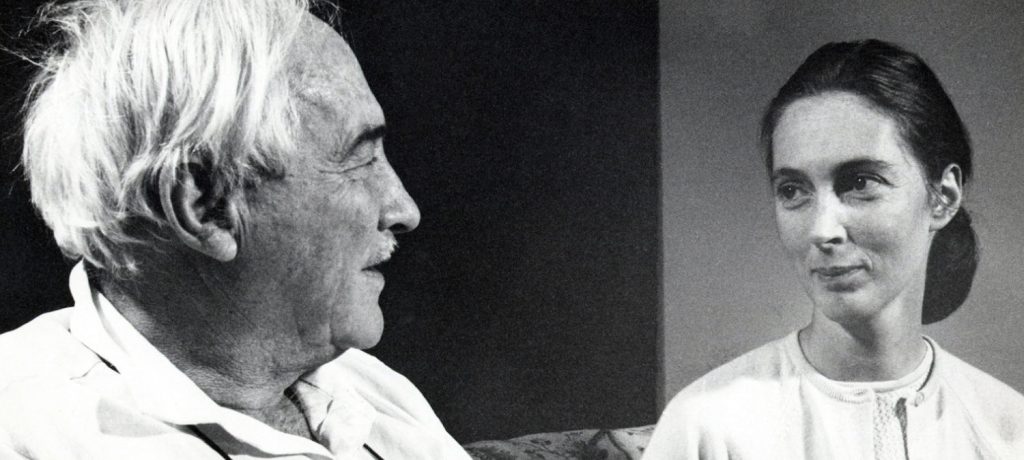
I think Jane Goodall put it so well – despite the rich repertoire of communication in chimps, without a human-like language “they are trapped within themselves”

15.What updates to the Out of Africa hypothesis do you have that you think we should all know?

That there was a not a single line of evolution in one region of Africa leading to us, and that there were several Out of Africa events in the last 500,000 years, as well as (no doubt) some Into Africa ones…

And there you have it! What a wonderful time with Mr. Stringer! A big thank you for doing this interview with us!

If you know someone or are interested in being interviewed, email me at sethchagi@icloud.com and we will see what we can do!

Thanks!

Lee Berger Interview Companion

Hello!

Hopefully at this point in time you have seen our interview with Prof. Dr. Lee Berger (if you have not please do so now) and noticed there were some audio issues with our interview. In order to mitigate that, and to provide more in depth information I am going to write up this companion article to explain not only what is going on in the interview, but to delve deeper into the information provided.

Read this while you watch, before or after either way it will make your interview watching experience that much better! So please use this guide as your resource, and make the interview that much more enjoyable.

You can find the interview here.

To start off the interview, Lee introduces himself, and we begin to discuss fossil sites that he is currently working on and things that are going on in that realm of his work.

We discuss the building and near completion of the new Malapa Museum which will hold discoveries from various localities including Gladysvale and all of the Malapa Hominins.

From there we discuss the Rising Star site, and the work that is going on there. specifically the augmented reality tour.

Then we learned more about some National Geographic expeditions over ten last few years, discovering 600 new cave sites, 200 new fossil sites, FOUR NEW HOMINID SITES AND 6 NEW HOMO NALEDI LOCALITIES!

You read that right! All those new locations and especially and most specially the 6 new H. naledi localities. Lee did not go into detail about what these new sites or localities reveal, but there are just so many possibilities its just an endless enigma. We will have to pay attention and look forward to these announcements coming from Lee and his team.

What has been confirmed, but we know little about, is that these new naledi discoveries give credence tot he deliberate ritualized body disposal of H,naledi, Lee would not go into detail so we do not know much, but when pushed on the subject he did admit there was more evidence to support this theory.

Going back to Rising Star, the team has discovered a new chamber, the Hill Anti-chamber where more discoveries have been made. There was going to be a new expedition to Malapa starting this month, but due to COVID19 it was cancelled.

Getting into the more genetic side of things we began talking about ancient DNA, the likelihood of finding naledi DNA or proteins from sediba. As it turns out we actually have a good chance of getting information from both of these sources.

With modern technology we are going to be able to better date and test the proteins found in the sediba fossils, and ongoing DNA studies are going on with the Homo naledi fossils, although delayed again due to the pandemic.

Nest we go on to discussing the idea of “there was no first for anything”, no first tool maker, no first fire maker, no first this or that. There was no “ah-ha” transitionary moment. We even discuss the idea that all hominids have been tool makers, and that not just Homo habilis was the first.

Are sediba and naledi going on more tours around the world? Well that remains to be seen, as this pandemic continues it is not known what will be safe for these invaluable objects, so only time will tell, but there were plans to send these guys to other places around the world to show them off.

And that about does it for our interview! We hope you enjoyed it as much as we did, it was an amazing experience and I am so thankful to Dr. Berger for participating in this interview. I look forward to many more in the future.

Interview Four: Lee Berger

Welcome one and all to our fourth, but first live video interview!

Today’s guest, is Prof. Dr. Lee Berger, famous for his discoveries of Au. sediba and H. naledi.

A leader in the world of open access education, Lee is pushing the boundaries with his discoveries and the way he educates the world about them.

Join us right here to watch our fantastic interview:

Please excuse any audio quality issues.

If you or someone you know would liked to be interviewed, either live or on paper contact us today and let us know!

Interview Three: Meredith Johnson from The Leakey Foundation

Well here we are! Interview three and one that I know many of you are very excited for as am I! Our inside look and chance to talk to the famous Leakey Foundation! An organization that has done such good for the world of human evolution that it will be logged in the annals of history for all time!

We had the pleasure of speaking with Meredith Johnson, Communications Director at The Leakey Foundation, someone we have been in contact with for a few years now, host of the Origin Stories podcast and general person extraordinaire, she was very happy to provide us with this interview so please, do enjoy.

Above all I hope that you learn something, and possibly even help in the goals of this foundation, goals which are shared by this organization.

Meredith Johnson

Communications Director

The Leakey Foundation

  1. Please take a brief moment to describe your organization and its mission statement. 

The Leakey Foundation is a nonprofit organization dedicated to answering the big questions about what makes us human. 

Our foundation was formed in 1968 by a group of people who were inspired by Louis Leakey. They were fascinated by the research he and Mary Leakey were conducting and they wanted to support them and other researchers. 

Our mission is “to increase scientific research, education, and public understanding of human origins, evolution, behavior, and survival.” We’re working to fulfill that mission in several ways. 

We fulfill the ‘scientific research’ part of our mission by funding multidisciplinary research, supporting graduate students from around the world, and providing emergency funding to keep long-term primate research sites going. We fulfill the ‘public understanding’ part of our mission through things like our lecture series, our free school outreach program that brings scientists into classroom across the United States, and our Origin Stories podcast

2.What is the biggest project that you guys are funding or working on that you can tell us about?

We currently fund around 60 research projects every year. All of them will help add to the world’s collective knowledge about human evolution and human behavior so it’s hard to pick one research project!

One large long term project we’ve been working on as an organization is the project of increasing the number of trained scientists from countries where fossils and non-human primates are located. We’ve been working on this since 1978 through a program called the Baldwin Fellowship. It started as a way of supporting students from Africa who were pursuing advanced degrees in subjects like paleoanthropology, geology, and primatology. The program has since expanded to support students around the world. We think it’s vitally important to empower people who want to study the prehistory or living primates of their own regions.

Another big project we’re working on is the digitization of our archive. We have fifty years of lecture recordings, photographs, papers, grant reports, and more. We are starting the process with our audio-visual collection. We’ve just received our first videos back and we’re excited to get them out to the public soon.

3.What can we do to help the efforts of the Leakey Foundation?

Thank you for asking that! People can help in so many ways. Reading this interview will help, as will following us on social media, listening to our podcast, and telling people about us. Because we’re a nonprofit, donations help a lot.

We are looking to build our group of sustaining monthly donors. If you care about human evolution and science, a small monthly donation will help fund important research, preserve endangered primates, and support students who don’t have a lot of other resources. Every donation will be matched by two generous sponsors so every dollar you give will be doubled!

4. Out of all the famous Leakey fossils, which is your favorite?

They are all so good! My personal favorite at the moment is a beautiful Miocene ape skull discovered by Mary Leakey in 1948 at a place called Rusinga Island. She named it Proconsul at the time (after a famous performing chimpanzee called Consul) but it’s since been renamed Ekembo, which means ape in the Suba language. 

This fossil is about 17 million years old and it was the first ancient ape skull ever found. It’s one of our very, very early ancestors from back before the split between the human lineage and all the other apes. I visited Rusinga Island in January and I stood on the exact spot where Mary Leakey discovered this fossil. It was a very powerful experience.

5. Is the family still involved with the organization?

Richard Leakey and Meave Leakey are members of our Scientific Executive Committee, which is a volunteer group of eminent scientists who review our grant applications and make the final recommendations for which grants we should fund. They’ve been involved in that capacity for a very long time and we are grateful.

6. Do you have any big plans for 2020?

We just launched two new grant programs and we’re excited to award the first of these grants. 

The Joan Cogswell Donner Field School Scholarship will give up to $2,000 to students who want to attend field school. This grant is intended to make field school affordable for people from the countries where field schools are located. 

The other program is the Francis H. Brown African Research Scholarship, a program in honor of the late Frank Brown, a geologist whose research helped establish the timeline for human evolution in Africa. He believed that African scientists should be given the same opportunities as Europeans and Americans to research our shared history. This fund is intended to help expand human knowledge and scientific interest in earth sciences and botany related to human origins by providing financial assistance to East African researchers and students in order to build capacity in the earth and botanical sciences in East African institutions.

7. Do you have any special plans for Origin Stories?

I absolutely love working Origin Stories. Interviewing scientists is the best part of my job because I learn so much and then I get to share it with people through the podcast. 

I’m working on several stories right now, including stories from interviews I recorded during my recent trip to Ethiopia and Kenya. The March episode will be about a group of hunter-gatherers who live in caves in Borneo. They are reaching out to the world for help to preserve their way of life and our podcast has the privilege of being the first media outlet to share their story.

8.Where does the foundation see itself in five years?

We recently celebrated our 50th anniversary. We’ve been funding research and sharing discoveries for five decades and we plan to keep doing what we do best! 

9. How is the Leakey Foundation supporting the education and active work in the field?

We support education in many ways. We have a free program that brings scientists to schools to talk with students about their work and share stories about what it’s like to be a scientist. We also provide public lectures at museums around the country. Our Origin Stories podcast is another educational resource we provide.

We support active work in the field by funding around a million dollars per year in research grants. These grants support paleoanthropology and primatology fieldwork and research around the world. Our funding helps start long term research projects, and it also helps keep them going. 

10. Why should we donate to the Leakey Foundation?

There are so many reasons! The first thing I’ll say is that understanding our history and our place in nature is important for our future as a species.

I can’t think of any other organization that lets you contribute directly to research funding the way we do. When you give to The Leakey Foundation, you are directly funding important scientific research. When the next amazing hominin fossil is discovered, you’ll know that you made it possible. It’s a great feeling. 

Another thing many people may not know is that a donation to The Leakey Foundation helps protect endangered apes and their forest habitats. Ongoing studies of primates in the wild are extremely effective for conservation. Our grants are critical for the survival of our closest living relatives. 

11. Tell us about the recent Australopithecus anamensis cranium discovery.

The discovery was made by Dr. Yohannes Haile-Selassie who is a Leakey Foundation grantee and the Curator of Physical Anthropology at the Cleveland Museum of Natural History. He’s an Ethiopian scientist who is said to be one of the best fossil finders in the world. He works in the Afar region of Ethiopia at a site called Woranso-Mille which he started with funding from The Leakey Foundation. 

In 2016, a local Afar worker named Ali Bereino saw a bit of a fossil sticking out of the ground in his goat pen. He came and told Dr. Haile-Selassie who at first thought it would be nothing, but decided to come check it out anyway. Haile-Selassie realized pretty quickly that there was something extraordinary there. It turned out to be a nearly complete 3.8-million-year-old Australopithecus anamensis skull. This discovery is important for several reasons, one is that it’s from a critical time period in our evolution, another is that it’s the first cranium of this species that’s been found, so it finally shows us the face of anamensis, a species that’s sometimes referred to as “Lucy’s grandmother.”

12. Do you think there is more out there to find?

Absolutely! Just look at the pace of discoveries over the past few years. Denisovans, Homo naledi, the oldest Homo sapiens, and the daughter of a Neanderthal and a Denisovan to name a few! 

There is so much more of our human story, just waiting to be told. Besides finding more fossils in more regions of the world, new techniques are showing how much more there is to learn from the fossils that have already been collected. 

13. What advice do you have for budding paleoanthropologists?

Read a lot and follow your curiosity. Reach out to scientists who do work you’re interested in. See if there are lectures at your local college or museum and try to attend. A lot of these lectures are free and they’re a great way to meet other people who share your interests. 

When it comes time to start a research project, apply for a grant from The Leakey Foundation!

14. Any special events coming up?

Our spring speaker series begins on March 23 in Houston with two lectures from Dr. Dean Falk. One is on the evolution of Asperger syndrome, the other is called “Brain Evolution from Lucy to Einstein.” We also have a talk on April 1 in New York and a film screening in San Francisco on April 21. Our May event in Chicago will be announced soon! You can learn all about these events at leakeyfoundation.org/events

15. What is the main, achievable goal of the foundation over the next decade?

Our work is like a never ending quest for answers to fundamental questions about what makes us human. Every grant we give and every scientist we support contributes to the world’s collective knowledge of our human story and there is always more to learn. This past decade has added thrilling twists and turns to that story. Over the next decade, we will continue the work. We will support scientists from around the world, we will fund their research and share their discoveries.

And there you have it! We oh so hope you enjoyed our interview! If you have any questions or comments please leave them down below!

As usual if you, or anybody that you know of would like to participate in our interview series, please have them contact me at sethchagi@icloud.com and we will get something set up!

For interview number four we will be talking with another institution do extraordinary things for the Anthropogenic community.

Stay tuned!

Seth

A Little Story Chapter Two

Since it seemed some of you liked chapter one and have asked for what I have written since I will post ch. 2. That is all I have written so far and I am deciding whether or not to continue the story.

Please remember this has not been edited as is purely from my head to paper so go easy on me. But let me know what you think.

Chapter 2:

Tactum woke with a start, sweat dripping off his brow despite the cold of the night air. The rain had stopped, and the thunder had moved on, but the sky was still void, and encased in clouds. Tactum sat up, and grabbed his amulet, a figurine of the great mother goddess, all members of the tribe possessed one, as they were carved by their mothers and given to them as a birthright. Tactum’ s was abnormally large, but then it fit his general size fairly enough. 

He looked up, trying to find the light of the moon behind the clouds, but he could not. It was so utterly dark save for the life and light pouring out from the fire that one of the men was keeping alive. 

“My Chief,” the man said, “Is everything alright?” He asked. 

Tactum turned and looked at him, he wasn’t a young man, but he was not old either, a well experienced hunter whom Tactum and come to know well over the years, his name was Hermon, and he was very skilled at the aiming of his spear and rarely missed. This night he was the guard on duty. His vigilance is what protected the group of men for the night, they all trust him with their lives. He was a good man to trust. Mated with a fine women with three children, one with a daughter of his own, he had a growing and happy family. “All is alright,” Tactum responded, “just a bad dream”. Hermon nodded, offering some fresh fish to the large man who sat down beside him to partake. “Tomorrow is going to be an important day,” Tactum said, looking worrisome as he glanced at each of his men. Each of them put their trust and their lives in Tactum’s hands, and he would not fail them. Fate was fate, but he would do everything he could to protect and get his men home. Even if it cost him his own life.

A voice replied out of the darkness, “Yes Tactum, the great spirits will be watching, and they will be guarding us. We have made our offerings and placated the spirits. I have flown on the wings of the great owl and have seen our success tomorrow,”. Nanak spoke. 

The rest of the men began to stir, and before Tactum even realized it, the sun was rising in the east, barely glowing over the great mountain range to their east. Within an hour all of them men were up and packed, ready to go. Today was the day, the day of the hunt and each man was as prepared as they were going to be. 

Nanak spoke to each man individually, blessed them and gave them the protections of the spirits, when he came to Tactum he said, “It is time my leader, we are here to serve our people, and the spirits of our ancestors, at your command we go.” 

Tactum climbed atop a large boulder, and faced his men. In a loud projecting voice he called to them. “You have all been with me since I became the leader of our tribe. You have all been loyal to the end and I trust each of you with my life, and the life of my family. Today is an auspicious day, and a dangerous day. We have beseeched the great caribou spirit, and our spiritual leader Nanak says the signs are good! So we move forward with our hunt, remember the plan and do not take any unneeded risks. Your life is more important than some meat”. He turned and stepped down from the boulder, using his spear for support. 

The men all gathered around him, placing their hands somewhere upon him. They took a moment of silence, and then began chanting, in an old and ancient voice. The evoked the spirits, and called upon them for their aid, the began yipping and yelling, dancing around their chief raising and lowering their spears in a rhythmic matter. Then suddenly they all stopped, got in a single file line, and followed Tactum forward out of the little gully in which they spent the night. 

The walked for a few hours, slowly and quietly following the tracks which became more and more clear. Soon they could see the end of the woods into a beautiful clearing. With green grass stretching knee high and wild flowers abound, bees bussing in the air, the men slowly made their way forward. 

Slowly.

Quietly. 

Then they saw them, the great and majestic caribou. The spirit animal of the tribe. Strong, independent and yet apart of, and integral to the general family unit. The caribou had been the leading food source for the tribe for as far back as the memories went. Each year they could be depended on, and they had never failed, and here they were again. Standing in the field before them, near a bristling brook was the herd.  

Ten thousand strong they were, great and majestic beasts to the last of them. The goal of the hunt was to kill, and butcher as much meat as they could carry back on their backs. It didn’t take much, but their spears were thin, fast and agile. Meant to be thrown. The hides of the caribou are thick and hard to penetrate. It makes for a difficult, albeit worth it problem to overcome. It would take a few well placed spears to take down a buck. But that is why each hunter always carried around three spears with them, and each of them knew how to make more in the blink of an eye, given the right materials of course. 

The men sat there in the grass, waiting and observing their prey. Looking to see for any weak links in the herd, be they young or elderly, but they were mostly kept in the middle of the mass of fur and flesh. 

The meadow that they were in, was located at the bottom of a valley, at one end of the valley stood a mighty waterfall, blocking all travel inwards and outwards from the valley at that point. On the opposite side, the valley opened up and leveled out into a sea of beige grasses culminating in great plaines, speckled with the rare tree here or there. The men were in the middle of the valley. Where it was lush woodland and grassy meadows. Nears by there is a large lake that overtakes one with its beauty as they stumble out of the high mountains or woods upon it. But the men were not here for the scenery. 

Tactum motioned for three of his men to go one direction, and three more in the other while he and three others went down the middle. So far they were down wind and the mighty beasts and no idea that they were there or what was about to happen. As they got closer the tension began to build. 

Tactum knew that one of two things would happen when he and his men kept from the brushes. The caribou would either break formation and run for their lives, thinking of nothing but their individual lives, or they would stick together, placing the strongest on the outside of a ring of horns, and give a fight for their lives, and the lives of their offspring and mates. If he could get them to break and run, they could target animals individually to take down, and it was a much easier affair, but if they refused to flee it would become a battle of wills. And the hunters would be hard pressed to capture anything. 

The men all took a collective deep breath, one last time before the plunge. Tactum raised his spear so that even over all tall grass everyone could see it. He stood abruptly, yelled and charged forward. Casting a spear into the great herd of beasts. His other men joined him, screaming and yelling as they came up, all throwing their first set of spears to hit or injure one of the animals. 

At first they did not know what to do, caribou were running in all directions, one of them had already been taken down as they formed up their phalanx. You could see the spears sticking out of the backs of some of them, proclaiming them as future targets. But with them all on the same side now things would get a great deal more difficult for the hunters. Tactum gathered his men to reassess the situation, as they decided what to do the caribou carefully watched them from across the meadow. Their numbers filing deep into the woods behind. 

The men knew that if they could scare just one of them out of formation there was a chance they would all break and make a run for it, leaving them wide open to attack. This is what they decided to do. 

They searched their enemy, looking for any sign of weakness or opening that could be exploited. The wall of horns was intimidating, and the caribou knew how to use them. But suddenly, Rikoo shouted. “That one! That one there!” They all looked, and there at the far left of the herd was a single beast with a limp. it was obvious, it was barely putting any weight on its leg. Anyone who saw it could tell immediately. They knew what to do. 

The men slowly began to head towards the injured caribou, slowly encircling it. The others started to snort, their breathe visible in the cold air. Hoofs started to beat against the ground and a dust rose in the air. On the count to three, the men through their spears in the direction of the injured animal. They did it. The animal fell to the ground with a loud thud and the herd scattered. Running in all directions, the men took them down and claimed victory!

Finally they were going to bring home well deserved and much needed meat back to their families. 

Suddenly, as they congratulated each other and patted each other on the backs the ground wrenched and dropped below them, then tearing them to the side throwing them off their feet. In the distance, towards the east the mountains had changed, one of them was gone, and in its place a column of smoke larger than anything any of the men had ever seen before. As if there was a fire lit by the spirits themselves. There was a great sound, and all of the men, who had not already, fell to the ground. The earth shook again, and more ash spewed from where the great mountain top had been, it blocked out the great flame, and soon ash was falling upon them. The sky drew dark, as the men gathered together shivering in the absence of the sun. 

In the distanced they could see red bolts of lightening spewing from the dark clouds in the distance. For some time none of the moved, or spoke. Here and there the ground would shake once more. Tactum looked on in astonishment, not sure what to say or do. Nanak was on his knees beseeching the spirits, but it was probably hose spirits cursing them now Tactum thought. 

They could not tell whether it was day or night, as the great flame had disappeared from the sky much earlier than it usually did, and there was no moon to be seen, or stars, or anything. It was hard to see ten feet ahead of you the ash and pyroclastic material in the air were so thick. The men were coughing, choking even. 

Tactum knew that he and his men could stay there no longer, they needed to get to clean air, they needed distance or high ground. He was not sure which he could provide first, and since the stars were veiled, they were of no help. The landscape was not the same as it was the morning before and he could barely tell where he was or in which direction he was facing. 

“My brothers!” He called out. “We cannot stay here! We must gather what we can and try to make our way back to the village! And hope this plight has not made its way there!” The men agreed and began to pack up and gather their things, they were sure not to forget the meat either. They started back out just as they had come in, in the dark. But it was an unnatural dark, and as they continued on more and more of them began to cough and show signs of slowing. 

Tactum was not sure if they would make it back to the village. The consistent shaking of the ground did not help to bolster their moral, and even he was close to cracking. But Kankut and his support kept him going. When one of the men, Ketel, fell to the ground, they decided it was time to make camp. They could not tell what time of day or night it was but they were all exhausted, and now some of them were sick. It was time to rest. 
My Birthday & the Leakey Foundation

Hello one and all!

I am very excited to tell you all that I am doing something special for my birthday (which is March 2nd) this year.

I am starting a fundraiser on Facebook to raise money to donate to none other than the Leakey Foundation!

The mission of The Leakey Foundation is to increase scientific knowledge, education, and public understanding of human origins, evolution, behavior, and survival.

This institute is world renown for their work in the field of human origins. So it is in that spirit and the spirit of furthering science that I decided to do this. I am very excited!

Just wait I have not even gotten to the beat part! When the Leakey Foundation got wind of this one of their donors decided to match all my donations! So every dollar donated becomes two!

Don’t pass up this great opportunity to contribute to education and the world of science donate today: https://www.facebook.com/donate/641850339695658/?fundraiser_source=external_url

Interview Two: John Bavaro

Welcome to our second interview in our new interview series! We have a-lot of great organizations and individuals coming forward wanting to participate!

Today we are graced by the presence of Paleo Artist John Bavaro.

John Bavaro, teaches illustration at Edinboro University of Pennsylvania. He’s published works that have appeared in BBC, BBC El Mundo, The Guardian, Current Biology,  Science Source, Science Photo Library and at nutcrackerman.com.

His art can be seen here, and here.

  1. What has been your favorite hominid to work on? 

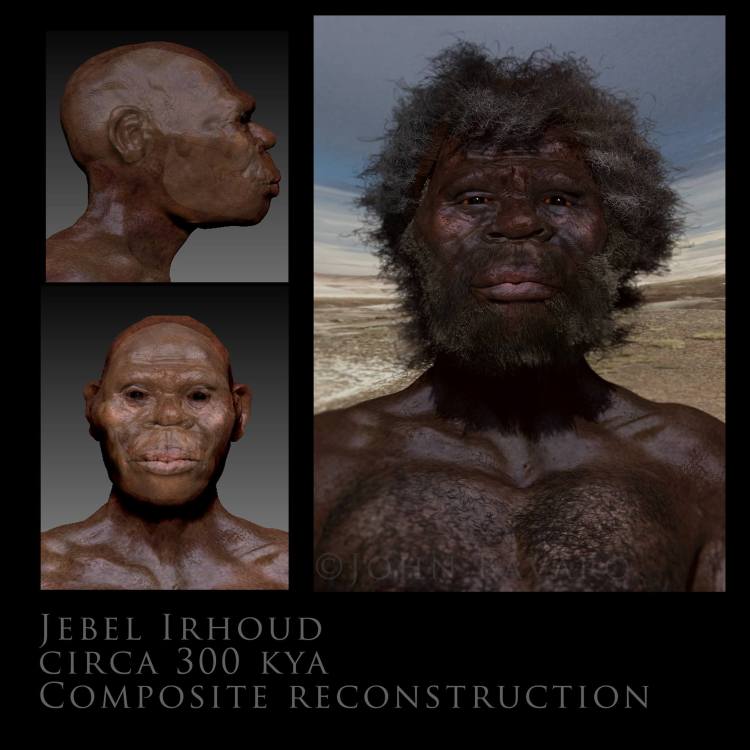
I loved doing the archaic Homo sapiens from Jebel Irhoud which was just revealed last year.


Because first of all I had to construct the (skull imperfectly I might add), but what it revealed to me was incredible because I immediately saw a connection with the with the earliest Homo sapiens which were the first modern humans, the Australia Aboriginals. Maybe it’s just me wanting to read connections in faces, but I seriously saw a connection when I began to construct the face, the hair etc. between the ancient and modern. For me it spoke of the diversity of humanity. A lot of people respond to this image (Jebel Irhoud), I don’t know why but it seems to resonate with people on some level.

2. Which has been the most difficult?

Believe it or not Turkana Boy, because he was young but “almost human”. Obviously, humans lost body hair by then, contrary the historical descriptions and images of Homo erectus and how they been envisioned in the last half century. Like the famous image of the “progress of man”. You know the one that starts with a monkey and ends with a human with modern sapiens? Artists have, till recently, a pre-conception about what these species looked like and they tend to do them all into the same light pigmented skin tones, losing hair gradually, even though light-skinned people didn’t come about until very recently. And their gait didn’t change so radically like in the picture. I think generally with the knowledge base of today’s artists, we collectively have a “responsibility” to get it right.

At least that’s what I tell myself. I know that a lot Paleoanthropologists think even trying to depict them is folly, and maybe they have a point, but people are hard-wired to imagine a face with the bones. At least in the popular imagination

For me, with Turkana Boy, I took an informed guess at it. It’s was a challenge, but it’s also a burden to get it right because once I’ve published it then it’s out there. Turkana boy was eight years old. What was the did an eight-year-old Homo erectus look like? Is it the same as us or not? There’s various schools of thought about that and I studied hard to find out the truth about it and I decided on both the skin tones, the what he would have truly looked like, the hair etc. But I don’t know exactly.

3. What is something they all have in common?

Their hips, which is quite remarkable and that’s what sets as a part as proto-humans-the ability to walk upright. I think that people have misunderstood evolution “that we came from apes”, which is ignorant and understandable at the same time because we did have a common ancestor, one which was so far removed from apes. Think about it, orangutans are 16 million years removed from humans, chimps are 7 million. So we were much closer to Australopithecus’ then we are to chimps. I think that’s something that layman, (myself included) tend to forget. That’s why human evolutionary studies are so important yet sadly so neglected. I think it is fascinating and why we don’t care where we came from or have an issue with human evolution because of biblical myth. That is ignorant.

4. In short, what is your process?

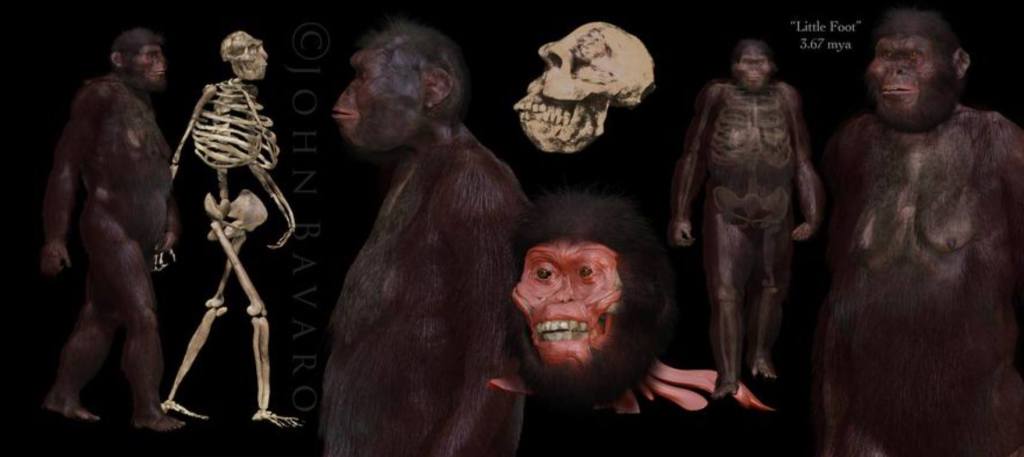
I work in a program called Zbrush which I am self-taught. I am getting better but there’s a lot to learn and a lot goes into it especially in the hair. It’s funny that sometimes I have a template that I can stretch the forms around a pre-existing model. Like Lucy and “Little Foot”, but it still takes me a week or two if I really want to focus on the proper dimensions and research the climate, their milieu, research about currently scholarship. It’s not the same as for instance as John Gurche, Kennis and Kennis, Elisabeth Daynes whose works are all is incredible. Because they construct the forms muscle by muscle over the skull. It’s quite remarkable and humbling for me when I look at their work. What takes me a week do took them six months or year. That’s the gift and the curse of working digitally.

5. Can we get any hints to your next project?

I’m currently doing a diorama of two Neanderthals hunting Wooly Rhinos. That’s taking me a lot of time because I had research the position they took when they threw a spear, like the stretch and the strain of the muscles etc. Which is more dynamic than a simple standing pose. Also the focus that I wanted to put on it, such as the depth of field, the environment that I used which was Alaska from a picture that I took. I’m also a painter and the time that I spent on doing this piece I could’ve painted it just as quickly. But I’ve also had my dominant hand compromised by a stroke I suffered from a ruptured carotid artery. While I can draw quite well now using my left hand, painting for me is still a challenge. Luckily, even with my struggles with aphasia and my compromised hand skills, I still can do digital art quite well.

6. Where do you see the field in the next decade?

Wow, that’s difficult to say. I am a teacher first and an illustrator second. Although I teach at the college level so it’s not mutually exclusive (publish or perish) they say. But I am also teaching graphic novel so I’m currently working on a graphic novel at the same time. Too many projects! It’s funny that when a Paleoanthropologist reveals discovery, there’s suddenly a “buzz”. I try to respond to it responsibly and quickly to the best of my abilities. I am currently represented by Science Library. They send me a request and sometimes its up to people to pick it up and use it and sometimes they don’t. Even though I say, “Oh this one’s going to be great”. It’s almost random how the internet picks something up and runs with it one image that I thought was really going to takeoff didn’t, piece that I was hoping to go viral didn’t. Right now I’m just enjoying doing models and sharing it with people. About the field, it’s a remarkable time to live with new groundbreaking discoveries are revealed almost weekly, churning up the old order with discoveries that revealed maybe were older than we think or maybe Neanderthals did have DNA coming out of Africa or first humans actually migrated from Eurasia. This just is a sample of the current dialogue. For my part I just “bring the popcorn” and draw. Science is by definition positing a thesis and setting out to prove it or disprove it. I like to think that my work is the same way. Even if it’s wrong I’m still following the scientific method- exploring, observing, and answering questions.

Stay tuned for the next interview! If you’re interested in being interviewed, or know someone who is, have them contact me at sethchagi@icloud.com and we will see what we can do! 

Thank you! 

A little Story

One of my biggest hobbies, aside from learning and reading is writing. I love writing on all kinds of subjects from the scientific to the political. But despite all that, at heart I am a creative writer.

I have had writers block for a while now when it comes to the creative side of things until tonight. Here is chapter one of a story that I just started. I have no plans to work on it more or continue it, but if I do I am just going to go where the writing takes me.

If you like this and think its good, be sure to let me know by liking this post so it gives me motivation to continue it!

If you dont like it, well oh well. You can deal with it.

This has not been edited for grammar or spelling mistakes so go easy on it.

Let me know what you think and if I should continue this or not!

Chapter One: 

The dark gloomy clouds moved overhead as the small band of hunters made their way through the valley. As the day wore on and as the great flame began to sleep the small group found shelter and made camp for the night. 

It had been two days since they had left the tribe, and it had been a rough two days at that. Storms and wild animals causing unpredicted delays. They should be days from here already, and the tracks of the caribou grow old and the path harder to follow.

“What should we do?” Asked Kankut, the advisor and best friend of the chief of the village, the one who led the hunt, Tactum. He looked grim, and likely knew the options that lay at hand but just did not want to mention them. They needed this hunt to be a success, the survival of the entire tribe depended on it. It had been a rough winter and as the snows thawed the flowers sprung, the hunger began to arise once again. 

“What we always do,” Tactum grumbled. “We will go on”. There was nothing else for it, either they turned back and empty handed to slowly starve with their families, or they pushed on until they found a suitable supply of food to bring back. While the journey was dangerous and some o them would not make it back, and they all accepted this, it was still more honorable than leaving ones family to fall to the dark grip of hunger.

“But we can barely follow the tracks, which way are we to go?” A man asked, Rikoo, it was his first hunt. Brave, and full of himself at the ripe age of thirteen Rikoo thought the world was under his foot, little did he know how small he was in the scheme of things. Something he would learn soon. 

As they got the fire started and got sleeping furs spread around it, light but big drops of rain began to fall. Making a soft, and soothing sound among the trees that surrounded them. While winter had just ended it was still very cold out at night, especially with how high up in the mountains they are, but with the fire, their sleeping furs and regular clothing, they would stay warm enough until the great flame rose once more. 

Tonight the hunters would be sharing a feast of three conies and two salmon caught from the river. For the ten of them, it was enough. Nothing special, but it was enough. The moon shown bright, as it was near its zenith and the men stayed up late into the night guided by the light of the great moon god, carving and telling stories. 

This group of ten was a tight knit group, ones who did everything together, and went on these long hunting trips, together with nothing to rely on but themselves, they quickly would become like brothers, despite the womb who bore them. A link that only hunters understood would form, and there was nothing else like it. 

“Tomorrow we will follow the river farther west, and then go north, that is where it think the heard is headed, I know of good feeding grounds up in that area, it will take us about two days to get there,” suggested Timuk, the star tracker who guided the men on where to go and when. 

“Agreed Timuk,” Tactum said, “I know of this hunting ground and I agree the caribou have made their way up the there.” He continued nodding.

A branch cracked, and all of the men immediately stood up, spears in hand and put their backs towards the fire, towards each other. One of them made a shushing sound. 

It was silent, not a noise to be heard in the woods, it was eerie, too eerie.

The men began to relax, one of them sat back down. A bolt of lightening ripped across the sky as the rain intensified. Others began to sit back down but not Tactum or Timuk, no they stood as silent sentinels guarding their men from what lurked in the darkness. Eventually they too sat back down, and eventually after designating a set of men to watch over the hunters for the night, found some hard earned sleep. 

The men rose with the great flame, gathering all of their things they were ready to go shortly after rising. Just as planned they began to follow the river, and after a half a days journey the came upon something that gave them all hope. Tracks. The caribou tracks had returned! They made the right decision! Soon just as their ancestors had done for beyond memory, they would hunt the great beasts to bring food and skins back to their people to prepare them for the next winter.  

On the night before they would come before the great heard, the spirit talker Nanak did a great ritual. To bless the men and keep them from harm. He invoked the names of the great spirits of earth and sky, and asked them for their blessings. Slicing each others hands, they all made a blood sacrifice to the great spirits, to protect one another, and to die for one another if need be. No hunter left behind. The ritual lasted a good part of the night, but left them plenty of time to sleep and prepare for the great hunt in the morning.

While some of them slept easily, others tossed and turned, anxious and afraid or too excited to sleep the men patiently waited for the sun to rise, and for the rest of their lives to begin.