For years, this site has been the home for our deep history explorations. However, in the spirit of finding a better “flow” and maintaining the clarity needed to balance a very full life, I’ve decided to move all future long-form content and updates to a new home: Deep History on Substack.
Why the Change?
If there is one thing that graduate research and Stoic reflection have taught me, it’s the importance of removing unnecessary friction. Between my MA thesis work at IPT, my responsibilities at Spirit Trucking, and—most importantly—being a father to Avery and a partner to Kota, time is my most precious resource.
Managing a full website backend often feels like trying to excavate a site with a spoon—it’s possible, but it isn’t efficient. Substack allows me to focus entirely on the writing and the science, delivering it directly to your inbox without the technical overhead. It’s a cleaner, more structured way for me to share my research and for us to stay connected.
What to Expect
The mission remains exactly the same: keeping complex science accessible, ethical, and engaging. By moving to the new platform, you can actually expect more frequent updates, including:
MA Research Updates: Deep dives into my current work on Neanderthal symbolic behavior and the evolution of art.
Life in Portugal: Observations and updates from Mação and my work with the Geosciences Center (CGeo).
The Story of Us & #PaleoPostPodcast: Centralized links and context for all my SciComm projects.
Deep History Insights: The same rigorous, non-sensationalized look at our human origins that you’ve come to expect from WOPA.
Join Me There
I’m not going anywhere; I’m just moving to a better lab. I would love for you to continue this journey with me. It’s the simplest way to ensure you don’t miss any of the new discoveries or updates coming this year—especially with the Indonesia trip and the June visit from my family on the horizon.
Follow the link below to subscribe and stay updated:
In the study of human origins, few things are as evocative as rock art. It is the visual record of the evolution of the human mind. However, keeping up with global developments in this field can be a challenge for researchers and enthusiasts alike.
Today, we are excited to introduce The 1902 Committee, a new Open Access initiative designed to aggregate, curate, and share rock art news from around the world.
A Global Clearinghouse for Rock Art
The 1902 Committee serves as a digital magazine and journal. We recognize that rock art is a global phenomenon, and our mission is to provide a platform where news from diverse regions can coexist. From documentation projects to new dating breakthroughs, if it involves art on stone, you will find it here.
Our Commitment to Open Access
Consistent with our values at The World of Paleoanthropology, the 1902 Committee operates on an Open Access model. We believe that information regarding our collective cultural heritage should be:
• Accessible: No paywalls for the public.
• Ethical: Focused on the respectful preservation of symbolic sites.
• Timely: Providing a quick turnaround for news and updates.
Get Involved
We are currently in the launch phase and are building our digital community. You can support this new resource by:
1. Following us on Facebook to get real-time news updates.
2. Staying tuned for our first formal call for contributions.
3. Sharing our mission with fellow researchers and students.
One of the quiet truths of academic life is that confusion is rarely caused by a lack of intelligence.
More often, it’s caused by overload.
Students drowning in literature they were never taught how to read.
Researchers buried under jargon they didn’t invent but are expected to wield fluently.
Educators and museums trying to communicate meaningful work to the public while navigating institutional caution, limited time, and shrinking resources.
Over the years—through research, teaching, public outreach, and The World of Paleoanthropology—I’ve watched capable, thoughtful people stall not because they lacked ideas, but because they lacked structure, framing, and translation.
Complexity Is Not the Enemy
Science is complex because reality is complex. That’s not a flaw—it’s the point.
But there’s a difference between complexity and obscurity.
When ideas are buried under unnecessary density, two things happen:
The public is excluded from knowledge that directly concerns them.
Students and early-career researchers mistake confusion for inadequacy.
Neither outcome is ethical. And neither is inevitable.
What “Support” Actually Means
When people hear “academic support,” they often imagine shortcuts or compromised integrity. That’s not what I’m talking about—and it’s not work I will do.
The work I care about lives upstream from writing:
Learning how to read academic papers strategically
Understanding how arguments are structured
Clarifying what a project is actually about before trying to present it
Translating research for public audiences without flattening nuance
This is scaffolding, not substitution. The thinking stays yours.
Why This Matters Now
We’re living in a moment where public trust in expertise is fragile, attention is fractured, and misinformation spreads faster than careful explanation.
Clear science communication isn’t optional anymore. It’s part of the responsibility that comes with producing knowledge.
And inside academia, clarity is survival—especially for students and adjuncts navigating systems that rarely pause to explain themselves.
Opening Space for Thoughtful Collaboration
I’m opening a limited number of collaborations with:
undergraduate and graduate students
researchers at any career stage
educators and museum professionals
small organizations doing public-facing science or heritage work
The focus is always the same: clarity, ethics, and respect for complexity.
I keep this work intentionally limited so it remains careful and human. If you think this kind of support would meaningfully help your work—or the work of your organization—you’re welcome to reach out.
Good ideas deserve to be understood.
That’s not marketing. It’s stewardship.
Please feel free to email me at worldofpaleoanthropology@gmail.com to learn more, and get in touch!
Recently, archaeologists uncovered evidence in the UK that early humans might have been using fire hundreds of thousands of years earlier in Europe than we previously believed. This discovery adds a fascinating new layer to our understanding of how our ancient ancestors mastered this transformative tool.
A Tale of Two Sites: Wonderwerk Cave and the UK Find
In South Africa, Wonderwerk Cave has long held the title for some of the earliest evidence of human-controlled fire, dating back around 1 to 1.5 million years ago. This African site shows that hominins had mastered the use of fire incredibly early, giving them advantages in cooking, protection, and warmth.
The new UK discovery, while not as old, suggests that by the time hominins reached Europe, they were using fire much earlier than we thought. Likely, this was Homo heidelbergensis, an ancestor of Neanderthals and modern humans, who might have carried their fire-making skills with them from Africa into Europe.
Carrying Fire Across Continents
What’s fascinating is the idea that early humans didn’t necessarily have to rediscover fire in each new place. Instead, they could have passed this knowledge along as they migrated. This paints a picture of ancient humans as not just tool users, but as early innovators spreading technology across vast distances.
Conclusion
In summary, the new UK findings add another chapter to the long and fascinating story of how our ancestors mastered fire. It’s not about reinventing the wheel, but about how early humans carried their innovations with them, lighting the way—literally—into new lands.
AI is now part of my toolkit for science communication, just like cameras, editing software, and drawing tablets.
It’s not a replacement for scholarship, and it’s not a magic oracle. It’s a tool I use carefully to share deep history with more people, more clearly.
This page explains:
Why I use AI at all What I do and don’t use it for How I handle accuracy, ethics, and artists’ labor Where I draw the line and how I plan to evolve these practices
I’m laying this out because I care about both truth and trust. If I’m asking you to take my work seriously, you deserve to know how it’s made.
1. Why I Use AI in Science Communication
My work sits at the intersection of:
Human origins and deep history Public-facing education and outreach Limited time, limited funding, and a lot of ideas
AI helps me:
Translate complex research into accessible language Create conceptual visuals quickly (when I don’t have the budget or time to hire an artist) Experiment with narrative and visual formats that might reach people who’d never pick up an academic article
I use AI to amplify my ability to communicate—not to replace critical thinking, scholarship, or human creativity.
2. What AI Images Are (and Are Not) in My Work
What they are
When I use AI-generated images in posts, talks, or social media, they are:
Conceptual / illustrative: visual metaphors, mood pieces, or stylized depictions meant to support a point, not stand in as literal data. Tools for engagement: a way to grab attention so I can then talk about fossils, methods, uncertainty, and real evidence. Clearly my responsibility: I treat every image I publish as something I am accountable for, regardless of the tool that helped generate it.
What they are not
AI images in my work are not:
Fossil evidence Direct reconstructions of specific individuals or species (unless clearly stated as such and based on referenced work) Substitutes for actual site photos, artifact images, or primary data
Whenever I show a real fossil, site, or artifact, I aim to:
Use actual photos or well-documented reconstructions Label them as such Keep AI out of that part entirely or clearly separate it
3. How I Handle Accuracy and Misrepresentation
AI is very good at making things that look plausible and very bad at knowing when it’s wrong.
To avoid misleading people:
For images
I don’t present AI images as literal, data-level reconstructions unless they are explicitly grounded in referenced research. When an image is AI-generated, I: Treat it as concept art, not evidence. Avoid “overconfident realism” that might confuse viewers about what we actually know. Add clarifying text in captions/posts when needed (e.g., “conceptual illustration” or “AI-generated conceptual scene”).
For text
I use AI tools to: Brainstorm structure Simplify wording Draft accessible summaries I do not use AI to: Fabricate sources Invent data Replace reading the primary literature
At the end of the day, I am responsible for the claims, citations, and interpretations. AI is a drafting assistant. The judgment is mine.
4. Artists, Labor, and Why I Still Support Human Creativity
I take seriously the concern that AI systems are trained on massive datasets that include the work of human artists who were not asked for consent.
My current commitments:
When I can hire artists, designers, or animators, I do, and I’m happy to credit and pay them. AI visuals are a stopgap, not my ideal state. They fill the gap when: Funding is limited Turnaround is tight The alternative is “no visuals at all”
I’m also open to:
Collaborating with artists who want to build AI-informed but human-led projects Updating these practices as the legal and ethical landscape evolves (e.g., models trained with explicit consent, more transparent datasets, better protections for creators)
If you are an artist with specific concerns—or interested in collaborative work—reach out. I’d rather have a real conversation than argue via comment sections.
5. Transparency and Labelling
Transparency is the minimum ethical standard for using AI.
My commitments here:
If an image is AI-generated, I will: Treat it as conceptual Label it clearly where the context could confuse people If text heavily involves AI assistance, I will: Maintain final editorial control Ensure all claims are checked against real sources Make clear, when relevant, that AI was used in the drafting process
My goal is that a reader or viewer should never have to guess whether something is evidence or illustration.
6. Respect, Harm Reduction, and Sensitive Topics
Working in human origins and deep history means I touch on:
Human remains Past populations who have living descendant communities Themes of race, identity, and humanity
My AI practices sit inside a broader ethical framework:
I do not use AI to: Generate sensationalized or disrespectful images of past or present people Create clickbait around trauma, colonization, or genocide When material involves human remains or descendant communities, I aim to: Stay grounded in respectful, accurate representation Avoid dehumanizing or “monsterizing” depictions Prioritize clarity about what is known, what is hypothesized, and what is imagined
AI is not an excuse to be careless with human stories.
7. Continuous Revision: This Is a Living Document
AI and its ethics are moving targets. The point of this page isn’t to claim I’ve solved it once and for all. It’s to:
Make my current principles visible Give you something concrete to critique or discuss Hold myself publicly accountable to better standards over time
I expect to revise these guidelines as:
New tools emerge Better ethical frameworks develop I learn from colleagues, artists, students, and community members
If you have specific, constructive concerns—for example:
“This image misrepresents X fossil because…” “This caption could mislead people about what we actually know…”
—then I’m very open to hearing them. Vague “AI bad” comments are not very actionable. Concrete critique is.
8. Summary: What You Can Expect from My AI Use
If you follow my work, here’s what you can expect:
AI is used: To brainstorm and draft text, which I then edit and fact-check To generate conceptual illustrations and memes that support educational content AI is not used: As a replacement for reading the literature As a source of data or evidence To make unlabelled “realistic” reconstructions that blur the line between concept art and evidence I aim to: Be transparent about AI use Avoid misleading audiences Respect human creators and communities Update my practices in response to well-founded critique
If we’re going to tell the story of us—humans, in all our weird, ancient, creative glory—then the tools we use should be handled with care, honesty, and a willingness to improve. That’s what I’m committing to here.
Rock art is one of the most enigmatic yet expressive forms of communication preserved from the Palaeolithic. Meanings remain debated, but the places and conditions in which images were made offer disciplined clues. This paper examines a spiral engraving in the Ocreza Valley in Portugal, set above a stretch of river where the rapids form a visible and audible swirl. I advance a working hypothesis: the Ocreza Spiral records a local soundscape, a river mark that draws attention to the turbulent flow below and may have carried a cautionary or mnemonic role. Rivers have distinctive acoustic signatures shaped by hydraulics and bedforms, and rapids produce stable roars that carry over distance (Pijanowski et al., 2011; Tonolla et al., 2011; Geay et al., 2019; Tatum et al., 2023). Comparative work shows that images and monuments often occupy places with unusual acoustic response, whether echoing gorges or roaring falls (Díaz-Andreu and García Benito, 2012; Mattioli et al., 2017; Goldhahn, 2002). Grounding the discussion in the Tagus and Ocreza corpus keeps the interpretation regionally anchored (Danelatos, 2022; Nash and Garcês, 2023). While the spiral is not the only engraving at the locality, its abstract form invites a sensory reading tied to water motion and sound. The paper introduces soundscape ecology, sets out parallels between rock art and watery acoustics, and proposes testable predictions for further study.
Background: Listening to landscapes
To ground the argument, a soundscape is the experienced acoustic environment of a locality, shaped by geophony, biophony, and anthrophony, and sometimes anchored by distinctive soundmarks (Schafer, 1994; Pijanowski et al., 2011). People often represent such place-specific sounds in marks or monuments in deep history and in living cultures. The Ocreza Spiral may be one of these records. Its form mirrors the eddy below the panel, and its placement overlooks a reach of river where rapids produce a persistent roar. Read this way, the spiral works as a river mark, a visual cue to a distinctive sound that signalled turbulence and focused attention on a memorable stretch of water (Tonolla et al., 2011; Tatum et al., 2023). Rapids and riffles create recognisable acoustic spectra that carry over distance, and their loudness and timbre vary with slope, bed roughness, air entrainment, and discharge (Geay et al., 2019; Tatum et al., 2023). A rapid can be heard before it is seen, which helps explain why such places invite marking. Studies of temperate freshwater soundscapes show a diverse acoustic milieu that would have framed such experiences (Rountree, Juanes and Bolgan, 2020). Archaeoacoustics shows that images and monuments often occupy locations with striking acoustic responses, including echoing gorges and roaring water, which suggests that what was heard helped decide where people made and used marks (Díaz-Andreu and García Benito, 2012; Mattioli et al., 2017; Goldhahn, 2002). A sensory reading is a complement, not a replacement, for other interpretations. Spirals and circles can also mark paths, altered states, or solar ideas. The claim here is modest. If spiral and circular signs tend to cluster near water features with distinctive acoustic qualities, then a river mark reading gains plausibility and becomes testable in the Tagus and Ocreza system and beyond.
Acoustic setting in rock art
By acoustic setting I mean the way a site’s sound behaviour shapes where images are placed and how they are experienced. Many rock art locales show pronounced resonance and echo. Studies in painted caves report that images concentrate in places with marked resonance, which implies that acoustic properties helped guide placement (Reznikoff and Dauvois, 1988). In open air gorges and along cliff lines, field measurements likewise show that panels coincide with strong reflections. Work in La Valltorta and the Central Mediterranean identified echo hotspots that match the distribution of imagery (Díaz-Andreu and García Benito, 2012; Mattioli et al., 2017).
Watery places are especially potent acoustically. Rapids, falls, and lake cliffs produce powerful geophony that draws attention and activity. Scandinavian and Finnish datasets show dense imagery at sites where water roars or echoes, which supports the idea that water sound helped structure where people made and used marks (Goldhahn, 2002; Rainio et al., 2025). These conditions aid audibility at distance, create rhythmic cues for performance, and produce call and response effects that make places memorable. Archaeoacoustic work applies repeatable measurements and modelling to such settings, from on site impulse responses to physical and digital reconstructions (Watson and Keating, 1999; Cox, Fazenda and Greaney, 2020). Not every cluster is acoustically driven, and present day acoustics may differ from past ones, so these links should be proposed as testable rather than assumed. Within this frame, the Ocreza spiral sits above a turbulent reach that produces a persistent roar, which makes an acoustic reading plausible and worth testing in the Tagus system.
Spirals, eddies, and water symbolism
Spiral motifs occur across Atlantic and Iberian traditions, yet meanings vary. I ask whether the Ocreza spiral indexes a local water phenomenon, specifically the eddy visible and audible from the panel. Regional syntheses set out the range of readings in Portugal and the Tagus basin and help anchor this discussion in local corpora (Bradley, 1997; Nash and Garcês, 2023; Danelatos, 2022).
Spirals, concentric circles, and cup and ring designs form a related family that supports several interpretations. Any water reading should remain a working hypothesis alongside solar, path, and trance explanations, and it should be weighed against site context and motif associations (Bradley, 1997; Nash and Garcês, 2023).
Why consider water here. Eddies generate rotating foam lines that trace a spiral planform. From the stance above the rapids the visible swirl matches the carved geometry, and the same reach produces a persistent roar that people could hear before they saw the water. That kind of recurrent sound functions as a soundmark and helps explain why such places invite marking (Schafer, 1994; Pijanowski et al., 2011; Tonolla et al., 2011; Tatum et al., 2023).
Comparative evidence shows that makers sometimes shaped grooves or basins so that water could enter or pass across carvings, and several authors link circular marks to water behaviour and watery places, though not in every case (Wikman, 2022; Bradley, 1997). This does not prove that spirals equal water everywhere, but it makes a cautious water reading reasonable when a motif sits beside turbulent flow that is both seen and heard.
There is also a performative angle. Carving a spiral asks for a continuous turning motion that echoes the gesture used when pointing out a swirl. The motif can be indexical of flow and meaningful in practice, linking body, water, motion, and memory during making and use.
The water reading should be tested with simple criteria. Support would include proximity to hydraulic turbulence, orientation toward the flow, and association with channels or basins that interact with rain or spray. Further support would be a local cluster of similar signs at other rapids in the Tagus system. Counter indicators would include consistent pairing with solar motifs far from water or panel orientations that ignore the river. These checks align with methods used to test acoustic siting in open air contexts (Díaz-Andreu and García Benito, 2012; Mattioli et al., 2017).
With these criteria in view, the Ocreza spiral’s position above a turbulent reach makes a cautious water reading plausible and worth testing against the wider Tagus corpus (Danelatos, 2022; Nash and Garcês, 2023).
Ocreza and Tagus case study
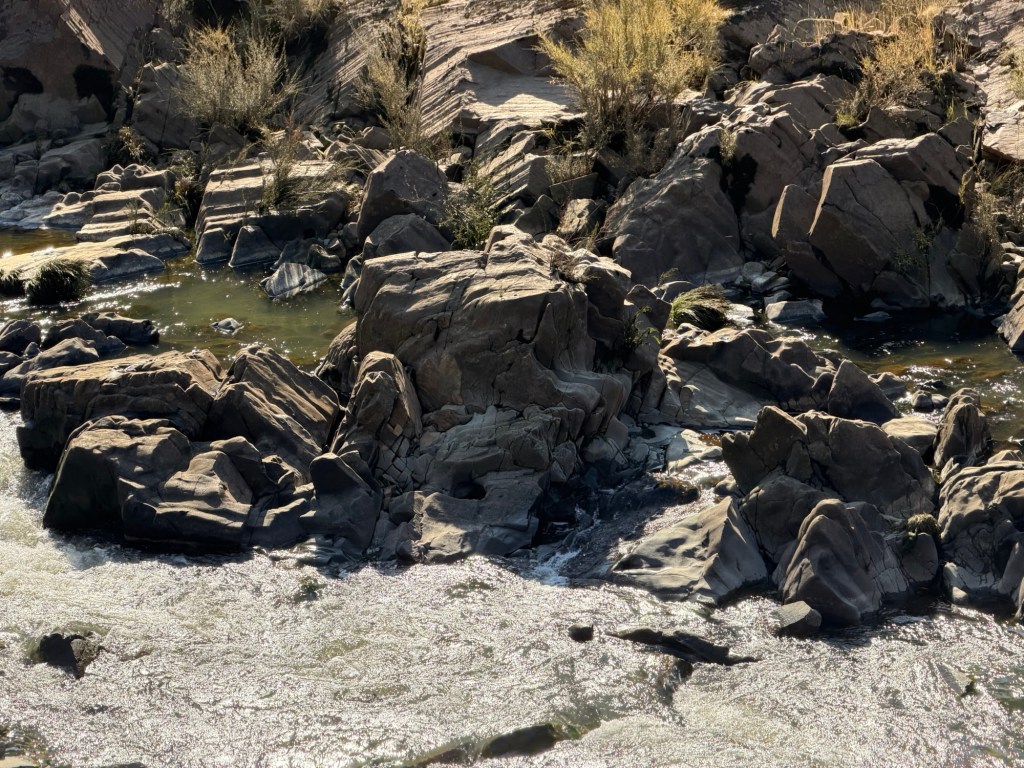
The Ocreza Valley is a tributary setting within the middle Tagus basin in central Portugal, where steep schist and granite walls confine a fast reach of river. Near the municipality of Mação, the engravings sit off the beaten path on private land above the channel. The reach below the panel is confined, and the water accelerates as it passes bed irregularities. You can hear the rapid before you see it, even from the height of the ledge where the engravings are.
The river in this sector is usually slow compared with true white water, but the increase in speed at the constriction is obvious. Foam rises to the surface where turbulence breaks through, and a small eddy forms below the obstacle. Modern dams on the Tagus have altered discharge and seasonality, so present sound levels are likely lower and less variable than they would have been in Palaeolithic times. Even so, the audible character of the reach remains clear enough to consider how sound may have structured attention here. This is a suitable place to test the working hypothesis. See Figure 4 for the wider reach.
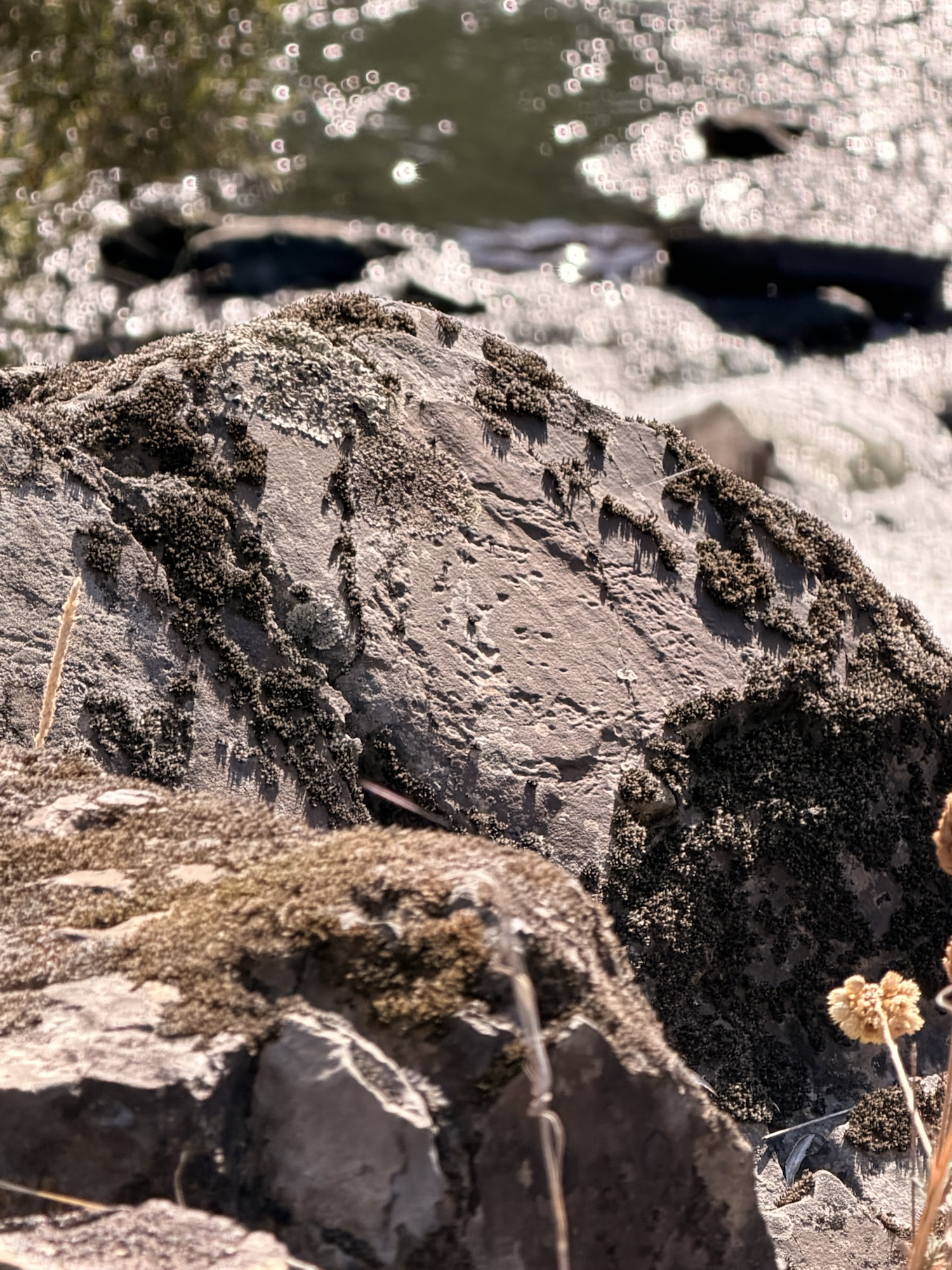
The spiral sits on a lightly weathered panel above river level. In good light the carving is readable; in flat or overcast light it recedes and becomes difficult to see without knowing where to look. The panel has a view over the river and the rapid. The incision is shallow but continuous, and the motif is a simple single spiral rather than a nested set. The rock surface shows age and exposure, yet the line remains coherent in favourable light. See Figure 1 and Figure 2.
Viewing and approach matter. To see the motif clearly a person stands on the ledge facing the panel with the river sound in the background. From this stance the eddy below is visible, and the carving sits at a natural pause point along the slope. The motif is therefore more likely to be a description or locator than a distant warning. It reads as a record that makes sense to people who already know the bend and its behaviour. See Figure 3.
The rapid’s turbulence and entrained air produce a broadband roar that carries across the valley, with intensity expected to rise under higher discharge. The present feature is not ferocious, but the same morphology under greater flow would have produced a louder, more emphatic sound. The combination of a visible swirl and a persistent roar gives the place a distinctive acoustic identity.
Method note: doing archaeoacoustics with light fieldwork
This study is desk based with observations from a single site visit. Extrapolation from analogues and literature is justified here because the acoustic behaviour of rivers is well described at reach scale and because similar rock art settings have been measured in caves, gorges, and at monuments. Where possible I lean on published methods and findings rather than new instrumentation in order to minimise impact and to respect property and conservation limits (Kolar, 2018; Till, 2019; Cox, Fazenda and Greaney, 2020).
The approach has three tracks. First, a literature and analogue track. I treat the Ocreza reach as a confined rapid where turbulence, roughness, and air entrainment produce a broadband roar that is audible at distance. This is consistent with river soundscape studies and with acoustic siting observed at open air panels elsewhere. The aim is to use what is already known about river noise and echo rich settings to frame the Ocreza spiral in a way that can be tested against the Tagus corpus.
Second, a minimal field protocol that could be added later with permission and without intrusive methods. A short soundwalk would log one to two minute recordings at a few stances that matter for viewing and listening. Basic metrics like LAeq can be extracted from smartphone recordings offline. A simple impulse response can be captured with a hand clap or balloon pop if this is safe and allowed. Short hydrophone snapshots can document underwater turbulence if access is straightforward and conditions are stable. Each clip should be paired with clear metadata that notes date and time, weather, water level if known, stance location, and camera view to the river. No chalking or contact tracing would be used. Photogrammetry of the panel may be added only under permit and in ways consistent with conservation guidelines (Kolar, 2018; Till, 2019).
Third, a light modelling and auralisation track for communication rather than proof. Existing impulse responses from comparable gorges and generic rapid recordings can be convolved to create short audio illustrations of what a listener might experience from the stance. Physical scale modelling is a powerful technique at monuments like Stonehenge, but it is not required here and is noted mainly as a precedent for rigorous reconstruction when direct measurement is restricted (Cox, Fazenda and Greaney, 2020). The emphasis in this paper remains on clearly stated criteria that others can test in the Tagus basin.
Desk based mapping supports these tracks. Known spirals and circular signs in the Tagus can be plotted against channel confinement and likely hydraulic features. Simple measures include distance to nearest rapid or eddy, panel orientation relative to flow where photographs allow it, and the presence of grooves or basins that might interact with rain or spray. A first pass can compare frequencies near turbulent reaches to those along quiet runs. Even coarse results will show whether the Ocreza spiral is an outlier or part of a repeatable pattern. Figure 6 shows a simplified schematic of panel, stance, flow, and eddy.
All of this sits under a simple rule. Offer testable claims, accept the limits of present conditions, and keep the work traceable. The goal is not to force a meaning but to set out a path that allows the water reading to gain or lose weight as new data are added.
Discussion: what the spiral does
If the Ocreza spiral sits above a turbulent reach with a visible swirl and a persistent roar, the motif can be read as a local soundmark. It would draw attention to the bend and encode what listeners already knew. It may have served a cautionary role or acted as a mnemonic that fixed a story to a place. The carving also invites a performative reading. A maker stands at the ledge, turns the wrist in a continuous motion, and traces a curve that echoes the rotating foam below. Body, water, and mark align in a way that makes the place memorable.
Alternative readings remain viable. A solar reading is possible because the motif becomes clearer in strong light and can brighten when the sun is low. A path reading is possible if the ledge served as a natural pause along a local route. None of these roles exclude the others. A single mark can be polysemous and work in more than one register.
The test is at the landscape scale. If similar spirals cluster near rapids and eddies more than they do near calm pools, if they face toward flow, and if they tend to coexist with grooves or basins that interact with rain or spray, then a water reading carries more weight. If the opposite pattern holds, the reading weakens. The point is not to win an argument now but to show exactly what evidence would move the needle.
Conclusion: hearing deep history
This paper sets out a cautious case that the Ocreza spiral records a local soundscape. The reach below the panel is confined and noisy. The eddy is visible from the stance and the roar is audible at distance. Rivers are known to produce stable acoustic signatures, and rock art is often placed where sound behaviour is striking. The water reading is not exclusive and it does not displace other interpretations. It gains plausibility only if it holds up across the Tagus basin and beyond. That is a tractable task. The steps are clear and the methods are light. The broader value is simple. Listening belongs with looking when we try to understand how and why people made marks in places like this.
Works Cited
Bradley, R. (1997) Rock Art and the Prehistory of Atlantic Europe: Signing the Land. London: Routledge.
Cox, T. J., Fazenda, B. M. and Greaney, S. E. (2020) ‘Using scale modelling to assess the prehistoric acoustics of Stonehenge’, Journal of Archaeological Science, 122, 105218. https://doi.org/10.1016/j.jas.2020.105218
Danelatos, D. (2022) The Upper Palaeolithic Rock Art in the Tagus Valley Rock Art Complex: Context, Style and Chronology. Master’s thesis, Instituto Politécnico de Tomar.
Díaz-Andreu, M. and García Benito, C. (2012) ‘Acoustics and Levantine rock art: Auditory perceptions in La Valltorta Gorge (Spain)’, Journal of Archaeological Science, 39(12), pp. 3591–3599. https://doi.org/10.1016/j.jas.2012.06.034
Geay, T., Gervaise, C., Roulund, A. and Perret, C. (2019) ‘On the origin of acoustic waves generated by water flows in rivers’, Earth Surface Dynamics, 7, pp. 301–316. https://doi.org/10.5194/esurf-7-301-2019
Goldhahn, J. (2002) ‘Roaring rocks: An audio-visual perspective on hunter-gatherer engravings in northern Sweden and Scandinavia’, Norwegian Archaeological Review, 35(1), pp. 29–61.
Kolar, M. A. (2018) ‘Archaeoacoustics: Re-sounding material culture’, Acoustics Today, 14(4), pp. 28–37.
Mattioli, T., Farina, A., Armelloni, E., Hameau, P. and Díaz-Andreu, M. (2017) ‘Echoing landscapes: Echolocation and the placement of rock art in the Central Mediterranean’, Journal of Archaeological Science, 83, pp. 12–25. https://doi.org/10.1016/j.jas.2017.04.008
Nash, G. and Garcês, S. (eds) (2023) The Prehistoric Rock Art of Portugal. Abingdon: Routledge.
Pijanowski, B. C., Villanueva-Rivera, L. J., Dumyahn, S. L., Farina, A., Krause, B. L., Napoletano, B. M., Gage, S. H. and Pieretti, N. (2011) ‘Soundscape ecology: The science of sound in the landscape’, BioScience, 61(3), pp. 203–216. https://doi.org/10.1525/bio.2011.61.3.6
Rainio, R., Aro, A., Lahelma, A., Äikäs, T., Lassila, M. and Oikkonen, J. (2025) ‘Reflected encounters at hunter-gatherer rock art sites’, Public Archaeology, 24(1), online first.
Rountree, R. A., Juanes, F. and Bolgan, M. (2020) ‘Temperate freshwater soundscapes: A cacophony of undescribed biological sounds now threatened by anthropogenic noise’, PLOS ONE, 15(3), e0221842. https://doi.org/10.1371/journal.pone.0221842
Schafer, R. M. (1994) The Soundscape: Our Sonic Environment and the Tuning of the World. Rochester, VT: Destiny Books.
Tatum, T. A., Anderson, J. F. and Ronan, T. J. (2023) ‘Whitewater sound dependence on discharge and wave configuration at an adjustable wave feature’, Water Resources Research, 59(8). https://doi.org/10.1029/2022WR033802
Tonolla, D., Lorang, M. S., Heutschi, K., Gotschalk, C. C. and Tockner, K. (2011) ‘Characterization of spatial heterogeneity in underwater soundscapes at the river segment scale’, Limnology and Oceanography, 56(6), pp. 2319–2333. https://doi.org/10.4319/lo.2011.56.6.2319
Watson, A. and Keating, D. (1999) ‘Architecture and sound: An acoustic analysis of megalithic monuments in prehistoric Britain’, Antiquity, 73(280), pp. 325–336.
Wikman, V. (2022) ‘The water symbolism that is filling up the cupules and flowing through the cup and ring marks’, Adoranten, pp. 126–145.
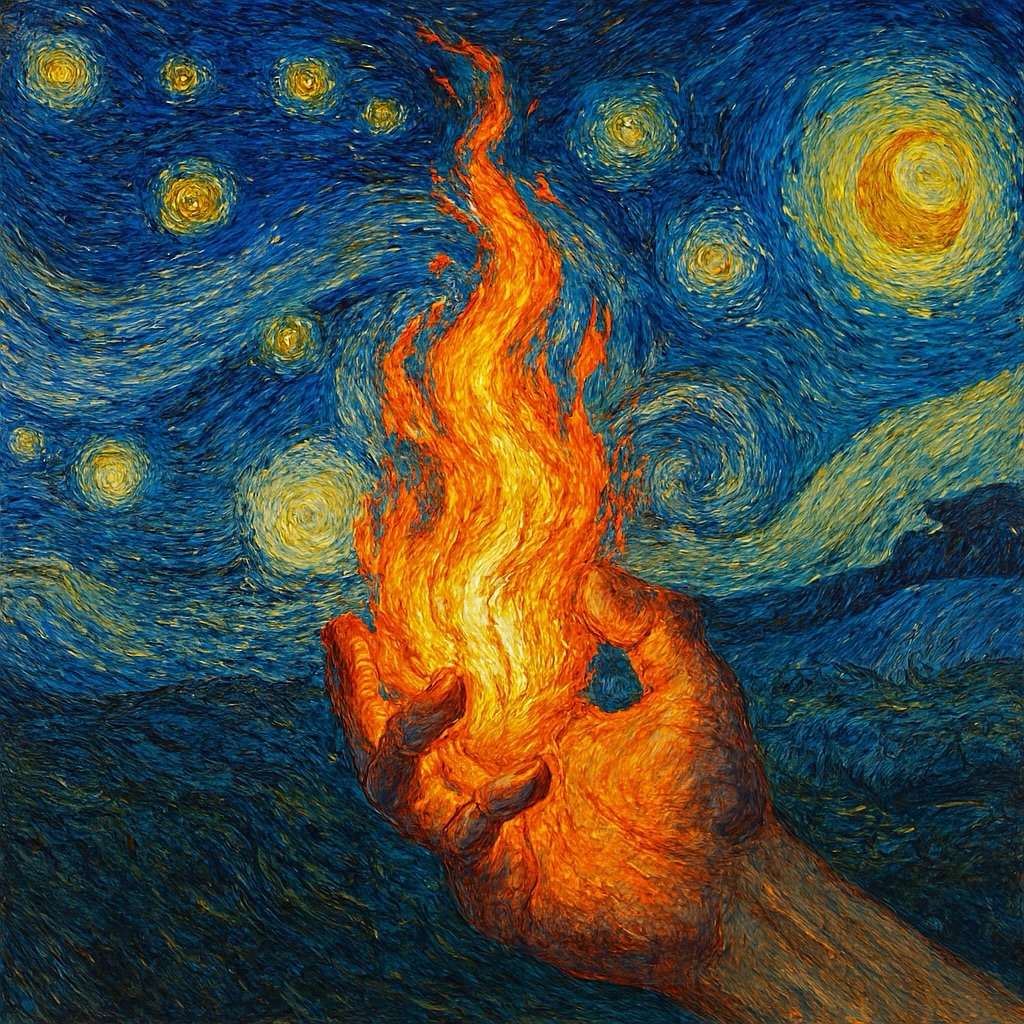
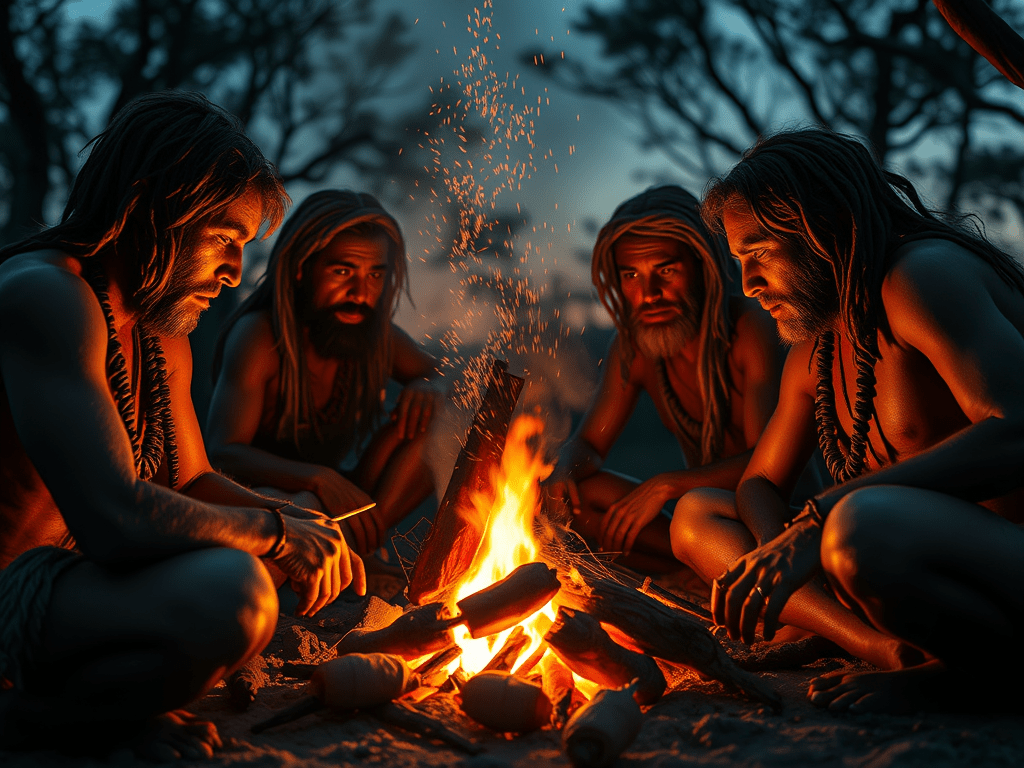
Picture a small group gathered at twilight. Sparks rise. Meat crackles. Tubers sweeten. Voices soften as the night pulls tight around a glow that feeds bodies and quiets fear. If there is a single scene where biology, culture, and meaning braided together into something recognizably human, it is the hearth. This is a story of energy and enzymes, of smoke and ash, of kin and strangers who learned to sit close without claws. It is also a story of wonder. The question is simple and audacious. Did the hearth become the first altar?
I think the answer is yes in spirit and maybe in fact. Here is why.
Fire changed our bodies
Cooking does not only make food tasty. It changes the math of life. Thermal processing breaks cell walls, denatures proteins, gelatinizes starch, and kills pathogens. That means more calories are available with less work by the gut. Experiments that measured energy gain directly show what many of us have felt since childhood when we discovered roasted marshmallows are suspiciously satisfying. In controlled studies, mammals fed cooked meat or cooked starchy plants get more usable energy and gain more mass than those fed the same foods raw, even when activity and intake are held constant. The energetic edge of cooking is large enough to matter in evolution.
This energy story links to a second line of evidence about brains, bodies, and time. Human brains are expensive organs. They burn an outrageous share of our resting metabolism. Analyses of neuronal counts and feeding time argue that a raw diet places a ceiling on brain size because there are not enough daylight hours to chew and digest what a large brain would cost. The path out of that bottleneck is higher energy yield per bite. Cooking is the obvious route.
Put these findings together and you have a clean argument. Cooking raises net energy yield from key foods. Once control of fire becomes routine, hominins can afford smaller guts and larger brains while spending fewer hours feeding. That is an evolutionary bargain with downstream effects on everything from dental anatomy to daily schedules. The claim is not dogma. It is a working model with experimental support and a plausible ecological pathway.
Fire entered the archaeological record, then took over
How early did our ancestors use fire inside spaces they lived in rather than dodge wildfires and carry embers? Secure evidence now reaches back roughly one million years. Microstratigraphic work at Wonderwerk Cave in South Africa shows ash and burned bone in place far inside the cave. These are not traces blown in by wind or washed by water. They are residues of combustion where people lived. This is the earliest widely accepted in situ fire in an archaeological context.
By around seven hundred eighty thousand years ago in the Levant, the pattern becomes richer. At Gesher Benot Ya‘aqov, the distribution of burned flint, seeds, and wood fragments is localized rather than random. The spatial pattern suggests repeated burning at specific spots, very likely hearths, and therefore control rather than mere encounter. Later work even used thermoluminescence and spatial modeling to evaluate fire intensity across activity areas. The signal is behavioral, not accidental.
By three hundred to four hundred thousand years ago, in several regions, fire use becomes habitual rather than sporadic. In Europe, a broad review concluded that routine, repeated fire appears surprisingly late and becomes common only after roughly four hundred to three hundred thousand years. That late takeoff matters because once fire is dependable, it can structure how people butcher, cook, and share, not just how they warm their hands.
Qesem Cave in Israel shows what habitual fire looks like on the ground. There, researchers documented repeated use of a central hearth over many occupation episodes, with associated cut marks, bone breakage for marrow extraction, and blade production nearby. The hearth sat in the middle like a social machine, and activities radiated from it in a way that feels familiar to anyone who has stood in a busy kitchen while everything important happens around the stove.
Fire reshaped daily life and social structure
Energy freed time. Light extended day. Warmth pulled people into closer proximity. Those ecological changes created social opportunities. A central hearth encourages central place foraging and delays consumption. Meat need not be devoured on the spot with blood still warm. It can be brought home, roasted, and shared. Archaeofaunal evidence at Qesem Cave shows exactly that picture. Carcass transport was selective, processing was organized near the fire, and meat sharing is the best explanation for the pattern of broken bones and cut marks. Sharing is not a moral lesson here. It is a logistical solution that turns dangerous hunts into reliable meals and reputations.
We can also watch what people do with the night once they have a pool of light. Ethnographic studies of foragers in the Kalahari compared conversations by day and by firelight. Day talk leans toward work and social friction. Night talk tilts to stories, music, and ritual. Firelight changes the subject and, over time, culture itself. Narratives travel further than meat and last longer than embers. The result is a quiet revolution. Fire stabilizes calories and it also stabilizes meaning.
There is even evidence that watching fire can lower blood pressure, especially when sound is present. That is one small physiological clue to what our ancestors might have felt as the flames settled into a rhythm and voices slowed. Calm is not a trivial byproduct. A calmer group can sit longer, listen harder, and agree on things that matter.
What cooking did to the senses
A cooked meal is a symphony of chemistry. Starch molecules swell and uncoil. Proteins denature and form new bonds. Fats render and carry volatile compounds up into the nose before a bite is taken. The Maillard reaction paints a signal of readiness on meat and tubers alike. These changes do not only entice. They shortcut digestion. Mice do not need to know molecular biology to show weight gain differences when given cooked versus raw diets under controlled conditions. They just do. Humans, with larger brains and bodies that evolved under selection for higher energy throughput, would have felt the edge even more.
Add light and sound and you get a full sensory ecology. Firelight is warm and flickering. It reduces blue wavelengths that keep us hyper alert and replaces them with long wavelengths that flatter skin and wood. Crackle adds an auditory metronome that masks small noises in the dark and draws a crowd to one focal point. The combined audiovisual stimulus relaxes people measurably in experiments. That is not mystical. It is nervous system math. And it is one reason storytelling thrives at night by the flames.
The hearth made space sacred
If we take animism seriously, the hearth is not only a tool. It is a presence. It devours and gives. It demands attention and rewards devotion. Archaeology cannot read prayers. It can map ash and analyze bone fat. Even so, there are moments when the pattern looks like ceremony.
Start with the simplest case. A central hearth used again and again in the same place over centuries signals more than convenience. It speaks to a mental map of home that anchors bodies and remembers events. Qesem Cave offers that exact signature. Micromorphology shows superimposed ash lenses and heat altered sediments stacked like rings of a tree. People returned to one living flame that marked the center of their social world. That is the structure of a shrine whether or not anyone would have used that word.
Move forward in deep history and the relationship between fire and symbol grows overt. In Central Europe during the Gravettian, people fired small clay figures in simple kilns at sites like Dolní Věstonice. These are some of the earliest ceramics on Earth and they are art, not pots. They required careful control of temperature and atmosphere, which means planning, skill, and shared knowledge around fire. We can argue about what the figures meant. We cannot argue that fire became a partner in deliberate acts of making that blur utility and ritual.
Now widen the lens beyond prehistory. Across many later traditions the hearth is a formal sacred focus, from Hestia in Greek religion to Vesta in Roman public life. This is not a proof that early hearths were altars. It does show a durable human habit of treating domestic fire as a bearer of order, purity, and continuity between household and cosmos. When a pattern endures across time and culture, it is at least reasonable to look for its roots in older behavior.
Costs and complications
Fire is not a free lunch. Smoke damages lungs, eyes, and hearts. Sparks burn children and old kin. Sparks also burn landscapes when wind rises. Archaeologists debate whether the earliest fire signals reflect regular control or opportunistic use. In Europe there is a long stretch where occupation spreads into cold latitudes without strong evidence for routine fire indoors. That caution matters. The simplest picture is not always the true one. Still, by three hundred to four hundred thousand years ago, the material record in multiple regions shows fire integrated into daily life and food processing, and after that the social and sensory consequences would have been hard to reverse.
There is also the honest point that brain size trends and fire control timelines do not line up perfectly. Some researchers argue that significant encephalization predates routine cooking. That is a real challenge and a good reminder that evolution is a braid of causes, not a straight pipeline. Even so, when you look at energy budgets, digestive anatomy, and the clear performance edge of cooked foods, cooking still reads as a major amplifier of the human niche rather than a minor garnish.
So did the hearth become the first altar?
Altar is a heavy word. It implies offering and presence and a shared grammar of reverence. In that strict sense, formal altars come later with architecture and priests. But if we loosen the term to mean a place where matter and meaning meet under a rule of attention, then yes. The hearth is our proto altar.
It is where we first learned to trade the chaos of the night for a circle of light, to slow down enough to tell stories and remember them, to transform the raw into the good through a repeated act that felt both practical and profound. It is where we learned that devotion has a form. Feed the fire. Watch it. Share what it makes possible. Do not look away when it needs care. That is ritual in every sense that matters, and it changes the people who practice it.
As a Stoic would note, fire teaches discipline and acceptance. You do not control the flame fully. You work with it. You prepare, you attend, you respond. As a Nordic animist might say, fire has a spirit. It is alive enough to negotiate with, worthy of respect, and dangerous without it. As a Zen practitioner would add, fire is the breath made visible, a present moment that radiates and fades. Daoists would smile and call it one more way the ten thousand things move in balance. No doctrine necessary. Sit quietly and watch the coals. You will feel what our ancestors felt.
A last image
Imagine a child at the edge of a Paleolithic hearth. The child is drowsy and full. On a flat stone, a parent sets roasted marrow bones. On another, a tuber splits and steams. Voices braid a story of a hunt and a flood and an ancestor who became a star. Sparks climb. The child stares into the red and sees patterns. The first altars did not need temples. They needed only fire, food, and faces close enough to care.
That is how cooking created the human spirit. Not by magic, but by energy and attention, by making a place where we could be fully animal and more than animal at once. The hearth did not just feed us. It formed us.
⸻
Works Cited
Alperson Afil, N. 2008. Continual fire making by hominins at Gesher Benot Ya‘aqov, Israel. Quaternary Science Reviews 27.
Alperson Afil, N., and N. Goren Inbar. 2004. Evidence of hominin control of fire at Gesher Benot Ya‘aqov, Israel. Science 304.
Barkai, R., A. Gopher, and colleagues. 2014. Evidence for the repeated use of a central hearth at Middle Pleistocene Qesem Cave, Israel. Journal of Archaeological Science 44.
Berna, F., P. Goldberg, L. K. Horwitz, J. Brink, S. Holt, M. Bamford, and M. Chazan. 2012. Microstratigraphic evidence of in situ fire in the Acheulean strata of Wonderwerk Cave, South Africa. Proceedings of the National Academy of Sciences.
Carmody, R. N., and R. W. Wrangham. 2009. The energetic significance of cooking. Journal of Human Evolution 57.
Carmody, R. N., Z. Weintraub, and R. W. Wrangham. 2011. Energetic consequences of thermal and nonthermal food processing. Proceedings of the National Academy of Sciences.
Gopher, A., R. Barkai, M. C. Stiner, and colleagues. 2011. Hearth side socioeconomics, hunting and paleoecology during the late Lower Paleolithic at Qesem Cave, Israel. Journal of Human Evolution 60.
Herculano Houzel, S., and K. Fonseca Azevedo. 2012. Metabolic constraint imposes a tradeoff between body size and number of brain neurons in human evolution. Proceedings of the National Academy of Sciences 109.
Henry, A. G., A. S. Brooks, and D. R. Piperno. 2011. Microfossils in calculus demonstrate consumption of plants and cooked foods in Neanderthal diets. Proceedings of the National Academy of Sciences 108.
Karkanas, P., R. Shahack Gross, F. Berna, C. Lemorini, A. Gopher, and R. Barkai. 2014. Evidence for the repeated use of a central hearth at Middle Pleistocene Qesem Cave, Israel. Journal of Archaeological Science 44.
Karkanas, P., and S. Weiner. 2011. Microarchaeological approaches to the identification and interpretation of combustion features in prehistoric sites. Journal of Archaeological Method and Theory 18.
Lynn, C. D. 2014. Hearth and campfire influences on arterial blood pressure. Evolutionary Psychology 12.
Roebroeks, W., and P. Villa. 2011. On the earliest evidence for habitual use of fire in Europe. Proceedings of the National Academy of Sciences 108.
Shahack Gross, R., F. Berna, P. Karkanas, C. Lemorini, A. Gopher, and R. Barkai. 2014. Evidence for the repeated use of a central hearth at Middle Pleistocene Qesem Cave, Israel. Journal of Archaeological Science 44.
Shimelmitz, R., A. Gopher, R. Barkai, and colleagues. 2014. Fire at will. The emergence of habitual fire use three hundred fifty thousand years ago. Journal of Human Evolution 77.
Stiner, M. C., R. Barkai, and A. Gopher. 2011. Hearth side socioeconomics at Qesem Cave, Israel. Journal of Human Evolution 60.
Wiessner, P. 2014. Embers of society. Firelight talk among the Ju/’hoansi. Proceedings of the National Academy of Sciences 111.
Wrangham, R. W. 2009. Catching Fire. How Cooking Made Us Human. (book widely cited in the literature on the cooking hypothesis). For experimental and review work linked to the hypothesis see Carmody and colleagues above.
Further references on fire, ritual, and symbol
Burkert, W. 1985. Greek Religion. Archaic and Classical. Harvard University Press. On Hestia and the sacral role of the civic hearth.
Gordon, R. 2016. Vesta, Vestals. Oxford Classical Dictionary. A reliable summary of the Roman hearth cult as public religion.
Vandiver, P. B. 1987 and later work cited in: “The Origins of Ceramic Technology at Dolní Věstonice.” American Anthropologist 89. For an early synthesis on fired clay figurines as a fire using technology connected to symbolic action.
Recent imaging studies on the Dolní Věstonice figurines. See micro computed tomography investigation of the fired clay Venus and background on Pavlovian ceramics. Journal of Archaeological Science: Reports 2024.
⸻
Author’s note: The citations above anchor the main claims. Debates continue about timing and causation. That is the work. But the outline is strong. Fire increased net energy, reconfigured time and space, and pulled people into a circle where food and story could be shared. That circle looks a lot like the first altar.
Across the deep past of our lineage, few questions generate as much debate as whether a hominin buried its dead. The practice is often seen as a hallmark of humanity: a line crossed into symbolic thought, planning, and perhaps even ritual. Yet the truth is more complicated. What counts as a burial? How do we distinguish intentional placement from natural processes such as sediment collapse or animal activity? And why does this matter so much—for both how we interpret our ancestors and how we see ourselves?
This feature explores three major players in the burial debate: Homo naledi, Neanderthals, and our own species, Homo sapiens. Each presents tantalizing evidence, controversy, and significant implications. Along the way, we examine how scientists differentiate graves from accidents and consider the ethical questions around handling the dead.
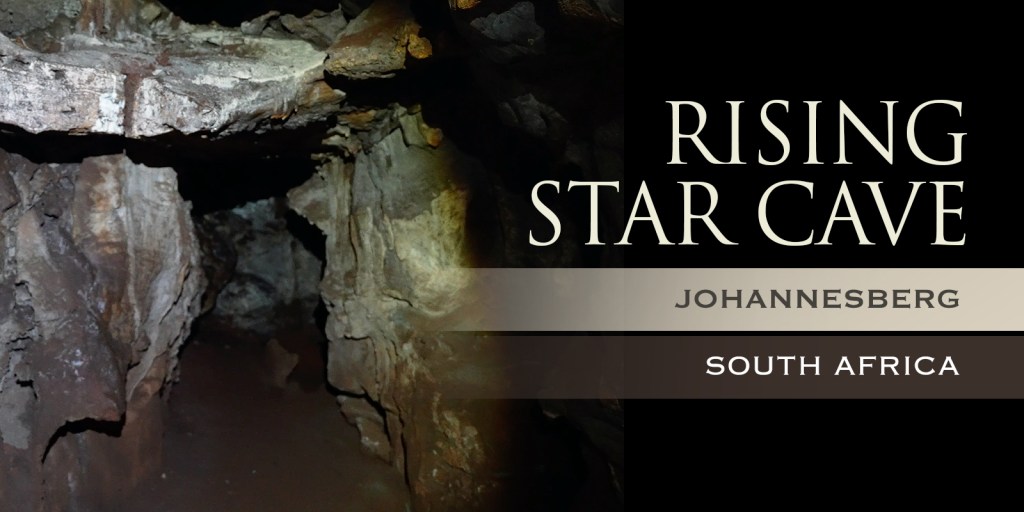
Homo naledi: Burials in the Rising Star Cave?
In 2013, explorers entered South Africa’s Rising Star Cave system and retrieved fossils unlike any seen before: small-brained, primitive-bodied hominins that lived around 250,000 years ago. Named Homo naledi, they rewrote textbooks by surviving contemporaneously with early modern humans.
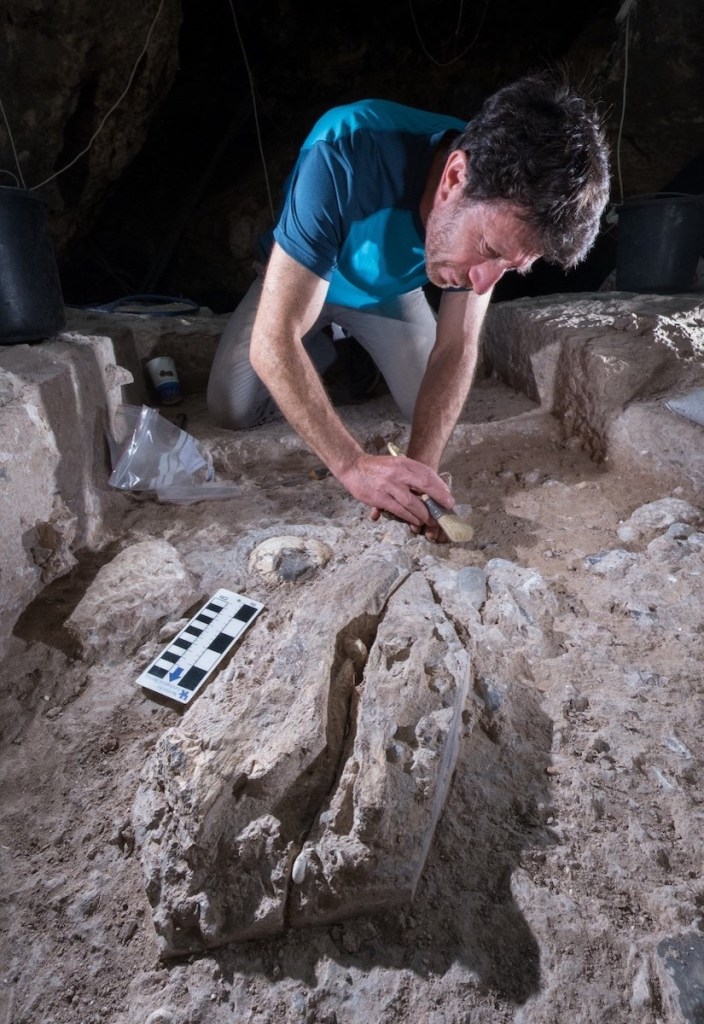
Soon after, a bold claim emerged: the fossils were not scattered by floods or predators but deliberately placed in deep chambers, perhaps covered with sediment—suggesting intentional burial. This made global headlines. A small-brained hominin, with a cranial capacity of 465–610 cc, engaging in behaviors once thought unique to humans? The idea shocked the field.
The most recent updates, published in eLife (2025), describe articulated skeletal regions preserved in matrix, interpreted as rapid covering prior to decomposition. To the excavators, this pattern indicates intentional burial, repeated multiple times.
Not everyone agrees. Critics, including a 2024 Journal of Human Evolution paper, argue that the sedimentology remains inconclusive, clear grave cuts have not been demonstrated, and natural deposition has not been ruled out. Skeptics also note the caves’ inaccessibility and question whether bodies could have arrived without deliberate action.
The debate boils down to this: if naledi buried their dead, mortuary behavior may have evolved independently across hominins, uncoupled from brain size. If they did not, naledi still present a fascinating depositional mystery, and the debate itself strengthens archaeological methods.
Neanderthals: From Flowers to Skepticism
Few images are as enduring as the “flower burial” of Shanidar Cave in Iraq. In the 1960s, pollen clumps near a Neanderthal skeleton inspired romantic reconstructions of mourners laying blossoms on a grave. Later work showed the pollen could have been introduced by rodents—an early reminder of the risks of overinterpretation.
Even so, Neanderthal burials remain compelling. At Shanidar, reanalysis has revealed multiple individuals placed in shallow pits, some with flexed body positions. Across Europe and Western Asia—from La Chapelle-aux-Saints in France to Kebara in Israel—articulated skeletons appear in grave cuts, occasionally with ochre or objects.
Critics such as Paul Gargett have long urged caution. Yet the weight of evidence suggests that by 60–70,000 years ago, Neanderthals were consistently burying their dead. While less elaborate than later human rituals, these practices demonstrate repeated, intentional interment.
The question remains: why? Were burials practical—to deter scavengers or manage hygiene—or did they express grief, memory, and care? The most plausible answer is both.
Homo sapiens: Early Burials in the Middle Paleolithic
For our species, the record is equally intriguing. At Qafzeh and Skhul in Israel, burials from 100–120,000 years ago reveal deliberate interments, some with ochre and objects. Children and adults alike were carefully placed, sometimes in flexed positions.
In 2025, discoveries at Tinshemet Cave in Israel added further weight. Multiple burials dating to roughly 100,000 years ago were found with bodies in fetal positions and ochre staining. Researchers argue this represents a true burial tradition among early Homo sapiens in the Levant.
Unlike Neanderthals, sapiens burials often show symbolic associations—pigments, objects, and consistent placements. This does not prove Neanderthals lacked symbolism, but it highlights how early sapiens may have invested more heavily in ritual as part of their cultural identity.
Methods: How Do We Know It’s a Burial?
Distinguishing intentional burials from accidents requires multiple lines of evidence:
Sediment micromorphology: identifying cut edges, backfill, or disturbed layers.
Body articulation: determining whether bones stayed connected in ways requiring rapid covering.
Taphonomic context: checking for carnivore gnawing, water sorting, or collapse versus deliberate placement.
Geochemistry: analyzing phosphate concentrations, ochre traces, and mineral profiles.
Dating precision: ensuring deposits are contemporaneous and not mixed by later disturbance.
These methods explain why naledi remains are controversial—several indicators are disputed, and independent replication is needed.
Ethics: Whose Dead Are These?
The burial debate is not just scientific; it is ethical. Labeling something a “burial” implies intention, ritual, and meaning. That symbolism can shape how modern societies view both the past and themselves.
Treatment of remains also matters. Should hominin skeletons remain in labs and museums indefinitely? Should some be reburied, particularly where descendant communities or cultural connections exist? Many anthropologists today emphasize collaboration with local groups, transparency in excavation, and avoiding sensationalism.
The naledi case underscores how headlines can outpace peer review. Declaring symbolic burial by a small-brained species is not just academic; it reshapes public narratives about intelligence, humanity, and dignity.
Synthesis: A Graded Emergence
Taken together, the evidence suggests burial was not a single “spark” but a mosaic emerging across our genus:
Homo naledi — if deliberate, shows mortuary behavior in a small-brained species; if not, remains a cautionary case in interpretation.
Neanderthals — consistent yet simple burials, reflecting social care and possible symbolic meaning.
Early Homo sapiens — embedding burial within ritual, pigment use, and tradition.
The boundary between “us” and “them” blurs. Burial was not a uniquely modern human invention, but part of a deeper, more complex story of how hominins made sense of death.
References
Berna, F., Goldberg, P., Horwitz, L. K., Brink, J., Holt, S., Bamford, M., & Chazan, M. (2012). Microstratigraphic evidence of in situ fire in the Acheulean strata of Wonderwerk Cave, Northern Cape province, South Africa. Proceedings of the National Academy of Sciences, 109(20), E1215–E1220. https://doi.org/10.1073/pnas.1117620109
Dirks, P. H., Berger, L. R., Roberts, E. M., Kramers, J. D., Hawks, J., Randolph-Quinney, P. S., … & Elliott, M. (2017). The age of Homo naledi and associated sediments in the Rising Star Cave, South Africa. eLife, 6, e24231. https://doi.org/10.7554/eLife.24231
Hovers, E., & Belfer-Cohen, A. (2013). On variability and complexity: Lessons from Levantine Middle Paleolithic burial practices. In N. J. Conard & J. Zeidi (Eds.), The Paleolithic of the Levant (pp. 395–418). Tübingen: Kerns Verlag.
Pomeroy, E., Soficaru, A., & Trinkaus, E. (2020). The human burial record of the Middle Paleolithic. Journal of Human Evolution, 146, 102867. https://doi.org/10.1016/j.jhevol.2020.102867
Rendu, W., Beauval, C., Crevecoeur, I., Bayle, P., Balzeau, A., Bismuth, T., … & Tillier, A. M. (2014). Evidence supporting an intentional Neandertal burial at La Chapelle-aux-Saints. Proceedings of the National Academy of Sciences, 111(1), 81–86. https://doi.org/10.1073/pnas.1316780110
Reich, D., Green, R. E., Kircher, M., Krause, J., Patterson, N., Durand, E. Y., … & Pääbo, S. (2010). Genetic history of an archaic hominin group from Denisova Cave in Siberia. Nature, 468(7327), 1053–1060. https://doi.org/10.1038/nature09710
Shea, J. J. (2011). Homo sapiens is as Homo sapiens was: Behavioral variability versus “behavioral modernity” in Paleolithic archaeology. Current Anthropology, 52(1), 1–35. https://doi.org/10.1086/658067
Zaidner, Y., Weinstein-Evron, M., Yeshurun, R., & Hershkovitz, I. (2025). A Middle Paleolithic burial ground at Tinshemet Cave, Israel. Nature Human Behaviour. https://doi.org/10.1038/s41562-025-02016-9
Imagine a cave somewhere in Ice Age Eurasia. A fire smolders low, smoke curling upward into the darkness. A group of Neanderthals huddles close, trading stories, sharpening tools. Suddenly, a stranger appears — stockier, broader-jawed, carrying something unfamiliar: a greenstone bead, maybe, or a tool chipped in a style just slightly different. What happens next? Trade? Curiosity? Suspicion? Maybe all three.
That’s the spark for this week’s journey — exploring the little-known cultural remix between Neanderthals and Denisovans. We usually hear about modern humans and their encounters with Neanderthals, but Neanderthal–Denisovan interaction is a quieter story, hiding in fragments of bone, DNA, and a handful of tools. And yet, the few traces we have suggest a fascinating world where two archaic cousins may have swapped genes, ideas, and perhaps even symbols.
Who Were the Denisovans?
The Denisovans are one of the most enigmatic branches on our human family tree. First identified in 2010 from DNA extracted out of a finger bone found in Denisova Cave (Siberia), they’ve since been revealed as a widespread but ghostly presence across Asia (Reich et al., 2010). Genomic studies show that Denisovans interbred with both Neanderthals and modern humans, leaving traces in populations from Tibet to Oceania (Browning et al., 2018).
Archaeologically, though, Denisovans are slippery. We don’t have a nice suite of skeletons to study — just a few teeth, bone fragments, and genetic fingerprints. But the cave where they were discovered — Denisova Cave — also preserves an archaeological record shared with Neanderthals. This overlap gives us a rare window into how the two groups might have interacted.
Neanderthals and Denisovans: Neighbors in the Same Cave
Denisova Cave is the ultimate Ice Age roommate situation. Layers show that both Denisovans and Neanderthals occupied it at different times, sometimes overlapping. In fact, genetic evidence from one extraordinary individual — the so-called “Denny,” a young girl — revealed that she was the direct offspring of a Neanderthal mother and a Denisovan father (Slon et al., 2018). That’s not just contact; that’s intimate entanglement.
So what else might have happened when these groups crossed paths? The archaeological material from the cave includes sophisticated stone tools, ornaments made of animal teeth, and even a striking green chlorite bracelet with drilled holes (Derevianko et al., 2015). While the exact maker isn’t always clear, these artifacts suggest that cultural creativity was alive and well — and potentially shared — among both groups.
Tools as Conversation
When archaeologists talk about “cultural exchange,” one of the best proxies is technology. Stone tools, after all, don’t fossilize genes but they do fossilize habits, preferences, and problem-solving strategies.
Neanderthals were masters of the Levallois technique — preparing a stone core so flakes could be struck in predictable shapes. Denisovans, while harder to pin down, also left behind advanced lithics in Denisova Cave, including bladelets and ornaments (Bailleul et al., 2020). The overlap of these traditions suggests more than coincidence. If both groups used the cave, it’s not impossible that one watched the other’s knapping style and adapted a trick or two.
Think of it as the Paleolithic version of “I like how you sharpened that scraper — mind if I try it?”
Shared Symbolism?
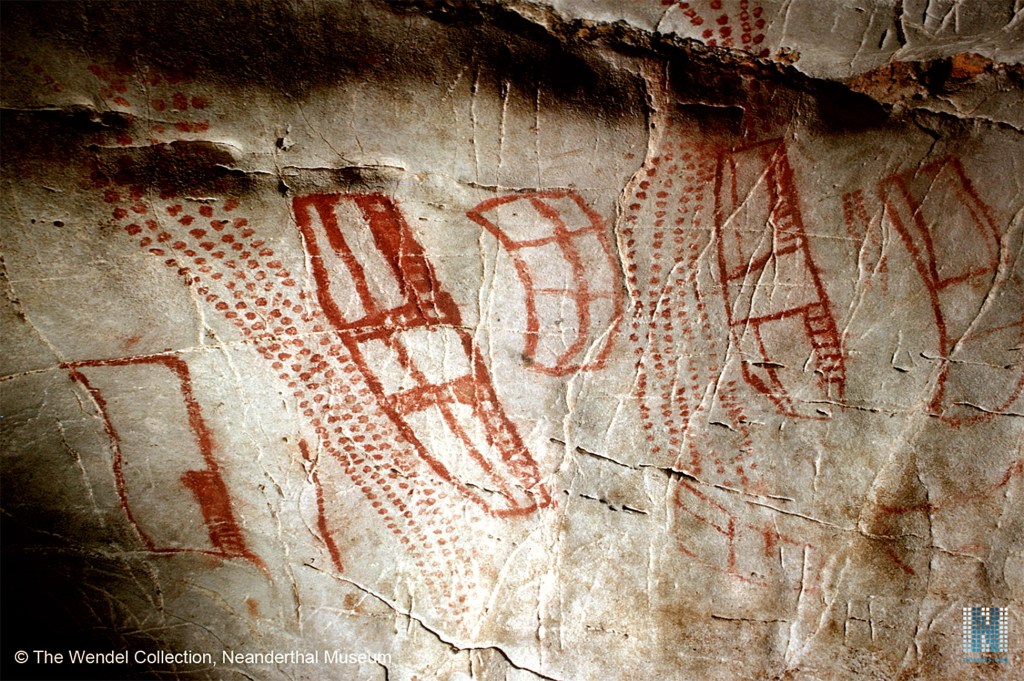
If tool styles were exchanged, could symbols be too? Neanderthals across Europe left hints of symbolic behavior — red ochre, perforated shells, engravings (Hoffmann et al., 2018). Denisovans, meanwhile, remain more elusive, but the chlorite bracelet from Denisova Cave shows a level of craftsmanship bordering on the ornamental.
Imagine the scene: a Denisovan craftsman drilling a bead or bracelet, and a Neanderthal stopping to watch, intrigued. Did ideas about adornment — about marking identity, belonging, or ritual — ripple between these groups? While we can’t say for certain, the possibility opens up tantalizing questions about shared symbolic vocabularies.
Genetics as Cultural Evidence
Genomics also gives us cultural clues. Interbreeding doesn’t just tell us about biology — it implies social interactions. The existence of hybrid offspring suggests moments of connection, negotiation, and perhaps the blending of traditions.
The case of “Denny” is a striking example: not only does she show direct Neanderthal–Denisovan mixing, but the genetic record also reveals that Denisovans carried bits of Neanderthal DNA from earlier encounters (Slon et al., 2018). This wasn’t a one-off. It suggests multiple episodes of contact across generations — enough time for cultural habits, as well as genes, to be passed along.
The Remix in Context
We often talk about “remix culture” today — blending music, art, or memes into something new. But remixing is one of the oldest human traditions. When groups meet, they swap not just DNA but tricks, techniques, and maybe even myths. Neanderthals and Denisovans weren’t just evolutionary curiosities; they were players in this remix, shaping each other in ways we’re only beginning to uncover.
Their exchanges didn’t leave behind a Spotify playlist, but they might echo in the hybrid genomes of today’s populations, in the layered toolkits of Ice Age caves, and in the faint traces of symbolism that suggest a shared human urge to mark meaning onto the world.
Conclusion
Neanderthal–Denisovan interaction is one of the more shadowy chapters in our story. But through genetics, archaeology, and a bit of imagination, we can begin to see how two groups of archaic humans — so often overshadowed by modern humans — might have blended lives and cultures. Their remix wasn’t recorded in full, but enough fragments survive to remind us that culture is never a closed system. Wherever humans (and near-humans) meet, exchange happens.
Maybe, just maybe, a Neanderthal once wore a Denisovan bracelet — and in that act, carried forward a spark of creativity that still hums in us today.
References
Bailleul, J., Bence Viola, T., Krivoshapkin, A. I., & Derevianko, A. P. (2020). Upper Paleolithic lithic industries from Denisova Cave: Technological and cultural insights. *Quaternary International, 559*, 44–58. [https://doi.org/10.1016/j.quaint.2020.04.007](https://doi.org/10.1016/j.quaint.2020.04.007)
Browning, S. R., Browning, B. L., Zhou, Y., Tucci, S., & Akey, J. M. (2018). Analysis of human sequence data reveals two pulses of archaic Denisovan admixture. *Cell, 173*(1), 53–61. [https://doi.org/10.1016/j.cell.2018.02.031](https://doi.org/10.1016/j.cell.2018.02.031)
Derevianko, A. P., Shunkov, M. V., Volkov, P. V., & Agadjanian, A. K. (2015). The Denisova Cave: Palaeolithic cultures of Central Asia. *Archaeology, Ethnology and Anthropology of Eurasia, 43*(3), 2–27. [https://doi.org/10.1016/j.aeae.2015.12.001](https://doi.org/10.1016/j.aeae.2015.12.001)
Hoffmann, D. L., Standish, C. D., García-Diez, M., Pettitt, P. B., Milton, J. A., Zilhão, J., … & Pike, A. W. G. (2018). U-Th dating of carbonate crusts reveals Neandertal origin of Iberian cave art. *Science, 359*(6378), 912–915. [https://doi.org/10.1126/science.aap7778](https://doi.org/10.1126/science.aap7778)
Reich, D., Green, R. E., Kircher, M., Krause, J., Patterson, N., Durand, E. Y., … & Pääbo, S. (2010). Genetic history of an archaic hominin group from Denisova Cave in Siberia. *Nature, 468*(7327), 1053–1060. [https://doi.org/10.1038/nature09710](https://doi.org/10.1038/nature09710)
Slon, V., Mafessoni, F., Vernot, B., de Filippo, C., Grote, S., Viola, B., … & Pääbo, S. (2018). The genome of the offspring of a Neanderthal mother and a Denisovan father. *Nature, 561*(7721), 113–116. [https://doi.org/10.1038/s41586-018-0455-x](https://doi.org/10.1038/s41586-018-0455-x)
Paleolithic cave art often occupies deep, hard-to-reach chambers where light is scarce, surfaces vary, and the air itself feels different from the outside world. Traditional explanations for motif placement emphasize visibility, surface suitability, pigment access, and preservation bias. In recent decades, researchers have added a complementary, measurable factor to that list: acoustics. Echoes, resonances, and long low‑frequency decay change how a space feels and how sound behaves within it, and these sonic properties may have influenced where people sang, drummed, performed, and painted (Fazenda et al., 2017; Till, 2019). This article synthesizes the core empirical work, explains the methods used to measure a cave’s “voice,” surveys key case studies, and outlines interpretive frameworks linking acoustics with ritual practice, memory, and symbolic cognition.
Why acoustics matter
Spaces invite action through their sensory affordances. A chamber that produces strong low‑frequency resonance creates a bodily sensation — a chest‑filling vibration and a long decay — that differs markedly from the sonic experience in an open shelter or a shallow alcove. Echoes and reverberation alter intelligibility, change the perceived emotional weight of voice, and reshape the perception of rhythm and pitch. Across many cultures, resonant spaces are central to ritualized sound-making: drumming structures time, chant synchronizes groups, and acoustics amplify presence (Till, 2019). If Paleolithic people noticed these affordances, they may have preferred acoustically rich niches for performance and then marked those places visually; thus image and sound could have been co‑produced in ritual contexts (Fazenda et al., 2017; Miyagawa et al., 2018).
The state of evidence
Archaeoacoustics has moved from anecdote to systematic inquiry. Earlier observational notes documented curious coincidences between motifs and acoustic quirks; subsequent work introduced standard acoustic measures and larger sampling strategies. The strongest empirical work comes from grid‑based impulse‑response surveys carried out in decorated caves, where dense acoustic sampling has been paired with precise mapping of motifs. These studies report a modest but repeatable pattern: abstract marks (dots, lines, punctuations) are disproportionately found at positions with moderate reverberation and measurable low‑frequency resonances (Fazenda et al., 2017). Reviews and comparative studies corroborate that acoustics are a plausible variable influencing motif placement (Till, 2019; Díaz‑Andreu & García Benito, 2012).
Important caveats remain. Acoustic measurements are highly sensitive to microphone position, environmental conditions (humidity, water flow), and human presence. Taphonomic processes filter which motifs survive for us to sample, and deep chambers may have been chosen for reasons (privacy, initiatory control) that correlate with acoustic traits. Consequently, observed correlations do not amount to proof of intentional sonic selection. Instead, acoustics provide an independent, testable axis for evaluating competing explanations of where and why people decorated caves (Fazenda et al., 2017; Reznikoff & Dauvois, 1988).
Methods: measuring a cave’s voice
Field archaeoacoustics adapts tools from architectural acoustics to fragile archaeological contexts. Researchers map decorated surfaces, establish measurement grids, and record impulse responses that describe how a space reacts to a short, broadband input. The modern standard is a sine‑sweep played through an omnidirectional speaker, recorded with calibrated microphones and deconvolved to produce high‑fidelity impulse responses across frequency bands (Till, 2019).
From those impulse responses researchers extract metrics such as reverberation time (T30/T60), early decay time (EDT), speech‑transmission indices approximating intelligibility (STI), clarity indices (C80), and spectral analyses that reveal low‑frequency peaks or modal behaviour. Good practice pairs acoustic metrics with archaeological variables — distance from the entrance, wall smoothness, motif type and density, hearths, and artifact concentrations — and uses matched control points and spatial statistics to test whether motif placement is associated with specific acoustic signatures (Fazenda et al., 2017). Perceptual experiments in which listeners judge recordings or simulations help link measurable acoustics to emotional and mnemonic responses (Miyagawa et al., 2018).
Because acoustic fields are condition‑sensitive, reproducible research requires careful logging of temperature, humidity, and water flow, as well as open data so other teams can verify patterns across seasons and sites (Till, 2019).
Case studies and comparative notes
La Garma and several Spanish sites offer some of the clearest empirical evidence. Dense grid sampling paired with meticulous archaeological mapping found that abstract marks clustered in acoustically distinctive niches; the study stands out for its sample size and transparent controls (Fazenda et al., 2017). In Cantabria, including El Castillo, several of Europe’s oldest motifs occur in deep chambers with long decay times and pronounced low‑frequency energy; these patterns are testable against preservation and access explanations (Fazenda et al., 2017; Reznikoff & Dauvois, 1988).
The Hal‑Saflieni Hypogeum in Malta—Neolithic rather than Paleolithic—demonstrates that subterranean spaces can exhibit discrete spectral peaks and that architecture can be used to create or exploit resonant properties (Wolfe, Swanson, & Till, 2020). Comparative research that systematically contrasts decorated and undecorated caves of similar geology, accessibility, and surface quality remains a priority. If acoustic hotspots persist as a distinguishing feature after careful control, the case for intentional or opportunistic use of sound strengthens (Díaz‑Andreu & García Benito, 2012).
Interpretive frameworks
Three overlapping frameworks help translate acoustic observations into behavioral hypotheses. The performance and ritual framework proposes that resonant chambers supported communal sound‑making—drumming, chanting, low‑pitched vocalization—and that visual marks served as backdrops, sequence markers, or durable traces of ritual events (Till, 2019). The mnemonic mapping framework suggests that visual marks anchor fleeting sonic episodes into spatial memory, providing cues for recalling sequences, songs, or actions associated with a place (Miyagawa et al., 2018). The cross‑modal practice framework argues that translating auditory experience into visual tokens exercises abstraction and symbolic mapping; repeated cross‑modal practices could, over generations, scaffold representational capacities and contribute to the emergence of symbolic thought (Miyagawa et al., 2018).
These frameworks are compatible rather than exclusive: ritual performance may lead to mnemonic marking, and repeated cross‑modal practice may gradually foster symbolic cognition. Present data support plausibility and point to testable predictions rather than definitive conclusions (Fazenda et al., 2017; Till, 2019).
Conclusions and research priorities
Archaeoacoustics contributes a measurable sensory dimension to debates about parietal art. Quantitative studies show modest, repeatable associations between motifs and acoustic features in several decorated caves, and theoretical work links these patterns to ritual practice, memory, and symbolic cognition (Fazenda et al., 2017; Miyagawa et al., 2018; Till, 2019). Practical and conceptual challenges remain: acoustic measures are condition‑sensitive and require standardized protocols, and researchers must avoid single‑factor explanations that marginalize taphonomy, access, or surface suitability.
Near‑term priorities include building cross‑regional datasets that compare decorated and undecorated caves with robust archaeological controls, running controlled perceptual experiments to quantify human responses to resonant soundscapes, and creating open repositories for impulse‑response data paired with archaeological metadata. Longer‑term work should integrate acoustic data with cognitive neuroscience and ethnographic analogues to test whether repeated cross‑modal practice plausibly supports the emergence of symbolic behaviors. Treating caves as multisensory contexts moves archaeology toward a more embodied understanding of prehistoric practice.
References (APA 7th edition)
Fazenda, B., Scarre, C., Till, R., Jiménez Pasalodos, R., Ontañón Peredo, R., Watson, A., Wyatt, S., García Benito, C., Drinkall, H., & Foulds, F. (2017). Cave acoustics in prehistory: Exploring the association of Palaeolithic visual motifs and acoustic response. The Journal of the Acoustical Society of America, 142(3), 1332–1349. https://doi.org/10.1121/1.4998721
Miyagawa, S., Clark, A., Blasi, D., & Cysouw, M. (2018). Cross-modality information transfer: Cave art as cross-modal mapping. Frontiers in Psychology.https://doi.org/10.3389/fpsyg.2018.00077
Díaz-Andreu, M., & García Benito, C. (2012). Acoustics and Levantine rock art: Auditory perceptions in rock art landscapes. Journal of Archaeological Science: Reports.
Till, R. (2019). Sound archaeology: A study of the acoustics of three world heritage sites, Spanish prehistoric painted caves, Stonehenge, and Paphos Theatre. Acoustics, 1(3), 661–692. https://doi.org/10.3390/acoustics1030039
Wolfe, K., Swanson, D., & Till, R. (2020). The frequency spectrum and geometry of the Hal Saflieni Hypogeum appear tuned. arXiv.https://arxiv.org/abs/2010.13697
Reznikoff, I., & Dauvois, M. (1988). La dimension sonore des grottes ornées. Bulletin de la Société Préhistorique Française.












 World of Paleoanthropology