A New Chapter: We’re Moving to Substack For years, this site has been the home for our deep history explorations. However, in the spirit of finding a better “flow” and maintaining the clarity needed to balance a very full life, I’ve decided to move all future long-form content and updates to a new home: Deep HistoryContinue reading “A New Chapter: We’re Moving to Substack”
Category Archives: anthropology
Bridging the Gap: The Launch of the 1902 Committee Rock Art Journal

In the study of human origins, few things are as evocative as rock art. It is the visual record of the evolution of the human mind. However, keeping up with global developments in this field can be a challenge for researchers and enthusiasts alike. Today, we are excited to introduce The 1902 Committee, a newContinue reading “Bridging the Gap: The Launch of the 1902 Committee Rock Art Journal”
Clarity Is an Ethical Obligation in Science
One of the quiet truths of academic life is that confusion is rarely caused by a lack of intelligence. More often, it’s caused by overload. Students drowning in literature they were never taught how to read. Researchers buried under jargon they didn’t invent but are expected to wield fluently. Educators and museums trying to communicateContinue reading “Clarity Is an Ethical Obligation in Science”
Fire Through the Ages: From Wonderwerk Cave to Ancient Britain

Introduction Recently, archaeologists uncovered evidence in the UK that early humans might have been using fire hundreds of thousands of years earlier in Europe than we previously believed. This discovery adds a fascinating new layer to our understanding of how our ancient ancestors mastered this transformative tool. A Tale of Two Sites: Wonderwerk Cave andContinue reading “Fire Through the Ages: From Wonderwerk Cave to Ancient Britain”
How I Use AI in My Work: Ethics, Limits, and Practice
AI is now part of my toolkit for science communication, just like cameras, editing software, and drawing tablets. It’s not a replacement for scholarship, and it’s not a magic oracle. It’s a tool I use carefully to share deep history with more people, more clearly. This page explains: Why I use AI at all WhatContinue reading “How I Use AI in My Work: Ethics, Limits, and Practice”
Swirls by the Rapids: An Archaeoacoustic Reading of River Soundscapes and Spiral Motifs in the Tagus and Ocreza

Echoes of the Past: The Ocreza Spiral and Its Turbulent River Story
Fire, Flesh, and Faith: How Cooking Created the Human Spirit
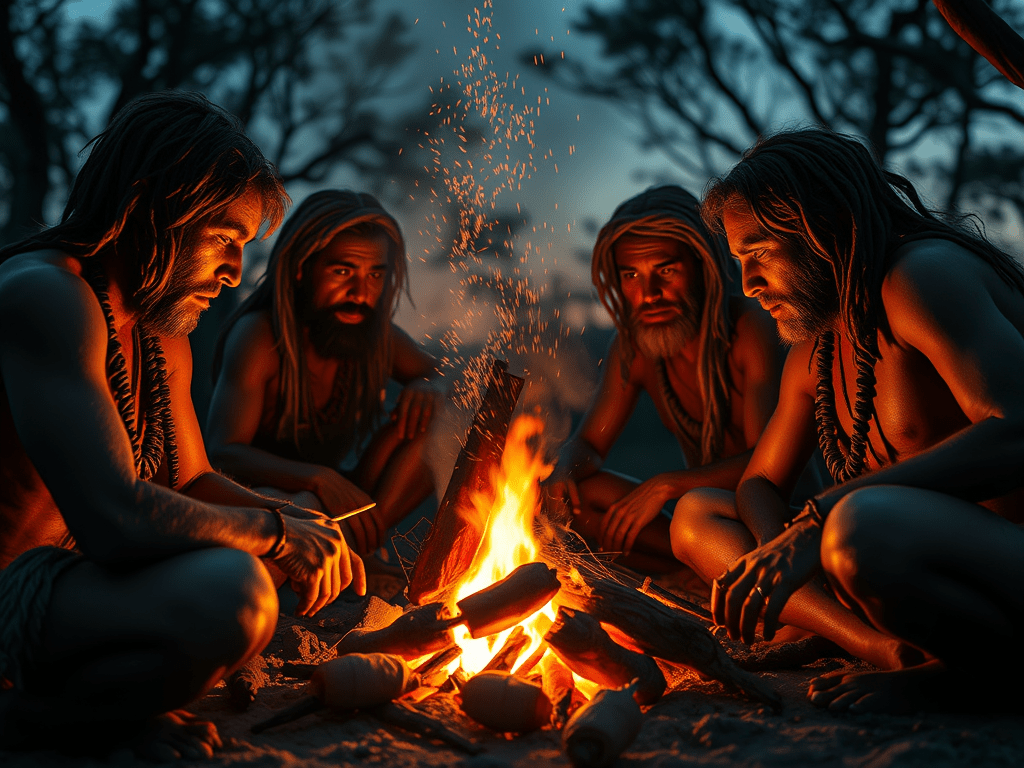
The text explores the significance of the hearth in human evolution, linking it to cooking, energy consumption, and social structure. The control of fire allowed early humans to cook food, improving energy yield and enabling larger brains and smaller guts. Archaeological evidence shows that fire usage became commonplace about 300,000 to 400,000 years ago, shaping daily life and social interactions around central hearths. It argues that the hearth served as a proto-altar, merging practical and ritualistic elements, fostering community through shared meals and storytelling, and reinforcing a sense of sacred space. Ultimately, the hearth transformed not just sustenance but the very essence of humanity.
Exploring Human Expression: The Origins of Art and Symbolism

The origins of art showcase human creativity’s deep evolutionary roots, extending beyond Homo sapiens to include Neanderthals and earlier hominins. Discoveries reveal symbolic expression dates back over 500,000 years, suggesting complex cognitive abilities and the importance of art for communication, spirituality, and social cohesion in ancient societies. Creativity connects us to our ancestors.
How Human Evolution Shapes Our Future

Why Study Human Origins? A Journey Into Our Past Where do we come from, and how did we become who we are today? These are big questions that many of us wonder about. Whether we look for answers through faith, science, or both, our curiosity to understand our beginnings brings us together. Studying human evolutionContinue reading “How Human Evolution Shapes Our Future”
Parenting Across the Ages: What Early Hominins Can Teach Us About Raising Children Today

Imagine what it might have been like to be a parent 1.8 million years ago. There were no cribs, no baby monitors, and no parenting books. Yet, the task of caring for and raising children was just as important then as it is today. While we often think of things like stone tools, fire, andContinue reading “Parenting Across the Ages: What Early Hominins Can Teach Us About Raising Children Today”
 World of Paleoanthropology