In this episode of “The Story of Us” we featured famed geneticist and anthropologist, Dr. Todd Disotell.
Hailing from NYU, this long-time researcher and professor have made long strides in the world of paleo genetics and phylogeny during his tenure.
Moving to the University of Massachusetts to take a slight career change, Dr. Disotell has a lot of advice to pass on to future geneticists, anthropologists, and researchers in general.
Join us in this episode to learn about the split between humans and apes, as well as what it means for science to evolve as a field.
Be entertained as we discuss some funny incidents in Todd’s past, and learn what it takes to make it in academia.
Join us!
If you like this episode please be sure to subscribe for more, and turn on that notification button to always know when I have a new episode out!
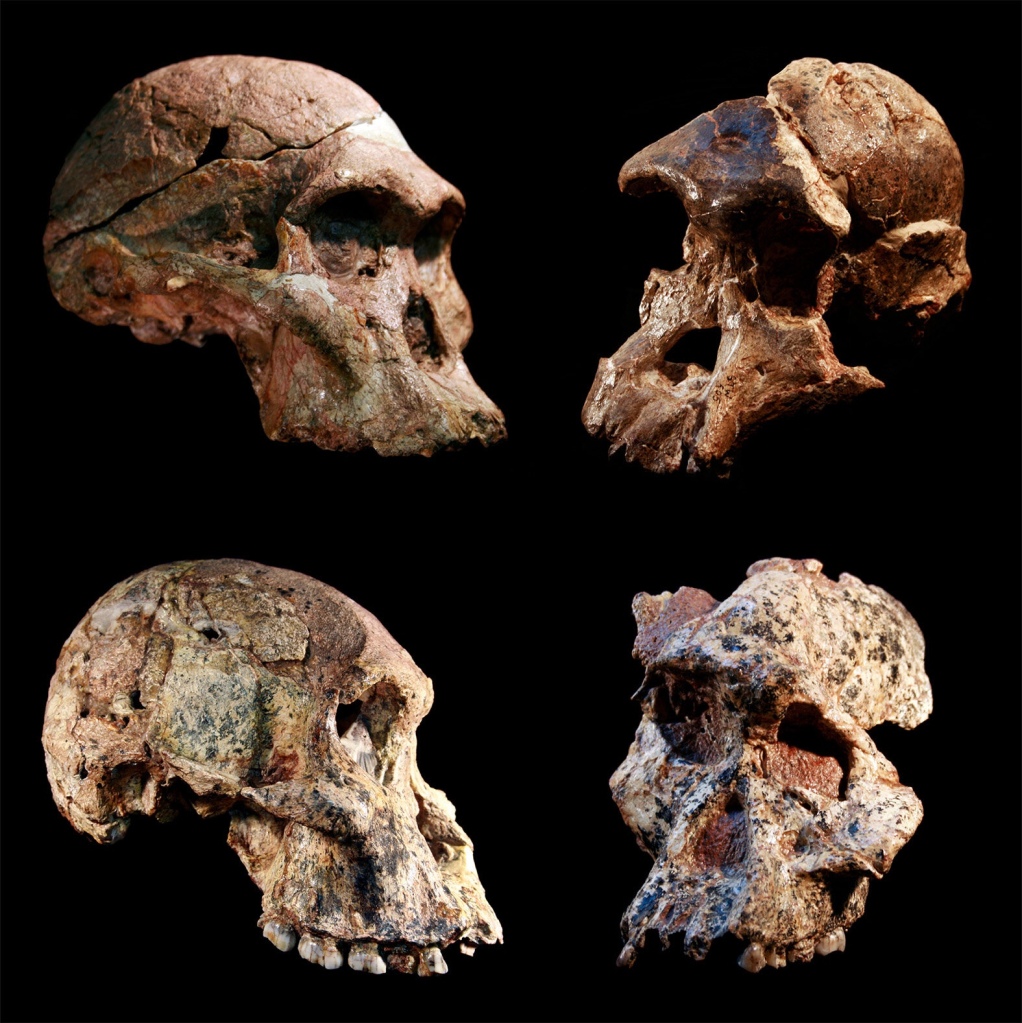
A new dating technology developed by Purdue researcher Darryl Granger is being used to re-date breccia blocks containing many of the world’s most famous South African hominin fossils.
Four different Australopithecus crania that were found in the Sterkfontein caves, South Africa. The Sterkfontein cave fill containing this and other Australopithecus fossils was dated to 3.4 to 3.6 million years ago, far older than previously thought. The new date overturns the long-held concept that South African Australopithecus is a younger offshoot of East African Australopithecus afarensis. Credit: Jason Heaton and Ronald Clarke, in cooperation with the Ditsong Museum of Natural History.
Using this new technique, (which measures the Cosmogenic Nuclides in the rock), at the world-famous UNESCO World Heritage Site, Sterkfontein Caves have been famously known for the number of hominin fossils found within the caves.
It is by far one of the richest Australopith sites in South Africa and has…
What I do, is not the most common thing. To many people, it is not even a worthy pursuit. Some say educating is for the classroom, and for teachers only with credentials in certain fields. And of course, they have their very important place. But due to a severe lack of direction and communication within the school systems as to what should be taught when it comes to science (we can blame politics and religion for this), it is harder for many people to access certain information.
Science Communication is about teaching, or rather communicating a complex, and hard-to-understand topic that many people struggle with, and making it easy to understand. To a point that the person who did not understand before, can explain it to others.
While to some, this may not seem important. Why do we need to know all these specific details about the world around us? Is what we learn in school, not enough?
In many cases, no, it is not. Depending on where you come from, your understanding of science, no field, in particular, is going to vary drastically from someone from somewhere else. Although true science should, and needs to be universal. But without the understanding that all humans are entitled to proper education, it is key to forming an educated society, which can progress and grow in healthy ways.
Hopefully, at this point, we, together as a group are starting to understand the place of scientific communication. While it of course does not replace traditional forms of education, it can and should serve as an important supplement.
Giving people the extra chance to really go hands-on with certain subjects, to see the science at work, to have it explained step by step, this is what SciComm or Science Communication is and why it can be so crucial to building a well-educated society.
Some of the best-known science communicators in our modern world, are Bill Nye, Neil deGrasse Tyson, and many others. There are many more amateurs such as myself as well that are attempting to do the same thing but for more specific purposes and sciences, such as myself with Paleoanthropology.
What science communication can do, is enlighten, and excite people of all variations and ages. It brings people together, it helps them understand. People who understand something are more likely to be encouraged to learn more about it, and other subjects.
Once the spark is lit, there is little that will put it out, and that is the goal of SciComm. To light the flame, to spark the inspiration. It is what I hope I do everyday, even if it just a single person that I reach.
There are so many difficult things to understand in this world, and some of us are just more inclined, and or raised in a way that they had more access to certain information and training in their lives that others did not. When they share this knowledge that they were keen enough to run into, it is when we see the true light of humanity, the passing off of knowledge.
When we have a well educated population, we have well educated leaders, and we can make proper decisions not only for ourselves, but for the planet as well. If we want to change this world, we need to give the growing generations what they need to succeed, not just in the business world, or the dating world, but in the intellectual world as well, for a world full of intellectuals rather than worries, will be a much kinder place.
There is always more to learn, and if you enjoyed this article, and want to see more of what I am talking about, then I implore you to check out my Youtube Channel right here, so you can start your science communication journey about Human Origins today!
Modern humans take great care of our dead, we revere them in many cultures, and in almost every culture we take care of our dead in one way or another.
It seems like it is something that is uniquely human, and while there is indeed a question of “What is Human?”. For now, we will leave that for another episode. For now, we will be focusing on the idea that non human hominins could have also disposed of their dead in a direct way, and even possibly, in a ritualistic way.
Of course, with out some sort of window into the past, we cannot know for sure what the Neanderthals did, how they lived, and as importantly, how they died and what happened to them afterwards.
Dr. Pomeroy is currently working on Shandihar Cave in Iraq, a very important location for Neanderthal studies, a cave where up to ten or more Neanderthal bodies have been found.
Some of these individuals have very interesting features that could really change the way that people view Neanderthals, and their complexity.
Tune in to find out all about this cave, Neanderthals, and a great amount of info surrounding their deaths!
Today, sad news is reaching the Paleoanthropological world as it seems to be doing often this year. We have lost many great minds of the anthropological world, from Richard Leakey, and now to the famous fossil hunter Kamoya Kimeu, most famous for discovering the Turkana Boy skeleton in the Turkana Basin in 1983.
It is sad that I have yet again to need to write another obituary, but I feel none of it is said better than the way Louise Leakey put it, a close family friend, who is now trying to raise money to cover medical bills and debt that was caused by Kamoya’s sudden illness, which eventually proved fatal.
I would like to simply share the words from the GoFundMe page, and hope that you spread the news, and help us raise as much money as possible to cover costs of medical bills, and funeral needs.
Thank you.
“
Some very sad news just received from Kamoya Kimeu’s daughter, Jennifer Kamoya, who has informed me that Kamoya Kimeu has just passed away.
He was admitted to hospital in Nairobi two weeks ago, with complications in kidney function. Kamoya’s family have sadly incurred a debilitating medical bill, and it is my hope that those who knew Kamoya and who appreciate his many contributions to understanding our past, can help me to raise some support for the family to clear the debt. I will pass this on to them as it comes in.
We are appealing to friends and well-wishers, to those who knew Kamoya personally or who appreciate his many contributions to understanding our past, to make any contribution, large or small, that can help support the family to clear the debt.
Kamoya was a fossil hunting legend. He worked extensively in the Turkana Basin from 1968 through to his retirement in 1993. His most remarkable find was that of the Turkana Boy skeleton, from Nariokotome, in 1983. This iconic, 1.6 million-year-old Homo erectus skeleton was highly significant due to its completeness. Nothing like it has ever been found since in east Africa. His many other discoveries have contributed enormously to the understanding of human prehistory.
Kamoya was recently awarded an honorary degree from Case Western University, in recognition of his major contribution to the field of paleoanthropology. He worked with both Louis and Mary Leakey at Olduvai and went on to explore the Turkana Basin and managed the field teams between 1969 and the year 2000.
Always with a jovial smile, positive attitude and extraordinary resolve to get through difficult situations, his perseverance and leadership led to the many important fossil discoveries both of animals and hominins at Lake Turkana. He was a mentor to many who have followed in his path. He will be greatly missed.
Kamoya leaves his wife, Mary Mbiki Kamoya and children- Steve Kamoya, Boniface Kamoya, Jacinta Syokau, John Kilonzo, Jenniffer Mwelu and Nicholas Makau.
Please share this as widely as possible. Your support is most appreciated.
Paleoanthropology is the study of our shared Human Origins. We know from near 100 years of study, that our lineage began in Africa, somewhere between 6 and 7 mya. (Million Years Ago).
There have been numerous finds that support this theory, known as the Recent African Origins Hypothesis, or better known as the Out of Africa 2 Model. We have empirical evidence, the fossil record to support what we know and think about our evolution in Africa during this time. From the Australopiths that lived 3-4 million years ago, to the rise of our genus, Homo.
DVD 1114 (08-07-22) Presentación del descubrimiento de la cara del primer europeo, en el yacimiento de Atapuerca. De izquierda a derecha, Rosa Huguet, Jose María Bermúdez de Castro, Gonzalo Santonja, Eudald Carbonell y Juan Luis Arsuaga. Foto Samuel Sanchez
Another great question that many anthropologists have, is how did modern humans get where they are today? Or, especially, how did the many various hominin fossils that we have found around the world, arrive there? We have Neanderthals all across Europe and the Levant, Denisovans in Asia, and more. All of these hominins date to well within the last 1 million years.
At a site in Spain, the farthest western area of Europe, we have the well known area of Atapuerca. It is a great case, where many hominin fossils have been found. Thus far, the fossils found in this chasm have been dated to being the oldest hominin fossils in Europe, dating to around 1.2 mya. While the fossils in Dmanisi date to around 1.8 mya, it is not considered to be apart of Europe, and not only that, but those specimen seem to be Homo erectus. The fossils found here, are much different.
In 2007 a jaw of an unknown hominin species was discovered in level 9 of Sima del Elafante, and at the time it was declared the oldest hominin in Europe. Now, lower in the chasm, by about two meters lower, another jaw, and tooth have been discovered, dating to about 1.4 mya. This is big news, as this makes it the oldest hominin in Europe by 200ky if not more.
Now the important thing to remember, is how far away Spain is from Africa, to have hominins this old so far away from Africa, changes how we think about the diaspora of hominins out of Africa. When did they leave? Where did they arrive, and how long were they there?
What species of hominin could they be? One possibility is that they belong to the known species H. antecessor which is believed to be the last common ancestor of Modern Humans, Neanderthals, and possibly even Denisovans.
An important thing to keep in mind however, is the dates have been calculated by where they are in the chasm, they have not been dated yet using a typical method, which will take about a year to get the final results in.
One of the most interesting aspects of the partial mandible and face that was found, is that there is a distinct, very human like chin. Something that we do not see in any other species besides our own. So what could this species be? As always, there will be more to learn and to figure out, but this find is truly astonishing and adds to another year of amazing finds.
The fossil was discovered by Édgar Téllez, on June 30th 2022, so this is truly very breaking news. There is just so much we can investigate and learn about this, and it is only the beginning.
“Téllez quickly warned Rosa Huguet, coordinator of the Sima del Elefante site. “His face when he saw what he had found was different than other times,” the scientist recalls.” (1)
The fossils have been presented this Friday in the town of Burgos by the three co-directors of Atapuerca (Juan Luis Arsuaga, José María Bermúdez de Castro and Eudald Carbonell), by Rosa Huguet and by Gonzalo Santonja, Minister of Culture of Castilla y León.”(1)
“This discovery will probably help us to know the species that socialized Europe,” Carbonell said. It is possible that there are previous hominids, he has argued, but these were the ones that began to establish the most numerous and permanent populations.” (1)
Along with the partial face, the tooth that was discovered may present a good opportunity for protein analysis, which can inform us a great deal about these hominins, from their health, to what they ate, and so much more.
Keep an eye out on this space for more information on this incredible find as it becomes available!
On this episode of “The Story of Us” we are chatting with longtime friend of the show, Prof. Fuentes out of Princeton.
While the original book was published ten years ago, we are now lucky enough to be getting a second edition! Listen to our chat; learn about what the motives behind the book are, and why you should pick up a copy as soon as you see one!
This book can, and if you read it correctly, will change the way in which you view Humanity.
“There are many ways to be Human”-Dr. Fuentes
We had a great time chatting, and hope you learn from what we had to say!
There is always more to learn!
*Video is Processing, check back soon for your viewing pleasure!*
A new dating technology developed by Purdue researcher Darryl Granger is being used to re-date breccia blocks containing many of the world’s most famous South African hominin fossils.
Four different Australopithecus crania that were found in the Sterkfontein caves, South Africa. The Sterkfontein cave fill containing this and other Australopithecus fossils was dated to 3.4 to 3.6 million years ago, far older than previously thought. The new date overturns the long-held concept that South African Australopithecus is a younger offshoot of East African Australopithecus afarensis. Credit: Jason Heaton and Ronald Clarke, in cooperation with the Ditsong Museum of Natural History.
Using this new technique, (which measures the Cosmogenic Nuclides in the rock), at the world-famous UNESCO World Heritage Site, Sterkfontein Caves have been famously known for the number of hominin fossils found within the caves.
It is by far one of the richest Australopith sites in South Africa and has been a backbone for South African Anthropology for nearly one hundred years.
Dating to what we thought was about 2.5-2.7 million years old, famous fossils such as Mrs. Ples were once thought to be a younger branch of the East African Australopithecus lines.
This may throw that in doubt.
The new dating method, which has thus far only been applied to the Sterkfontein fossils, is showing them to be a whole million years older than we once believed, placing them around 3.6 million years old. Which is older than the “Lucy” skeleton discovered in the ’70s.
However, with any new technology, it is essential to understand that there will be a margin of error, and in the way that this method works, the faunal dates that are often used to help identify the date of fossils, need not apply. This could be positive or negative for those doing the research.
It is important to realize why this is so important, understanding the paleo landscape of where our ancient relatives lived, is key to understanding how they acted, what they did, and why. Knowing how old a fossil is, and where it belongs on the fossil record, is critical to understanding its place on our braided family bush.
While it is going to take further testing and time to tell whether this new method is as successful and predictable as previous methods. As this first paper comes out detailing this new and exciting science (linked below) we can see the promise of such a new method.
We will see where it lands us, but the prospect of these new dates and their implications is very exciting! The more we learn, the less it seems that we know!
Today on this episode of The Story of Us, we are featuring someone I specifically look up to as a science communicator and paleoanthropologist in training, Dr. Briana Pobiner of the Smithsonian!
The list of activities and successes of Dr. Pobiner’s career are note worthy, and worth just listening to this episode to hear why she is so deserving of such acknowledgements.
From inspiring young children to fully grown adults, to seniors, the excitement of Paleoanthropology and science in general drives her on to do some pretty amazing things.
Learn about why science communication, or SciComm is so important, and critical to creating a healthy and sustained society for the future of the human race.
Today, yet again, I have sad news to report. Once again, in 2022 we have another great paleoanthropologist that has been lost to the annals of age and time. Last night, word spread that we lost Dr. Yves Coppens. A French paleoanthropologist, who in his home country is known as the discoverer of the Lucy skeleton, known as the “father” of Lucy.
Truth be told, to make clear the issue where you may be wondering, did Dr. Don Johanson not discover Lucy? The story is, that Dr. Coppens was the director of the field site for years, before the discovery of Lucy. Once he retired from the position and was no longer the leader of the expedition, Don came in, and in 1974 made the Lucy discovery.
Despite this, Coppens played a major role in the management and direction of the site. It is very clear and important to understand that Lucy may not have ever been discovered had the work that Dr. Coppens had done, had not been done.
A former professor at the College De France, which is considered to be the most prestigious scientific establishment in France, and in 2014 was named an Ordinary Member of the Pontifical Academy of Sciences by Pope Francis. Having 4 doctorates, and belonging to dozens of scientific organizations across Europe, let us not forget the many awards that he achieved during his career.
Leading an incredibly interesting, and well-lived life, Dr. Coppens will be missed dearly by his loved ones, colleagues, and those that he leaves behind.
His work, however, will live on and continue to inform us about the history of our early Human Origins.
May the Coppens family have the peace and quiet that they need to heal and recover from this great loss, and we from the World of Paleoanthropology send them our best, and sincerest wishes.