After a good deal of hard work, I am proud to announce that we finally have our own podcast on iTunes!
Click Here to Get to Podcast
This podcast, titled, you guessed it “The Story of Us!” will be the highlighted episodes of our beloved video and interview series. Not all episodes will be available, only specific curated ones.
Allow me to make this clear as I do not want anyone to misunderstand this. The first episode of the podcast, which is our Neanderthal Symposium is free, but all following episodes will require a monthly subscription for $2.99 a month, or $30.99 a year. This DOES NOT affect any of the episodes that we post on Facebook, or Youtube. All of our videos and content will still be available for free, with open access on our site and YouTube.
This is just the extra premium if you would like to use the app, and help support what I do here. Currently, I make zero funds from doing this, in fact I have to spend money in order to keep all of this running, I do not expect much, but If I could get some funds coming in, I could do more, and more exciting and fun things! And the more of that I have, the more premium content I can make for those who are subscribers!
As time goes on, there will be content that is for the podcast only, but not the traditional interviews, or anything like that, so no one should feel like they are being left out, but I do want to offer this premium option to help fund STEM and SciComm projects.
Please, listen, like, enjoy, and if you can, subscribe!
For some of us, the chase for knowledge is never ending, and the need to learn as much as we can is insatiable. Trust me, I am one of those people, and I understand the importance of balancing modern day life, work, family etc. with academic pursuits. Some of us are lucky that we can dedicate our lives to academia, but others of us are enthusiasts, and there is nothing wrong with that!
However, what that does mean, is that many of us are loosing out on what is going on in the Anthropological world because we do not have the time to sit and read all the new journal articles (if we can even afford it, #OpenAcess FTW) or sit and read the newest books. While i highly recommend you do when possible, I understand the difficulties with keeping up with things this way.
Since Paleoanthropology is, in my opinion of one of the fastest moving fields in STEM, it is important to try to stay up to date with current data and hypothesis, with the research and what is going on. When we have time, siting down to listen to an Audiobook, or to pick up a physical book, or watch a documentary, its a great thing to do. But sometimes, we do not even have time for that! And even if that is not the problem, some of us just like a different medium for their entertainment and education!
So today, I am proud to show off our Top Eight Anthropology Related Podcasts of 2022, so far! These are not listed in any particular order, if they have made it onto this list, that means they are all of high quality, and worth your time to listen to!
All of these podcasts are on Apple Podcasts, I do not know if they are available on other services as I do not use them, but I will give the names of them, and their links for Apple, so you can at least search for the names!
There are many things that are tough to understand in this world, those of us in positions of researching and making the discoveries that cover the headlines, should take some time to actually explain what these things mean…this is SciComm.
We live in an amazing world. One that, if given the chance, will never cease to amaze or astonish you. No matter where you come from, who you are, or who you want to be, planet Earth is the place to be. From magical woodlands to dense tropical forests, and the highest mountain peaks; Earth is a varied, and dramatic place.
For many of us, there is this interest, an interest to understand the world around us. Some of us do this with our five senses; sight, sound, touch, taste, and smell. Others of us, just as validly try to figure out the mysteries of the universe and Earth through prayer, or communion with whom they believe to be a higher power.
It is hard to go wrong when it comes to discovery, as long as you are not harming another living thing, then the world is your oyster. For as long as modern humans have been on this planet, which as far as scientists can tell is around 300,000 years, we have been wondering not only about the world we found ourselves in, but about ourselves too; beginning to answer questions about where we came from, and why we seemed to set apart from nature.
Whether you find your answers or just more questions, there are some ways in which we can go about exploring the natural world around us. Today we will be talking about the scientific approach, the more modern and unbiased approach. We need to be able to answer the questions that plague our society today, those surrounding climate change, famine, and wealth disparities, in fact, we are even facing a sixth great extinction event. We need now to be more prepared and educated on the world around us than ever before.
Today we will be discussing just what SciComm is, why it is important, how to start practicing it, and why you should. Now is the time, there may not be many more tomorrows if we do nothing. But, as famous primatologist and naturalist Jane Goodall always likes to point out; there is always hope, and each of us can play even just a small role in turning the world around.
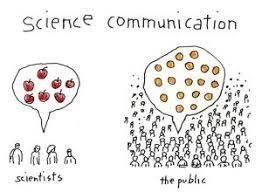
So what actually is SciComm now that I have mentioned it so many times? SciComm stands for “Science Communication”, and what that means is exactly what it sounds like. Communicating the aspects of science. But it goes beyond that. For much of our scientific history, which has of course only been over the last few hundred years, we have kept much of the knowledge higher up on the social threshold. Today that is no longer how things are done, or at least that is the new way in which the scientific community is leaning. Of teaching and educating, sharing, and advancing the sciences by spreading determination and inspiration to new generations all around the world.
Science can compose of so many things, there are so many fields of science, and truly when one gets to know a few of them a little more closely, it is clear how they all relate to one another. Many sciences are now multidisciplinary, meaning you take more than one field and apply its methods to a problem. Often times this causes a much more accurate answer, and in better time.
Today’s sciences focus on a variety of topics, some of that which the fate of our world depends on. Things like climate change, ecology, population sciences, agricultural studies, environmental studies, etc. are all ways in which modern-day scientists are trying to do their part in helping the world. If we cannot leave the world a better place than we found it, what are we leaving future generations? We must prepare, we must use the gifts that we have been given intellectually to solve our problems.
Now some of you might be saying that it is too late, or that the solutions to the problems take too much time or money. Well to that I say, never before has there been such an enthused generation to really make change for the better for not only ourselves but the planet in which we habitat. One of the best ways in which we have discovered how to do this is SciComm. Teaching the next generations right from ecological and scientific wrong. Giving them the tools and methodology to make real change in the world.
It is important to understand that when we are dealing with the sciences, there is a grand canyon sort to say, of a distance between a “fact” and an “opinion”. Many people like to believe that their opinions lead to some scientific truth, but for many, this is unfortunately not true. It is important when getting involved in science, of any kind, to know that it has to be unbiased and that your feelings and opinions do not, and cannot affect the data. Otherwise, the science is flawed. One of the most important rules a science communicator can teach.
All right, so now that we have gone over all of that important information, what actually is SciComm and what role does it play? Well, as mentioned above, for a very long period, pretty much up until the modern-day, scientific discoveries were for one reason or another kept away from the general public. Either for their “safety”, or other manipulative reasons, or simply the information was too hard to understand that people gave up trying to explain it. Science Communication aims to fix all of those wrongs.
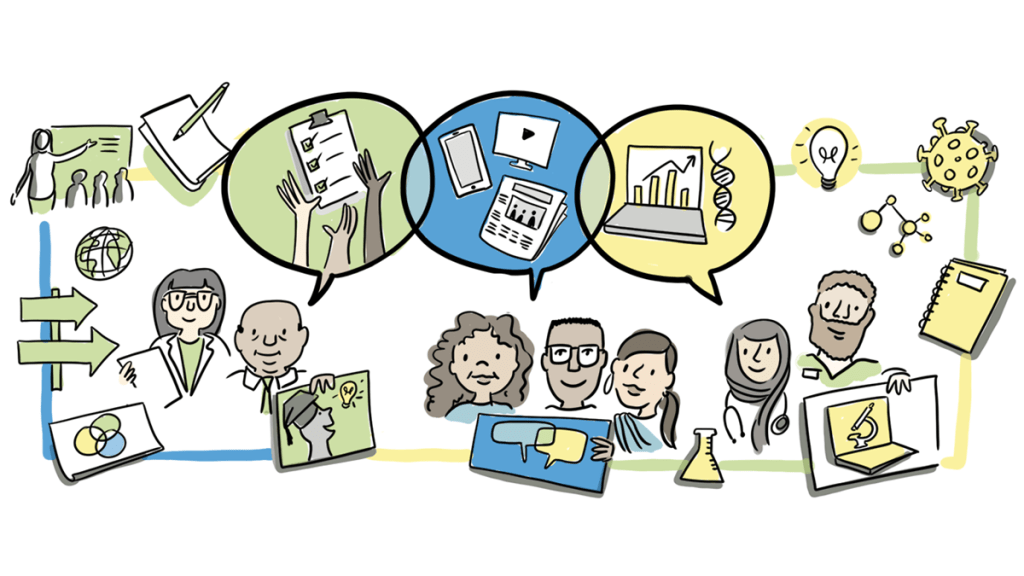
With science communication, the goal is to break open the doors of the “Ivory Tower” and let any interested person or party enter, to lay low the walls holding people back from a basic, or even advanced understanding of the sciences. Science communication is about taking advanced, hard-to-understand terms or concepts, and breaking them down in a way that anyone can understand. If done properly, it is even done in a fun way that is engaging and will live on with the individual the rest of their lives.
Science communication is about inspiration, about a call to action. It is about teaching that yes, there are real dangers out there, and there are real problems that need to be fixed, but, if we sit down collectively as a species, we can put our massive intellectual power together to save ourselves, and this planet. But beyond that, how else are we to advance as a species if we keep starting things over and over? We must build on what we know, share it with the next generation, and advance science.
So why is this all so important? Well, who do we want leading the world’s nations? Who do you want to make the decisions that are going to make massive ecological changes for dozens, if not hundreds of years or longer to follow? We need an educated body of people making these decisions, and unfortunately, that is not going to happen from the top down. It is sad to say but just is true, that we live in a world of old, outdated thinking. Pulling ourselves forward is going to take a great deal of effort, and that effort begins with each new generation.
When a new generation is born, it is an entirely new opportunity to start again, to instead of indoctrinating our children to believe one thing or another, but to give the facts, and nothing but the facts to those who seek it, and to allow them the opportunity to have, and express. These new generations will then grow to take over the positions of the old guard, creating a better, more educated world for us all to live in.
To do this, we must make sure that the resources are available, locally, and on national levels. That children of all nationalities, creeds, orientations, and backgrounds can learn to become whatever they dream to be. To create a future of possibility that seems to have been lost in this world. Science and education are shining lights in the darkness of an uneducated and ignorant world. A world that I do not think any of us wish to leave our children, our future generations.
Making this information available, creating lesson plans, tools, presentations, activities, and showing children the science, actually getting them involved is the best way in which we can make this happen. There is nothing like hands-on experience, and that is something unfortunately that so many children are lacking today.
Science has changed the world many times over, for better or for worse, and we have the chance to change the world again, and for the better, if we have the right tools, technology, and people leading us. This all starts with a science communicator sparking the interest of a child or two at a school presentation, or online. Or wherever it may be. We must do all that we can to promote these ideas and keep our societies moving forward, farther from the dark and towards the light.
Stone tools or lithics are very important to human origins and evolution. Without our advanced skills and ability to manipulate the world around us with tools, we would not be the dominant species that we are today. In fact, who knows if we would have even survived up until now. Stone tools date back to about 2.5 million years ago, it has long been believed that Homo habilis (The Handy Man) was the first toolmaker. But new dating in Oldupai Gorge in the Great Rift Valley, East Africa, has pushed back the dates of those tools, showing that they may have in fact been made much earlier, and by Australopithecines, before Homo.
Wherever stone tools originated, they completely changed how humans (and I use this term to describe any hominin in the last two million years). They allowed us to do things that were either much harder to do or plain impossible without them, such as cutting and slicing meat, which when added to our diet, changed us in many ways all on its own. Throughout human evolution, there is a clear pattern of stone tool cultures, starting with the Oldowan from the Oldupai Gorge, created and used either by australopiths, or early Homo, then we have the Acheulean, which was created and used by H. erectus the first hominin to have a truly human body to really hunt and cut meat, and a few more industries after that, until we get to the bronze age.
All of these different stone tool industries as they are called served different purposes and were in use for hundreds of thousands, if not millions of years. As our ancestors evolved, so did their ability to craft stone tools, making them more advanced, and able to suit more of our needs, and wants. Out of all the things in archaeology, we feel we have a pretty good understanding of stone tools, but a recent find may show that we know less than we thought.
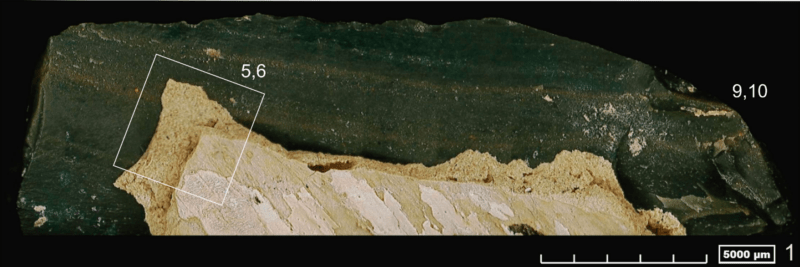
This week in China, in the Nijewan Basin, near Xiamabei (which is almost 100 miles from Beijing) we have discovered something new and mysterious. A whole new stone tool culture that we had never seen before. The tools, which were dated to around 40 thousand years ago, were not what was seen around the world at this time in other places, such as Africa and Europe. These tools, called bladelets (little small blades that are hafted onto bone, or wood handles) were found all over the area, in various shapes and sizes.
“The remains seemed to be in their original spots after the site was abandoned by the residents,” co-first author Shixia Yang, a researcher with the Chinese Academy of Sciences and the Max Planck Institute for the Science of Human History, told Live Science in an email. “Based on this, we can reveal a vivid picture of how people lived 40,000 years ago in Eastern Asia.” (1)
What makes this special, is that all other stone tool industries, at least at this time, varied greatly from these. They were unlike any that had been seen for this time at any other time. Found at a layer about 8 feet underground, using radiocarbon dating, we found out that these tools, which surrounded a hearth were 40 thousand years old. Thus unlike tools being used elsewhere in the world, these 380 miniature lithics were strewn all over the hearth area that was discovered, along with 430 mammal bones.
380 bladelits were found at the site, and all would have been used for a wide variety of purposes, from creating other tools, cutting textiles, or most likely, cutting up meat to make it easier for consumption.
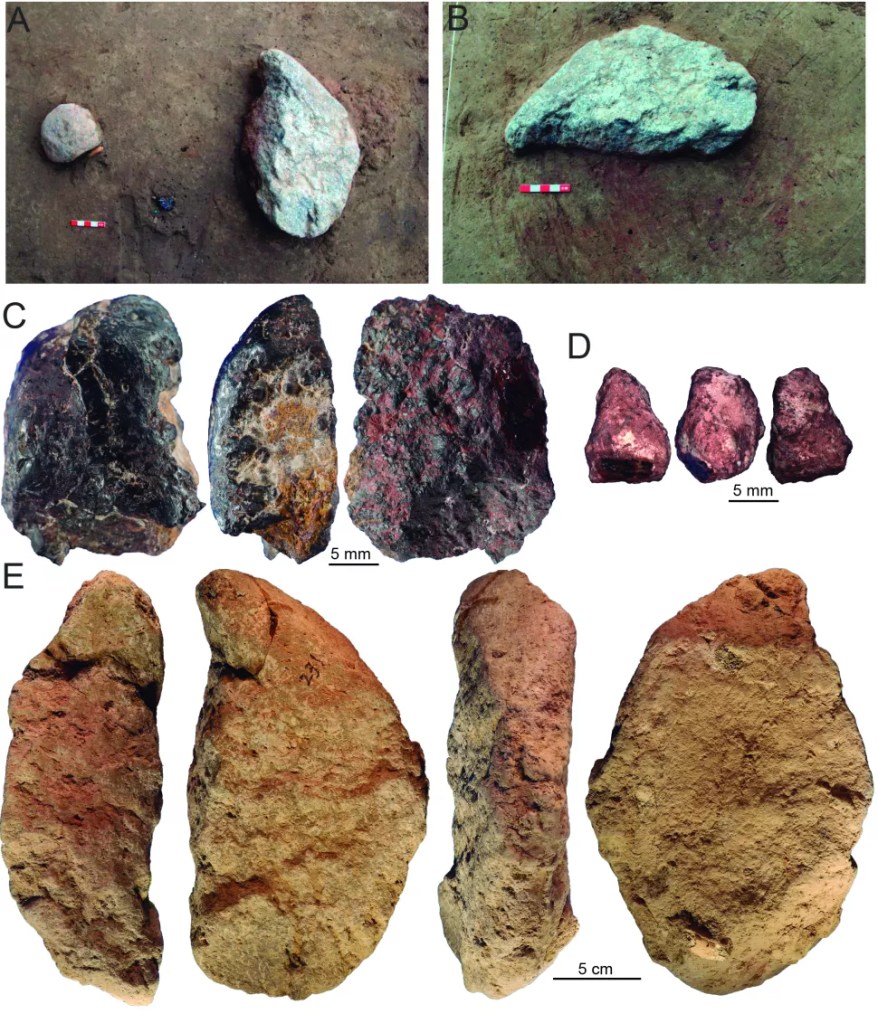
The other aspect of these tools, that is crucial and hard to understand, is that these are the first stone tools that we observed with the presence of Red Ochre in China. “Archaeologists have uncovered evidence of ochre processing in Africa and Europe, to a lesser extent, dating back to about 300,000 years ago, and there’s evidence of ochre use in Australia starting about 50,000 years ago, d’Errico told Live Science. But prior to the excavation of Xiamabei, “the evidence for ochre use in Asia before [28,000 years ago] was, however, very scant,” he said.”(1) According to an article written in live science, based on this paper.
So what were these tools used for? Well of course, as we all know while bones and stones may fossilize, behavior does not. So we cannot know for sure what these tools were used for, or who made them. While H. sapiens are believed to be the creators, other closely related species may have been in the area at the same time. So it is not impossible to rule out Neanderthals or possibly even Denisovans. The fact that these tools have Red Ochre covering them, gives them a ritual sense, or at least a sense of significance over anything else.
We know Red Ochre has been used for ceremonial purposes all over the world for millennia, and since this is the first finding of it in China, this is a pretty big deal! So while we may not know who did it, or why, we know it was important in the hominin development in China.
While there are still many mysteries to be solved about these new lithics that have been found, we know their general place in human history, for, of course, they would fulfill the same reasons any other human would have made stone tools. The mystery lies with why were these so different than other tools in the world at this time? Why were they covered in Ochre? How did it find its’s way onto these tools? We may never know, but it is very significant in the grand scheme of things, as the “first” for everything is important.
While we may not know exactly what these tools were for, why they were different, or even who made them, it is just another mystery to add to Paleoanthropology, which is an ever-growing field of questions, and I would not have it any other way!
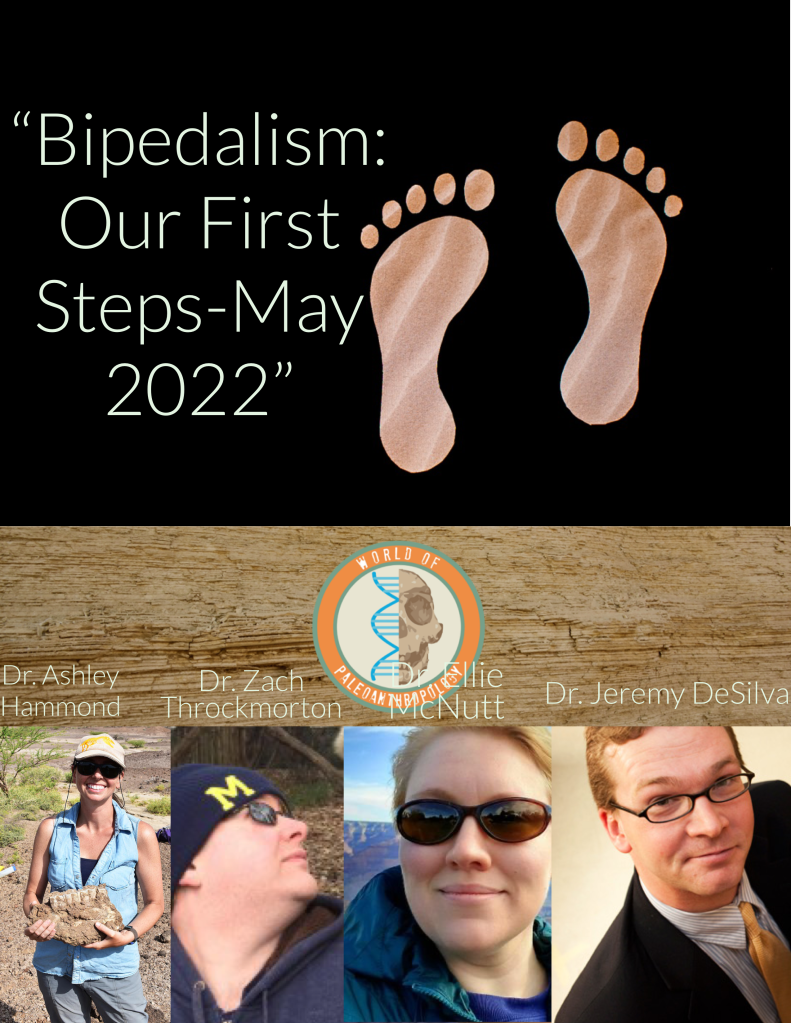
I am proud to announce the second #WOPA Symposium! This time on the origins and functionality of #Bipedalism, or upright walking, aka walking on two feet!
We have some awesome experts coming on board, and while this event is not live, you will have a chance to email your questions to worldofpaleoanthropology@gmail.com with the subject “Symposium Q/A” and we will have a period of time after all the presentations are done, to get them answered!
Each presentation will be between ten and fifteen minutes, followed by a 45 minute Q/A.
Once everything is filmed and put together, it will be posted across our social media sites for your educational and viewing pleasure!
Welcome to the next episode of “The Story of Us”, our online show where we interview and have chats with prominent members of the scientific community! Today we are featuring guest Dr. Craig Stanford of USC, a primatologist who has worked closely with Dr. Jane Goodall, and has many interesting stories of his own to share.
Dr. Craig Stanford
Come join us to learn about chimpanzees, conservation, Jane herself, and what it takes to be a naturalist. We join Dr. Stanford (whom I had the pleasure of seeing in person just the other week) who is as friendly as they come, and was kind enough to come join us!
Hear some of the secrets and misconceptions about Chimp society, and learn what makes a chimp a chimp!
Come along, and never stop learning!
Be sure not to miss an episode by subscribing! And if you learned something, please like and share!
In this episode, we are interviewing Dr. Carol V. Ward, a Paleoanthropologists who has done work in Kenya, and from her home University.
Leading a lab of her own and being a part of the leadership team for a research institute in the Turkana Basin, Dr. Ward is very well accomplished and is a wonderful storyteller. In this episode we talk about the current state of Anthropology, and where it is going in the next few years.
Tune in to hear our chat and learn all about Paleoanthropology in today’s age from someone on the forefront! To view all our episodes, please visit our Youtube Channel. For more information on Paleoanthropology please visit our website http://www.worldofpaleoanthropology.org for blogs, news, interviews, and so much more!
If you liked this episode, please be sure to like it, and subscribe so that you do not miss a future episode!
I have many fun ideas for some future videos and you are not going to want to miss them! Until next time! Never Stop Learning!