In collaboration with my University, we are having an #Anthropology speakers series!
Stay up to date on this page and follow to catch these awesome meetings!
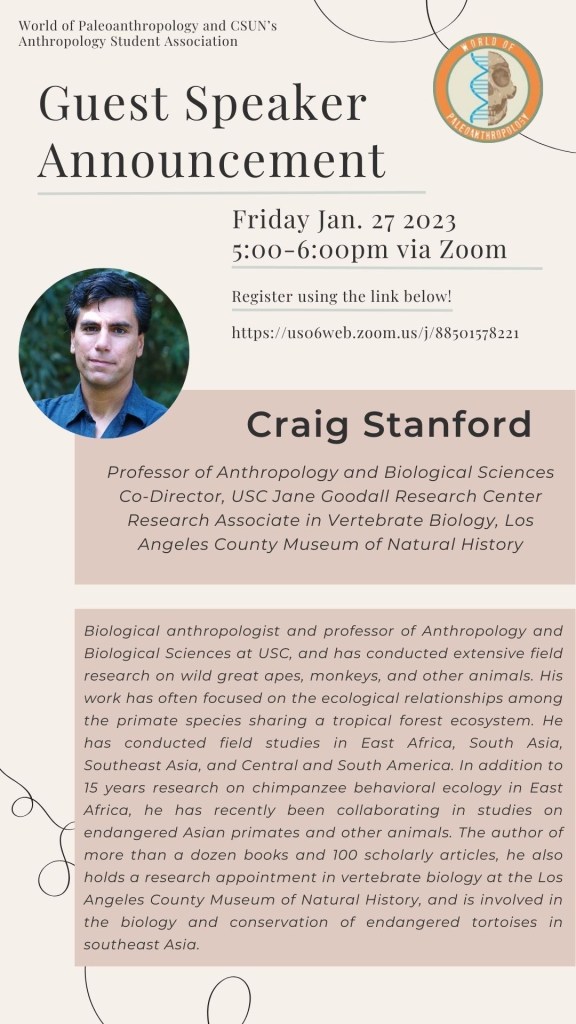
Coming up this week, we have Dr. Craig Stanford! A good friend of WOPA.
Join us on a Journey through Deep Human Time…
In collaboration with my University, we are having an #Anthropology speakers series!
Stay up to date on this page and follow to catch these awesome meetings!
Coming up this week, we have Dr. Craig Stanford! A good friend of WOPA.

View and Discuss on Academia.edu
From a small age, we as children begin to develop an idea based on a natural observation that we make. Animals with bigger brains are more intelligent. As far as children and most adults know, this is true. But not only is it a very general statement, we know that it is, in fact, untrue, and we have examples of it throughout the natural world. It is true that having a large brain, relative to body size, does help in the intelligence department, but the sociocultural aspects of our being, which as social apes, are crucial, may not lay in the cranial capacity of our skulls, but rather the formation and development of our brains themselves. For an organ that takes up 20% of our caloric intake, it must be an impressive act of feats it accomplishes.
Throughout the history of Paleoanthropology, scientists and researchers have assumed that if the hominin (one of our extinct bipedal ancestors) had a tiny brain, it must mean that said hominin was “lower on the evolutionary tree.” It was less intelligent, capable, and organized as a social animal. But there have been a few essential pointers here that we have to consider if we want to test the hypothesis of “does a bigger brain equal a more advanced, intelligent, and social animal.”
Of course, there will be hundreds of studies on this, surrounding animals of all kinds, throughout scientific literacy. Being an anthropology page, we will focus on humans and non-human primates. But the basic idea that I will try to prove in this article is that brain size relative to body size is not only critical, but how the brain is formed, the factions of it, and how it is divided up play much more important roles in the creation of the behavior of the animal, than the size of the brain itself. More brain matter does not equal more intelligence, as we will see.
So with that, let us begin.

Why is our Brain important? While this may seem like a dumb question, it is much more complicated than one might believe at first thought. Why do we have a center for all our electrical stimuli to originate? Why not other localities around our bodies or some ofter biological formation? While I am no neurologist, I will walk us through the basics of the development and evolution of the human brain and any mammalian brain, as we all share the same structure, despite differences in size and organization. First off, we have the development of the most basic form of our brain, the innermost brain. The deeper you go into the brain, the more ancient the parts of the brain are evolutionary. The Medulla Oblongata, the part of the brain that controls breathing, is believed to be, along with the pons, one of the most ancient parts of the brain. From then on, senses and other items were developed, leading to nerves and the nervous system; the brain became more complex, dividing itself into parts or lobes responsible for different things. For example, the back of our brains, the brains of modern Homo sapiens, is called the Occipital Lobe. This part of the brain is responsible for vision; we know this thanks to MRI scans of brain activity and the good old fact that if you get hit in the back of the head, you “see stars.” An animal with a brain half our size may still have an occipital bun larger than ours, or more importantly, more developed than ours, and thus may have better vision, even though its occipital lobe may be smaller.
So, where does the size of the brain come in? First, I need you to think about and understand an important point. Brain size is relative to the size of the body of the animal. It does not have relevance to the intelligence of the animal. An elephant, while extremely intelligent, with a much larger brain than ours, is not thought to be more self-reflective, intelligent, or social than Homo sapiens. Just because you have a big brain does not make you at the top of the food chain, so to say, What counts more, we have found out through numerous studies, is that the creases in our brain, called fissures, and the amount of them is more relevant to our level of intelligence. So, just because Neanderthals, in some instances, would have had bigger brains than our modern species, it does not mean they were more or less intelligent. When it comes to neanderthals, it is more likely that it comes to the fact that our brains are organized differently.
We can see from endocasts, which are prints that the brain leaves on the inside of a cranium; we can see and use advanced technology to recreate their brain structure (and those of other species, extant and extinct) and see how they differ from our own.
So why is this all so important? Especially at this point in the field of Paleoanthropology. Well, as was said for the longest time, we believed that our brains grew as we evolved and became closer to the beings we are today. However, even with this, there is a problem; in the last 20,000 years, we have lost brain mass, but have we become less intelligent? Highly unlikely. So what happened? (Refer to image 1). Even more importantly, there have been numerous discoveries over the last decade, such as the finds on Flores and Luzon. In South Africa, significant finds have challenged the idea that you need a big brain to have a complex and advanced society of what we would recognize as cultures today.
Here comes Homo naledi. Discovered in 2013 by a team led by Dr. Lee Berger, a mass of remains was found deep inside the Rising Star Cave System, dubbed a new species, and it became more and more apparent that something strange was happening there. There were so many individuals, in situ, laid out, children to adults, and everyone in between. While it was known at the end of 2022, there is evidence of burned charcoal and remains of small animals, soot on the roof of the cave, and even hearths discovered. Now, this may not sound all too impressive when you are talking about a member of the Homo lineage, but let me tell you something about naledi. Their brains were tiny, around 450-600cc, whereas ours are around double that. So now we have a creature performing possible ritual burial, controlling fire, and using it to light its ways to navigate in these insanely complex passageways, all with a brain the size of a chimp. According to Prof. John Hawks, this is because, as we mentioned earlier, the formation of the brain. While we are still piecing together exactly how their brain was formed, we can learn so much from the endocasts we have, archaeology, or the behavior they left behind.
Here we have a creature, 300,000 years ago, performing what we believe were at least simple burial rites, ritualistically, showing distinct signs of culture, with a brain the size of a modern chimpanzee. This stunned the scientific world and still holds many secrets to be unveiled. One thing is for sure, though, the recent discoveries in Indonesia and South Africa prove that a tiny brain is just as capable of forming a distinct and understandable culture and that a large brain is not needed for the intelligence required to be called “human.”
For decades, one of the most famous explorers has been wondering, “what makes us? Human” Dr. Louis Leakey started the world on an adventure that came about with “Man the Tool Maker,” thinking that only humans could possess the talent and brains needed to produce tools. How wrong we have been proven since then. Every major paper that comes out these days claims that they have discovered or proven something else that “makes something human or not.” And every other paper proves other animals had the same behavior. We are a part of the animal world, and we need to recognize that. We are all a part of a natural cycle, and by just looking at an animal and assuming its intelligence, consciousness, ability for apathy, etc., by just its brain size. I think we are looking at it the wrong way.
An animal’s smarts do not come from the size of its brain; while, of course, relevant to the size of its body, the brain does vary in how much of the body’s energy it consumes. Some animals need to be constantly alert, using their senses; others, such as modern humans, can put things on the back burner and relax our minds. This is due to our ability to compartmentalize through abstract thought. A sign of higher thinking that we do not see in other animals. Even with the mirror test, where we place an animal in front of a mirror and see if it can recognize itself as itself, only so few pass the test. Mostly primates, as one might expect.
In an interview done last week (as of the writing of this), Dr. John Hawks was on a podcast interview. In the interview, he claimed much of what has been said above, that brain size is not as important as an organization or how parts of the brain are connected in terms of the animal’s behavior and what it is capable of. In an interview this week, Dr. Lee Berger says there will be announcements about this species that change how we define and think of what is human (like I said, huh?) We will see what naledi was up to to make Lee think that, but he confirms that it is not the size of the brain that matters. So some big announcements concerning the behavior and activities of Homo naledi are on the horizon. So be sure to stay tuned for all of that juicy news!
Well, I think that about does it for this article; I hope it makes sense and clears up a few things for people who may be wondering how neanderthals had bigger brains than us in some cases or how such small-brained animals like the hobbit were surviving, even thriving for a while on such a small island with limited resources, yet modern ( for the time) tools. There is so much left for us to learn, and we will do it together at each step!
Until Next Time!
Seth Chagi

If you are a fan of Homo naledi such as myself, and you want to stay up to date with the latest news and explorations, I have no better place! Aside from this website and all I offer here, be sure to check out this specific playlist I created that has all of my related Homo naledi videos, with all the experts you know and love, and I will also be adding to the playlist as I create new content.
With three huge announcements coming early this year, it’s going to be a very active time and there is going to be a great deal of news to cover, so be sure not to miss it!
Check it out:
Dr. Alberg is a vertebrate paleontologist at the University of Uppsala, where he has found a passion for paleoanthropology.
For this interview, I bring him on the show to talk about something that many anthropologists fill find controversial, but I wouldn’t say I like playing where it’s safe. I like to explore and learn new things, so in this episode, we will do just that and talk about something that most anthropologists will shun, and for a good reason.
Today we will be talking about the 5.7 million-year-old footprints on the island of Crete in Greece that some believe belong to the first, if not an early, biped on its way into or out of Africa.
If true, we will have a whole new understanding of bipedalism.
Be sure to catch our other episode, where we talk to Dr. McNutt and her work on the Laetoli fossils, which we discussed quite a bit in a previous episode, and her mentor Dr. Jeremy DeSilva in an earlier episode, where we talk about the origins of upright walking.
Hit that like and subscribe button, and give a gift if you think we did a great job!
Thanks!
Contact Dr. Alberg for the fossil information here: Per.Ahlberg@ebc.uu.se
Here we will be discussing a very controversial fossil, at least how it is being treated.
Kabwe 1 is designated as a H. Hieldebergensis, but that may soon change with how classifications change.
What species does this fossil belong to? Is it its own? Or one that we already know of, such as photo-neanderthals, also known as basal neanderthals.
Join me on this episode of #SkullswithSeth as we look into the controversies surrounding the Broken Hill Skull and the morphology of the skull itself, let’s dig in!
*Premiering at 1pm PST*
This episode will not be the most fun out of my videos, but it is one of the more important, as it lays the groundwork for one of the most essential rules in Archaeology and Anthropology.
Looting… it’s a big problem.
Without these sets of ethics, and ways of viewing new and past discoveries, as well as what has been made absent from the record due to looting, must be repatriated and come back together if we are to do justice to the cultures and communities to which these items their ancestors created, or even in some cases, are the actual remains of the populations now living in the same area.
There is a lot to learn about this, I do not cover it all here, but I encourage every one of you to never take an item from an archaeological site, a fossil site, or any location designated as a site for all humans to come to visit, and learn.
Every piece that is taken is taken from all of us.
Well! Here we are at the end of the year, and what a year it was!
We had so many incredible discoveries that there is not one video to cover it all! But I decided to make a video of what I thought were some of the top discoveries in Paleoanthropology in 2022.
Buckle, and tune in, for it will be an excellent video as we traverse the last year and revisit some of the biggest stories!
To learn more, read my article here: https://worldofpaleoanthropology.org/2022/12/13/some-of-the-most-fascinating-paleoanthropological-discoveries-of-2022/
You can learn much more about each story I talk about in my written version of this video linked above.
What do you think were some of the most significant scientific discoveries of 2022? Let me know in the comments!
Be sure to like, share, and hit that notifications button to never miss another video!
Catch these each Friday and Skulls with Seth every other week, and The Story of Us whenever I get a guest!
Never miss the Paleo news!
Dear Anthropologists, Department Chairs, Professors, and Leaders in Undergraduate Studies,
As the Cambridge Journal of Human Behaviour Science Communications Officer, I am writing to you. I want to inform you of an exciting opportunity for your undergraduate students.

The Cambridge Journal of Human Behaviour is now calling for submissions for its third issue. (Deadline: February 15th, 2023).
CJHB is an interdisciplinary, ISSN-registered, and peer-reviewed journal publishing undergraduate work worldwide. We are excited to invite you, your students, and your colleagues to participate in the publication of its next issue. For many undergraduates, this proves to be a rare and excellent opportunity for their work to undergo peer reviewing and publishing!
Submissions may include dissertations, projects, and extended essays (max. 5000 words).
Topics include (but are not limited to) Biological Anthropology, Social Anthropology, Natural Sciences, Psychological and Behavioural Sciences, and Philosophy. Interdisciplinary manuscripts are strongly encouraged.
More details can be found on our website here: www.cjhumanbehaviour.com
For specific inquiries, please email ec750@cam.ac.uk
We look forward to receiving some of your work soon!
Kind regards,
Seth Chagi
Science Communications Officer
Cambridge Journal of Human Behaviour
Remember, there is always more to learn!
Paleoanthropology is the study, of the need for knowledge, of our deep shared human origins. Where do we come from? It is often a question that many of us find ourselves asking from time to time. For some, the answer is in religion, and if that works for you, then I encourage you to continue on that path.
For many of us, religion doesn’t seem quite so cut, explaining everything we encounter. For those people, science typically takes the place of explaining the world around us.
To answer the questions of “where did we come from,” and even “where are we going,” we need to look no further than our bodies, as the evidence of evolution is as clear and ay in everything that we do and in the way that we are built and function. But to provide even further evidence and to begin to provide the trail, we have what is called “The Fossil Record.”
The fossil record is what we have of the remains of our ancestors, hominins, or nonhuman primates within our genus (and a few preceding it) that show us indeed where we come from that we come from Africa, all of us that we share a typical home and origin story. We are not all that different, and that race is a social construct.
There is but one “race”: the human race. Understanding these things is the keystone to biological and paleoanthropology.
So why should you care? What is there to learn about digging up old fossils and having rigorous debates about social issues and behavior that evolved millions of years ago and persist in today’s society? Well, for one, the most simple thing is that we cannot know where we are going, as individuals or as a society; if we do not know where we have been, if we cannot learn from our mistakes, then we are bound to repeat them. So studying our past, even millions of years ago, is critical to this understanding.
Along with this, there is, of course, the fact that many of us have this passion, this wanderlust to know where we come from. An urge that we cannot explain that we need to know, “Who are we.” While we may never know the answer to this question with the current limitations of science, we know far more now than ever before.
For some, the quest for knowledge is all, and I write this paper for those of you. I hope you enjoy it, I hope you learn from it, and I hope that you can take something away from it. Most importantly, please remember that there is always more to learn! And as Prof. Lee Berger says, “Never Stop Exploring”!.
And with that long and wordy introduction, without further ado and in no particular order, I give you some of the most significant and exciting paleoanthropological discoveries of 2022!
The Red Deer Cave People
While this is not so much of a discovery, it is an important answer that we have found that many people have been wondering about the world in this field for decades since the discovery of this unique cave where human remains that are not precisely matching our morphology were found. These people, who dated around 14,000 years ago, seemed very similar to modern humans (you and I), but they had some distinct differences. They had prominent brow ridges, strangely shaped craniums and orbits, etc. There even was evidence in the cave of skulls being used, possibly as cups or containers. These individuals had culture, were intelligent, and were a mystery because while they had behaviors like modern humans, they did not seem to be us morphologically.
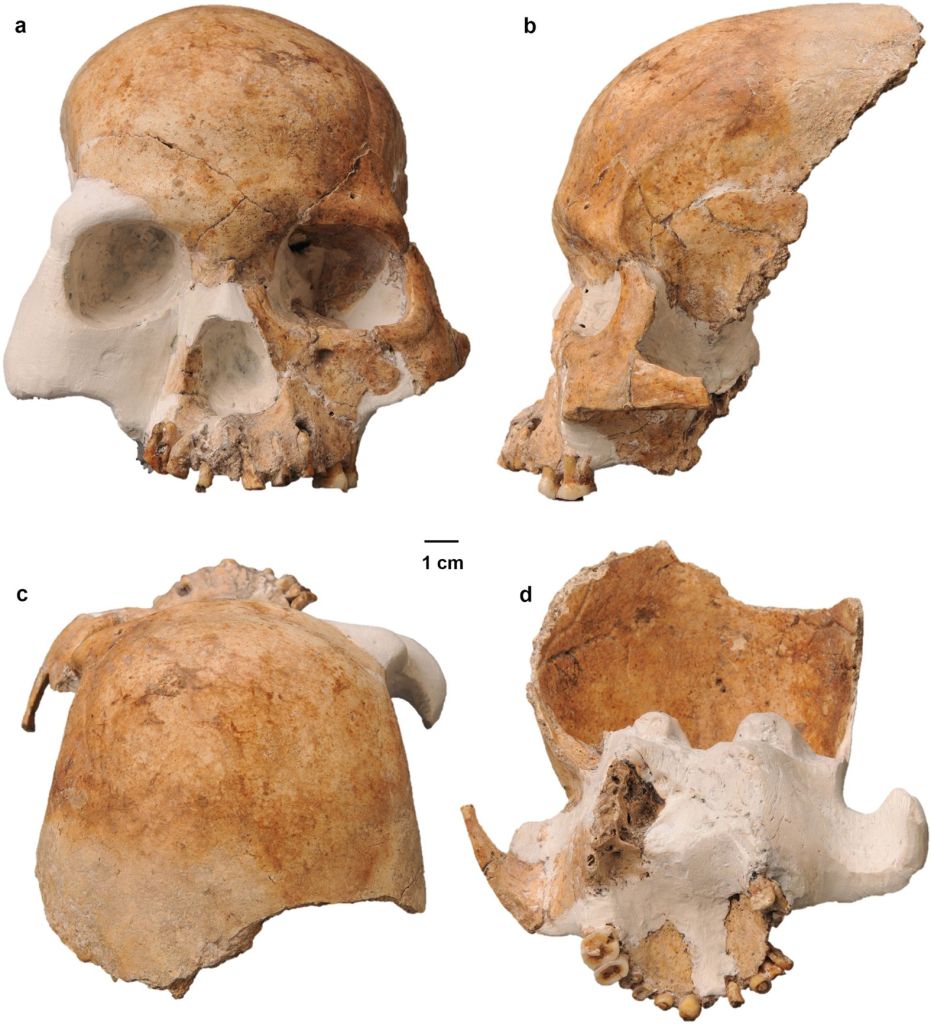
Thanks to Bing Su, a professor at the Kunming Institute of Zoology at the Chinese Academy of Sciences in Yunnan who was involved in the research study, we now know that the Red Dear Cave People are modern humans and fit within the area of anatomically modern human variation. They are not a different species, not as memorable as we once thought. Still, they are unique, thanks to regional and geographical microevolution. So are the Red Deer Cave People a new species of human? Not according to the DNA, and while many mysteries still surround these people, we now know much more about who they are.
Sterkfontein Cave
Next up on the list, we have some surprising news coming from a well-known site in South Africa, Sterkfontein Cave. In this cave, the first australopith was found by Dr. Robert Broom and Raymond Dart in the 1930s. But the war interrupted his investigations. It was once thought that these fossils dated to around 2 million years ago, but instead, they now are believed to be closer to four million years old thanks to new dating technologies that have shown this species to be A. africanus. There is so much to learn about this species. These new dates show that the first hominins may not have come from East Africa but rather from the South, where more and more fossils of various species are being discovered daily. These new dates show that we need to be careful when we set dates for things, embrace new technologies to study older discoveries, and ensure that we are accurate with what we are talking about. The new dates for Mrs. Ples show that Africanus is a much older species than once thought, pushing the date of Australopithecines back even further.

The Oldest Face of Europe
One of the main questions regarding genetics and populations is how they moved around, got to where they ended up, and the evidence left behind. Since 2009, a partial jaw bone from a Basal Neanderthal was found in level 9 of Sima del Elefante, a part of the complex of Ataperca in Spain. This jaw was the oldest evidence of our ancestors in Europe, that is, until this year when another partial jaw and tooth were found a few meters lower. These date to 1.4 MYA. Making this partial face the oldest ever seen in all of Europe. This, of course, is a big deal when we are trying to figure out when our ancestors reached Europe, who they were, and what they looked like. While the remains found in these chasms have been attributed to Neanderthals and Hiedelbergensis (Basal Neanderthals), it may be a long while before we know more about this partial mandible. But we know that these creatures, our ancestral cousins, were in Europe, entirely on the far end of Europe, hundreds of thousands of years earlier than we believed. What we will discover next in the area may continue to change that, but for now, the oldest face in Europe has now been found.

Most senior Signs of Humans in the Americas
For many researchers, the people of the Americas are a great and compelling mystery. As the decade’s pass, new hypotheses are formed as new data is collected from thinking people crossed the Bearing Straight thirteen thousand years ago to people sailing across the Atlantic to land on the east coast of the United States. There have been many ideas and hypotheses. And while we generally now know how people got to the North American continent, it is still a mystery. Many new finds kept pushing back when modern humans arrived in the new world. For a long time, the skeleton of a young girl found in South America dates to around thirteen thousand years old, even in South America. So indeed, humans reached North America first? A few new pieces of evidence have been found in the United States, such as the footprints at White Sands National Park, where we know the footprints of modern humans can be dated to around twenty-four thousand years ago. However, a controversial new find, which I will add, is a mammoth hunting site dating to about thirty-seven thousand years old. This site is that of a mammoth that seems to have butcher marks covering the bones, with bone tool assemblages left behind. This find was found in the backyard of a local man. While this is a very controversial find, as the marks could have been made by natural elements, more research is needed to determine precisely what happened at this site. But if it proves true, it pushes the existence of modern humans in America tens of thousands of years earlier than once believed.
Homo naledi and Fire
During a lecture by Prof. Lee Berger at the start of December (Which is why I have had to wait to publish this paper), I announced something unique if proven true. As of this writing, we are still waiting for the papers to be published, which are being stalled for unknown reasons. But regardless of what the papers say, we have the physical evidence of ash, charcoal, burned wood, hearths, and hearths. Homo naledi used fire to navigate the caves deep inside Rising Star and even used it to cook food, as we see burned bones in the hearths and remains scattered on the floor. First, Lee, once he got into the Dinaledi Chamber for the first time himself, looked up and saw something that no one expected, soot on the roof. This showed that there must have been a fire in the cave. Controlled fire. Furthermore, on his way out, one of his colleagues, Dr. Keneiloe Molopyane, discovered two hearths at the bottom of Dragons Back, an area of the passage you must crawl over and through. This shows much more about what we thought we knew about this species, and while many suspected this for a while, we may now have the proof. And the best part is that Dr. Berger has proclaimed on Twitter that three more impactful announcements are coming about Naledi as soon as they hit the journals. So get ready for more reporting, and be sure to check in for up-to-date news!

Toumai
One of the most controversial topics within Paleoanthropology is when we began to walk upright. As bipedalism is one of the keys that makes us human, it is essential to understand how we first became bipedal. The only natural way that we know how to figure this out is by examining the fossil record. As you should all know, the fossil record is sparse, especially when you go back farther in time. So who was the first hominin? Who was the first bipedal hominin? There are a few contenders, from Orrorin tungenensis to Sahelanthropus tchadensis. The main reason there is so much controversy surrounding the first biped is that Toumai only contains a skull and is highly distorted, so it is hard to tell if it was a biped. But there is good evidence. This year, a few new papers came out. One claimed that Toumai was not biped, and another claimed, using different parts of the remains, that there was no doubt Toumai could walk bipedally but was also adept in the trees. So, while still very controversial, Sahelanthropus tchadensis may be the oldest bipedal hominin.

While that was all fantastic exciting news that will add to what we know about human origins, there is also a big elephant in the room that needs to be addressed, but must be, and with the utmost respect. This year, we lost many famous but prominent, intelligent, and unique contributors to the field.
In Memorandum
While this year might have been great for discoveries, and the advancement of Paleoanthropology as a science, it has been a dark year in other terms. 2022 is one of the darkest years in Paleoanthropology regarding the greats we have lost. As of the time of the writing of this paper, we have lost five unique, influential, and powerful anthropologists. I want to reflect on and respect the explosive contributions the following people have made.s
In loving memory, we remember the following, in no particular order:
Richard Leakey

Isaiah Ngengo

Yves Coppens

Bill Kimbel

Kimoya Kimeu

Sir Paul Mellars
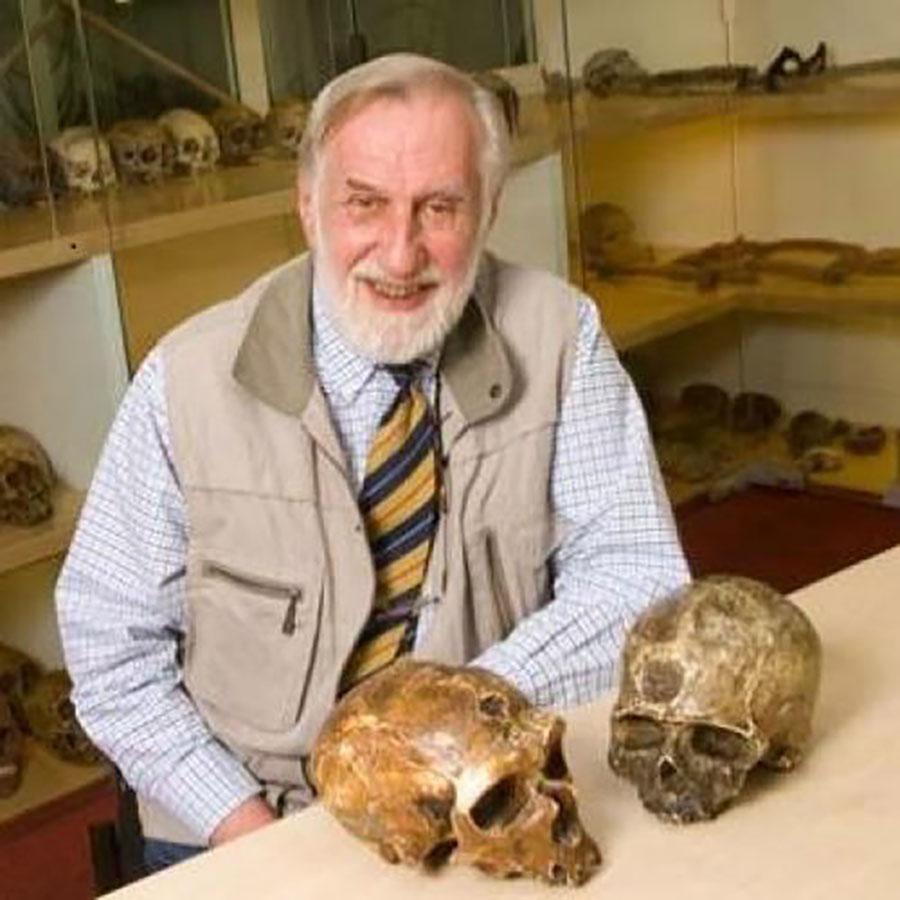
Andrea Leenen

These individuals have made contributions to our field, the likes of which are rarely seen. Their contributions to analysis, discovery, pure love of the area, and the inspiration they caused in so many others, should be a light we can all follow.
Some of these individuals, and the institutions they once belonged to, and arguably will forever belong to, have started funds in their name to help future students, most notably ASU and the Bill Kimbel Fund.
All of you should look into these funds and donate, and if not, spread the word about them, as they are essential to help future students and keep the memory of these individuals alive.
May we remember them fondly, always.
Thank you.
Seth Chagi

Episode Three- Zinj
ZInj, also known as the Nutcracker Man, or more properly Zinjanthropus Bosei or Australopithecus Bosei, is a species that lived about two million years ago.
With a lifestyle and diet extraordinarily different from our own, this is a unique hominin still struggling to find its place among our braided family stream. But one thing is for sure: this is a fantastic find made by the Leakey’s in 1959. *Note I said the 70s in the video, but it was the 50’s.
We have a great deal that we can learn from Zinj, especially when piecing hominin bones back together, as this was in 400 pieces, but Mary and her coworker and dear friend passed recently Kamoya Kimeu. Thanks to their hard work and dedication, you can see the 3D print I am showing you today!
I hope you enjoy this episode; if you did, please be sure to give it a thumbs up and subscribe for more content like this regularly and much more!
Learn more and how to help at www.worldofpaleoanthropology.org
Have a WordPress.com account? Log in now.

