*Sorry this one is only in 720p, I will not be using Zoom again for this*
If anyone does have recording software recommendations, I would most appreciate it. In this episode of Paleofridays, we will discuss the terms “Family Tree” and “Braided Stream” and why one is more appropriate for human evolution than the other.
Keeping up to date with the newest terminology in the field can be difficult, so check out this video to ensure you’re at the forefront and know what is being talked about! In part II, which will air next week, we will closely examine examples of species along our evolutionary line using my 3D printed collection.
It’s going to be a great episode! Be sure to like, subscribe, and share if you learned something new today!
Once in a great while, you will come across a piece of art that utterly overcomes you. It throws you into a tumultuous ocean of emotion, rising and falling with the strokes of the painting or the notes of the song. As far as we understand it, as modern humans and have an unprecedented capacity for understanding, appreciating, and creating art. As we all know, art comes in many forms, from the ancient cave paintings at Chauvet, the works of Leonardo DaVinci, and the film that I would like to introduce to you today; HUMAN by Yanns Arthus-Bertrand.
Youtube Link
If the human condition, in all that it entails, interests you, this is not a documentary piece you will want to miss. Continue to read on as we explore why this is one of the more beautiful and moving pieces of art that I have personally had the privilege of experiencing.
Besides the beautiful aerial b-roll, there is no fanciful camera work in this documentary, just you, face to face with another human. One from anywhere in the world, they are set against a black background, with no identifying features as to who they are or where they come from. This is done so that all people can be viewed in an equal and unbiased way by the viewers; beyond this purpose, I think it allows the viewer to be more engaged with the person on screen. There is nothing to distract you from the words on the screen (each person speaks in their native language, so CC is required). The music this documentary is set to, composed by Armand Amar, sets a somber, calming tone.
As we hear from these dozens of individuals, for that is the entirety of this documentary series, hearing the first-hand accounts of these individuals, we hear just what it means to be human. We hear our stories about The pain and love, the loss and happiness we feel daily and weekly. We see that they are dealing with the same problems, no matter how different they look, where they may be from in the world, or how different their language is. They have the same emotions, and they have the exact wants, fears, and goals.
While each person’s specific scenario is unique, and we hear tales of significant loss and sadness in stories that inspire us to do great things, this documentary covers it all in a way that conveys the human spirit so eloquently that the three hours pass by without a thought.
Many people today may feel that they understand how other people view things, how life is in other parts of the world, or how difficult they may believe their lives are. This film shows the wide range of human behavior, thought, and emotion. While our goals may be shared, how we humans achieve them depends on where we are on this earth and, for better or worse, who we are and are born to.
This is not a happy series; it is not a film to watch to see the happy ending. This is the film to watch for reality. For the hard truths in life that make the human condition the challenge and beauty it is. If you take anything away from this film, take away that you should be proud to be who you are, that you should be proud to be a human, that you work as hard as you can, you do the best that you can, you belong, and no matter who you are, there are others in this world with similar struggles as you.
Some of you may find this film boring or even hard to watch, but I promise that there is a takeaway in the end, and you will better understand who you are and your place in this world after viewing it. Please, take my word for it and watch this documentary. It has been made entirely accessible for viewing worldwide on their YouTube Channel found here.
Let me know what you think, and if you agree with my impression that this is a vital film for as many people to see as possible. So please, share amongst your circles. I know it is long, and some of the stories are hard to listen to, but we need to open our minds to how other people live and maybe, just maybe, take a good long look at ourselves, our lives, and the way we live.
“So, what’s in a name? The classification debate is not just a debate for the purist; it cuts to the core of our understanding of humanity’s place in nature and our evolutionary relationships with our closest living relatives. All hominins are hominids, but not all hominids are hominins.”
What is a Hominin? What is a Hominid?
Are they the same thing? In this week’s episode, we will be discussing just what these two taxonomical terms are, why they are essential, and why they get mixed up.
Hopefully, by the end of this video, you will have a better understanding of the two terms and why they may not be interchangeable.
I will admit I did have a little trouble with this video, so if it’s not the most informative, let me know, and I will remake it!
Welcome to this episode of #PaleoFridays! Sorry for the late episode, but accidents do happen!
Immobilized and feeling much better right now, thank you all for the concern and well wishes, next time I wont trip and fall!
On this week’s episode we will be discussing the oldest known stone tool complex thus far known. For decades many believed that the Oldowan Tool Complex was the first lithics to be made, and while they are quite old, and prolific, they may not be the first.
In 2011, a team led by Sonia Harmand and Jason Lewis from Stony Brook University, discovered what seems to be like stones altered by humanoid hands, dating back to an amazing date, far older than the Oldowan tools.
But what could they be, and who made them?
Learn all about the oldest stone tools on this episode of Paleofridays!
I was contacted the other day by Boneville publishing, home of artist Jeff Smith, because he had recently come out with the second novel in a new graphic series, dubbed “Tuki: Fight for Fire” (the first one), and the second one being “Tuki: Fight for Family”.
Now you might be asking what I have to do with reviewing graphic novels, and i was asking myself the same thing as I read the email, but then I soon found out that the theme, and topic of these graphic novels, is the lives of a few hominins walking the Earth about 2 mya, and their interactions with each other.
Book 1
I do not like reviews, or other talks that make you wait until the very end to hear the good stuff, you’re already here, I figure you want the best bits up front, and if you want to read on, I will leave that up to you.
Ill be honest, these are the first graphic novels I have ever read, and I was actually a little surprised to see how much I enjoyed them. I do not know if it is the subject matter, as I love all things paleoanthropology, but the fun of the entire experience was just great! As I am sure with most comics, the art is simple easy on the eyes, and a breeze to follow (once you figure out which way the storyboard goes, but for those more experienced graphic novel readers, I know this will not be a problem!)
The story, which I will not talk about much as I do want you to grab some copies (go ahead and click on the image to be taken the publishers website where you can purchase copies) but the important thing to know is, the story is fun. I think that is the best way to put it. You do not need to know anything about science or anthropology to enjoy it, but for those of us who are from the field, it is lovely to see the little tidbits, accurate tidbits mind you, that are put into the story.
I particularly enjoyed all the facts at the end of the book, as a science communicator, it was a great way to help explain some of the what seem to be simple topics, on a more complex level, and expose more people to the field. It was very enjoyable to read both of these books!
Basically, if you are a fan of comics, this is a great, and fun series that will keep you on your toes, and keep you guessing at what is coming next, and even for us science nerds who know a little bit more of what we are talking about when it comes to Paleoanthropology, this is a fun read.
I highly recommend for so many reasons, but above all, it exposed me to a whole new world of content consumption, and in a way that showed me it was not only just to enjoy, but can be educational too!
Hello fans of WOPA, and to those who have been following my work for the last few years, I have a very exciting announcement to make.
I have been invited by the president of the Biological Anthropology Society of the University of Cambridge, to be their Science Communications Officer.
They are very impressed with the work that I have done with WOPA, and my passion for Paleoanthropology.
I could not be happier!
We share many of the same goals, mainly our combined goal will be bringing researchers around the world together with students and host lecture series, events, and other activities. Providing opportunities for people to gather and learn. And it will be made as accessible as possible to all, as that is the goal!
Science for all!
This is a remote, volunteer position, and I gladly accepted!
I am not 100% sure on all of the details yet (I will find out within the week) but be prepared for some awesome things to be happening! Guaranteed! So stay tuned!
Thank you all for the support over the years, I would not be where I am today without you all!
For decades now, there has been a tenacious argument on who the first bipedal hominid was. There are a few contenders, dating to around 6.5-7 mya, While there has been a great deal of controversy, new analysis may shed light on who the first biped in our family stream was.
Sahelanthropus tchadensis by Seth Chagi
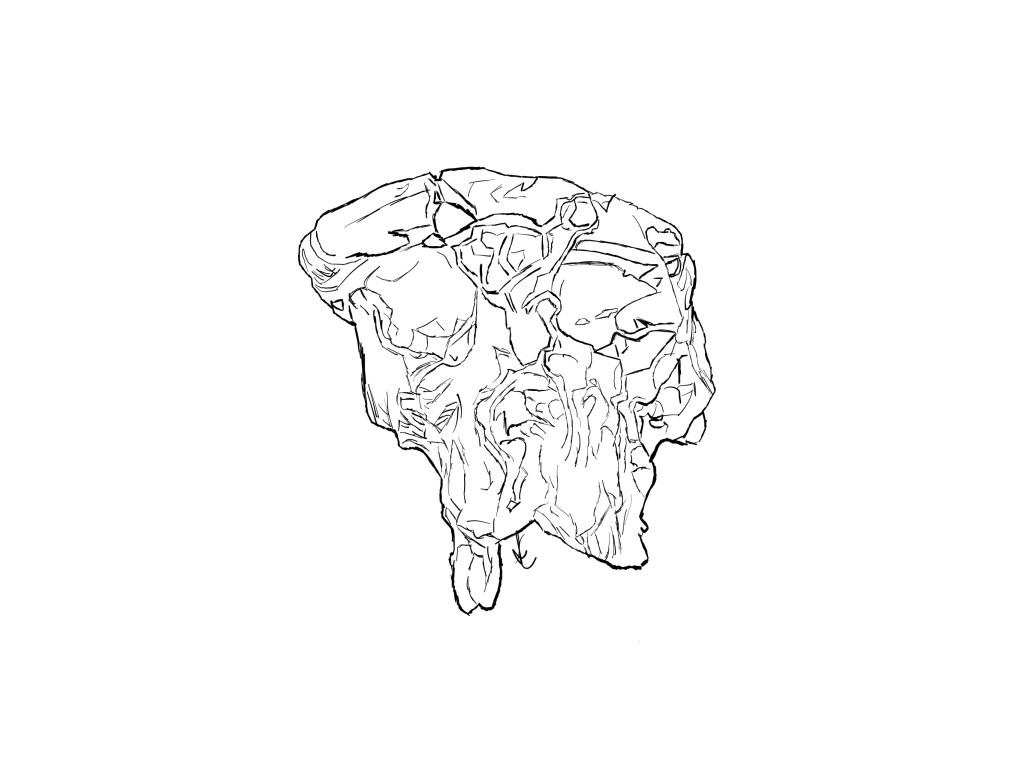
In 2001, a very interesting near complete, but very distorted cranium was found in the the Djurab Desert in norther Chad by a Franco-Chadian team, a year later, a team led by Michel Brunet described the skull, claiming that by the placement of the foramen magnum (the opening in the skull where the spinal spine passes through) proved that Toumaï, as the fossil would soon be known, was bipedal.
However, many anthropologists did not see this as clearly as Brunet thought they would. Many argued that the foramen magnum was pushed too far posteriorly, or towards the back of the skull, and that it would not have supported a bipedal gate. But many agreed that it would. A major problem with this, is that with the massive age of the skull, (7 mya) it had been crushed and distorted by geologic forces, and could only be reconstructed using computer programs to place the features back into their proper place, or at least what we believe is proper.
While the skull does support that this possible hominin was bipedal, there are associated post cranial remains that some researchers have determined show that sahelanthropus was indeed not a biped, that the possible associated femur that was found, would not support a upright walking pattern. So where does Toumaï stand? No pun intended! Was this species bipedal or not? While we may never know, a new paper published in Nature today, gives a great deal of more information.
“A research team, involving researchers from the CNRS, the University of Poitiers1 and their Chadian partners, examined three limb bones from the oldest human representative currently identified, Sahelanthropus tchadensis. Published in Nature on August 24, 2022, this study* reinforces the idea of bipedalism being acquired very early in our history, at a time still associated with the ability to move on four limbs in trees.
At 7 million years old, Sahelanthropus tchadensis is considered the oldest representative species of humanity. Its description dates back to 2001 when the Franco-Chadian Paleoanthropological Mission (MPFT) discovered the remains of several individuals at Toros-Menalla in the Djurab Desert (Chad), including a very well-preserved cranium. This cranium, and in particular the orientation and anterior position of the occipital foramen where the vertebral column is inserted, indicates a mode of locomotion on two legs, suggesting that it was capable of bipedalism 2.” (1)
Along with the skull of Toumaï, there were other post cranial remains that were found, and while there is no way to be sure that they were associated with the skull, the researchers are almost positive that they belong to the same species, as no other large ape has been found in the area dating to that time. “The femur and ulnae were subjected to a battery of measurements and analyses, concerning both their external morphology, and their internal structures using microtomography imaging: biometric measurements, geometric morphometrics, biomechanical indicators, etc. These data were compared to those of a relatively large sample of extant and fossil apes: chimpanzees, gorillas, orangutans, Miocene apes, and members of the human group (Orrorin, Ardipithecus, australopithecines, ancient Homo, Homo sapiens).” (1)
According to more than twenty comparisons of habitual bipedalism, based on observation and comparison of characteristics, the researchers from CNRS, University of Poitiers have concluded based on their findings that sahelanthropus was not only capable of walking upright terrestrially, or on the ground, but arboreally, or in the trees as well. It seems that the possible first hominin was capable as well as very adept at locomotion through the canopies as well as the floors of ground.
Of course, we will never know for sure who the first obliged biped was, but the research continues to point in the same direction. That Sahelanthropus tchadensis was the first bipedal hominin. Will this result stand the test of time? Only more research and fossil discoveries will tell, but for now I think it is safe to say Toumaï was the first obligate bipedal hominin.
As for me? Well, I have always been on the side of Toumaï being the first biped, having a 3D print of his skull, and seeing the features myself, it is clear to me at least where the spine would enter the skull, and to me, it is in a more upright position and not posteriorly, enough at least, to support quadrupedal locomotion. I think it would be too stressful on the skeleton to do that, bipedal locomotion seems to be the best way for that skeleton to move around. Of course, I am open to changing my mind, Ororin tugenensis is also a good client for the first biped, dating to around 6.5 million years ago, but I just think that Toumaï takes the cake. We will have to see, but for now, I think we have our answer.
In this episode of “The Story of Us” we featured famed geneticist and anthropologist, Dr. Todd Disotell.
Hailing from NYU, this long-time researcher and professor have made long strides in the world of paleo genetics and phylogeny during his tenure.
Moving to the University of Massachusetts to take a slight career change, Dr. Disotell has a lot of advice to pass on to future geneticists, anthropologists, and researchers in general.
Join us in this episode to learn about the split between humans and apes, as well as what it means for science to evolve as a field.
Be entertained as we discuss some funny incidents in Todd’s past, and learn what it takes to make it in academia.
Join us!
If you like this episode please be sure to subscribe for more, and turn on that notification button to always know when I have a new episode out!
A new dating technology developed by Purdue researcher Darryl Granger is being used to re-date breccia blocks containing many of the world’s most famous South African hominin fossils.
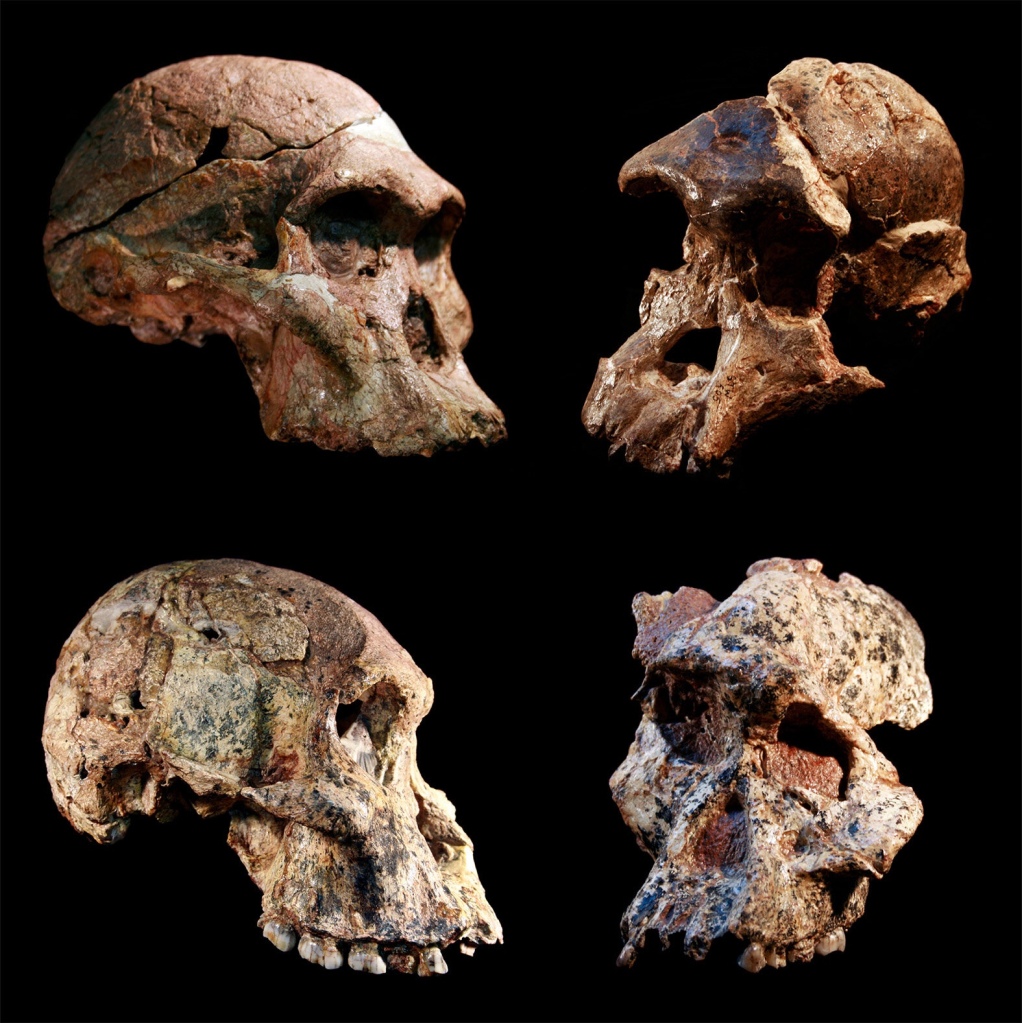
Four different Australopithecus crania that were found in the Sterkfontein caves, South Africa. The Sterkfontein cave fill containing this and other Australopithecus fossils was dated to 3.4 to 3.6 million years ago, far older than previously thought. The new date overturns the long-held concept that South African Australopithecus is a younger offshoot of East African Australopithecus afarensis. Credit: Jason Heaton and Ronald Clarke, in cooperation with the Ditsong Museum of Natural History.
Using this new technique, (which measures the Cosmogenic Nuclides in the rock), at the world-famous UNESCO World Heritage Site, Sterkfontein Caves have been famously known for the number of hominin fossils found within the caves.
It is by far one of the richest Australopith sites in South Africa and has…




 World of Paleoanthropology