Humans in Europe, 10ky before we thought? Seems so! 

For as long as people have been around, we have wondered where we came from. It is an innate curiosity that most of us share on some level. Whether it is wondering where our grandparents came from, their culture, and what language they speak. Or perhaps it is wondering which tribe an African American family belongs to. 

We all wonder, and we all have the potential to explore and find out, to the best of our ability, answer these questions. But Paleoanthropology, the study of ancient humanity, is one of the fastest fields in STEM today. With new discoveries all the time, each adding new pieces, and sometimes even rewriting what we understand about our own evolution and development. 

Most scientists agree that our species Homo sapiens evolved in Africa, 2-300,000 kya. The dispersal of our species is a series of events that are hard to explain and observe, but which leave traces to be discovered. Our species was not the first to leave Africa, that crown belongs to Homo erectus, one of our distant ancestors, who left Africa around 1.5 mya. They traveled into the Levant, Asia, and into South Asia. There is no evidence of them in Europe however, despite their large range. 

What we do have in Europe however, and most abundantly, are the Neanderthals. Their ancestors, who we shared in common, lived around 800,000 kya. At some point near there, we diverged, and one part of us stayed in Africa, further developing on our own path there. The other portion of the population moved out of Africa, through the Middle East, into Asia, Europe, and across much of the wold world. They speciated a few times, we now know of Denisovans, H. Hiedelbergensis, Neanderthals, H. antecessor, and of course at the last stage, modern Humans.

The periods in which all of these migrations occurred is something that is highly contested and is a key focus point for many scientists who focus and specialize in radiocarbon dating, such as a friend of WOPA, Dr. Tom Higham who was involved with this study. 

The importance of this new paper is not to show that humans migrated into Europe, we know that, but what is new is how long ago they did so. We can safely assume now that there was not a single “Out of Africa” event, a term that is often used incorrectly, as Dr. Chris Stringer prefers the term, Recent African Origins for this hypothesis on how humans populated the world.

The basic idea is that between about 60-90 kya AMH went on multiple migrations out of Africa and into various parts of Asia Europe Australia, and eventually even into the new world by 23 thousand years ago!

In a cave in Southern France, Grotte Mandrin, it has been discovered that modern-day humans, aka Homo sapiens sapiens, occupied this shelter as long as 56,800 years ago! This is about 10k years longer ago than was first believed. This paper is based on evidence of a tooth that was discovered in one of the deeper layers of the cave sediment. 

The cave had an occupation of Neanderthals on and off for the last 100,000 years, but it has been known that modern humans occupied the cave from time to time as well. But we did not know they were here this early. The layer in which the tooth was found is believed to show the occupation of modern humans for about 40 years around 56,800 and 51,700 years ago. This is where the tooth from, and has easily been attributed to AMH. “This was not a short-term hunter-gatherer cam but a tentative colonization of Europe,” main author and director of excavations at the cave for the last 24 years; Ludovic Silmak of the University of Toulouse-Jean Jaurés in France, along with his colleagues. 

This is important and implies a few key things. First of all, it shows that migrations out of Africa may be more complicated, and date back farther in history than we believed. And as mentioned in the study, this does not put a cap on how long ago modern humans were in Europe. This just shows what we know so far. But this does mean that Humans were around Neanderthals for a longer period than we once believed. 

Being around Neanderthals for ten thousand years longer would have given us longer periods for admixture, allowing European humans, who may have migrated back into Africa, traces of Neanderthal DNA, however slight. But this would explain the 2-4% of Neanderthal DNA found in modern-day Europeans. 

Another fascinating aspect of the study, that shows the importance of having a longer period with the Neanderthals, is that it appears there was a cross of technology or information on some level. The study details that flint tools were discovered among the sediment that came from within 100 km of the cave, but only an intimate knowledge of the landscape would have allowed for the harvesting of such resources, possibly suggesting that Neanderthals transferred this information to later modern humans who were living in the cave. 

Source:

Did Cooking and Eating Meat Make Us Who We Are Today?

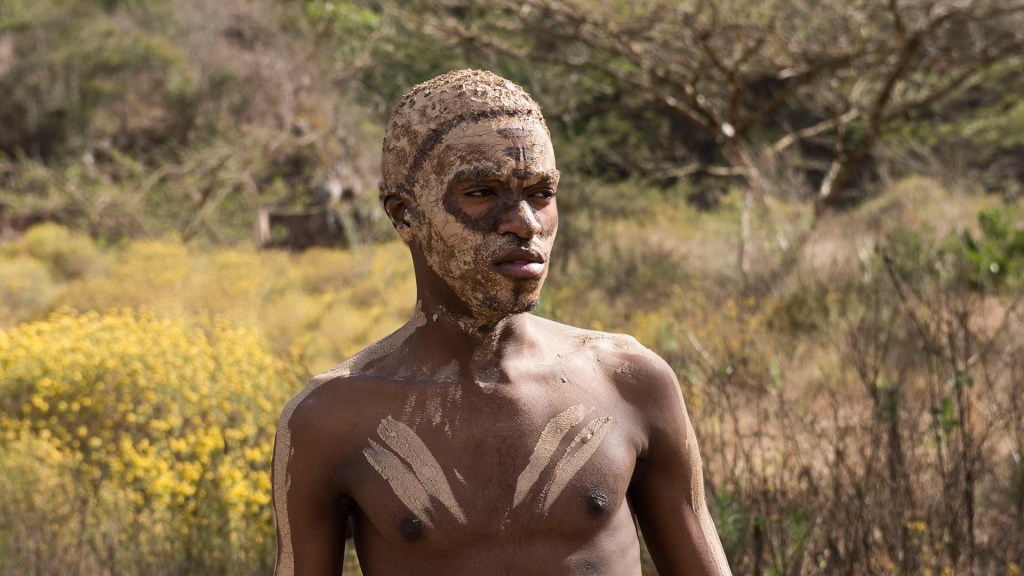
Turkana Boy

A new paper recently published in the National Academy of Sciences by Dr. W. Andrew Barr, Dr. Probiner, John Rowan, Andrew Du, J. Tyler Faith et.al details a new multi-year study where the dietary habits of early Pleistocene hominins were examined. They found some surprising results, which may change the way we view how we got our modern bodies, brains, and even cultures. For decades now, since Dr. Richard Wrangham’s theories on the use of fire and meat consumption detailed in his 2009 book “Catching Fire”, we have long believed that H. erectus began a new habit of meat consumption that would lead to many biological and cultural changes within the homo lineage. Many people believe that the advent of more effective stone tools and new behaviors led to a more active hunting lifestyle, also in part to their adapting anatomical bodies. Soon they were hunting, not just scavenging as all hominins were believed to do before. This new source of food, and mass amounts of proteins and nutrients, led to many things, as Dr. Wrangham explains.

Cooking allowed for the need for less mastication, our jaw muscles got smaller, our skulls changed shape to be home to these newly shaped muscles. Our brains were able to grow to larger sizes than ever before, double the size even. Due to all of this, when we see evidence of individuals being taken care of and surviving near-fatal injuries, we at first began to think we saw the start of a culture, a culture that would be recognizable to us as something different than those of the natural world. Something more human. But, this has all been put into question by this new paper. Let’s find out why. 

So what does the new study say? Well, let’s break it down. Basically, what the hypothesis was, is that H. erectus was not more of a meat eater than any other hominin, it was not more carnivorous. Which, at this point, I would like to say no hominin is or has ever been a carnivore, I do not agree with the usage of the term, as all hominins are omnivores. 

Anyway, the idea that erectus was not hunting any more than it ever had, started to become clear. The reason for this, the team believed, was because there was such a drastic focus on finding signs of meat-eating among them. Such a periscope focus that other signs and clues to the diets of these early hominins disallowed for other ideas and views to come to light. Generally, scientists are very agreeable with the former hypothesis for humans eating cooked meat at higher rates starting around 2.5 mya. But what if we started to look at the greater picture? What would we find? 

Studying around 59 different sites, dating from 2.6 to 1.2 mya (well within the range of H.erectus). What was shown was that as the abundance of modified bones and the number of zooarchaeological sites all show an increase in the activities of erectus the increase was mirrored by a corresponding rise in the way in which samples were searched for and the intensity of which they were discovered. So changes in human behavior, the way we act, and the reason we do the things we do, could be the cause, rather than an increase in the pure consumption of meat. 

There are alternative methods as to why we have the body designs that we have today, and our brains are as they are today after a long trail of evolution and random, successful progress. But here is the thing, the point that I personally would really like to get across to anyone reading this article. Humans, most primates in general (not all) are not herbivores, they are not carnivores, they are omnivores, and they are opportunistic. So what does this mean? Well, we will eat any, and everything that we come across. We are survivalists, it is how our genera have survived for so long, and through such drastic circumstances, we do not turn our noses up at what we eat (save maybe in this day and age). Our species and all of our ancestors ate whatever they could get their hands on so that they and their families could survive. 

As most things in evolution occur, what we came by to eat would have been by chance, what we ate, how nutritious it was, and what we decided to do with it, all added to the nutrients that were consumed. What was consumed led us to be who we are today, and our diets continue to drive our lives? Bad diets lead to unhealthy, unhappy lifestyles, we have proven this. Healthy diets make healthier, happier people. It’s our circumstances that bar us from all having fresh, healthy food. But it is what our bodies crave. A wide variety in diet is important for our brain health and growth. 

With this new challenge to the “Did Meat Make us Human” hypothesis, we may have a new light shined on the way our brains and bodies developed. It changes long-held thoughts on how Homo erectus lived, survived, and adapted. What was the change between habilis and erectus? The changes may not be as clear now as we once believed, and as always the lines in paleoanthropology become blurrier and blurrier each day, while other aspects become more clear. 

What we will find out as new studies continue to be published, and new ideas are explored, we will see which hypothesis stands the test of time. It seems we may not know exactly how we got here is yet another aspect. 

But isn’t that fun? 

See you next time, and never stop learning! 

Seth Chagi 

The Story of Us Ep #28 Homo naledi and the discovery of Leti with Dr. Juliet Brophy!

A Child from the Darkness of Rising Star…is what the title read of many papers and exciting articles just a few months ago, as Lee Berger and his team of Underground Astronauts made an announcement of an utterly amazing discovery out of the Rising Star Cave System, yes, the home of Homo naledi. We now have yet another astonishing discovery! 

You can catch all the information and news straight from the academic papers, and press conferences on our website here.

Today on the show, we are hosting the lead author on one of the two papers published about the discovery of Leti, the Homo naledi child that was found, in the thus far deepest places reached in the cave system, known as the “Chaos Chamber” or, a few other interesting names that you will hear in this episode! 

Join us, and meet Dr. Juliet Brophy, an expert in dentition, who has been working with Berger and the team since the days of the sediba discovery! 

Learn all about Leti in this episode, you won’t want to miss it! 

Please, if you enjoyed this episode and want to help me make more of them, like, share and subscribe! It helps a great deal and is much appreciated! 

WOPA Neanderthal Symposium 2022 – World of Paleoanthropology

Join us for the first ever WOPA Symposium focused on Neanderthals! Don’t miss out and come check this out!
— Read on worldofpaleoanthropology.org/2022/01/15/wopa-neanderthal-symposium-2022/

You won’t want to miss this! The first ever WOPA Symposium!Featuring some of the leading experts in the field on the topic, get your Neanderthal ?s answered! Like, share, and subscribe!

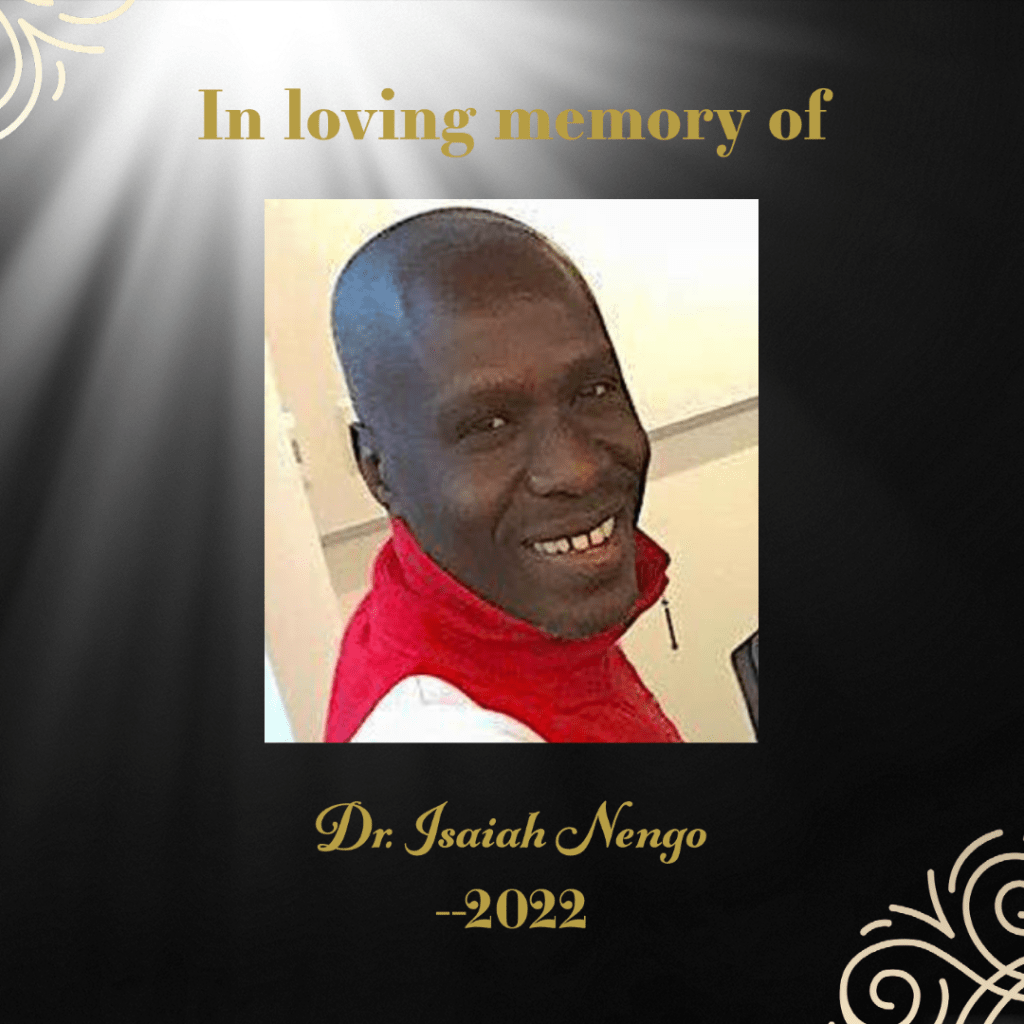
Dr. Isaiah Nengo, a true Paleoanthropologist-RIP

2022 is proving already to be a tough year for the Paleoanthropological community as a whole as we lose yet another giant in the field today. Dr. Isaiah Odhiambo Nengo passed away this morning to the surprise, and shock of all those who knew and loved him; which were many across the globe.

Born in Nairobi, Kenya Isaiah was a brilliant student and in High School, a fateful event occurred that would change his life, and the field forever. Luckily for Nengo, the famed Richard Leakey (who also passed earlier this very month) came to visit and speak to his class, as he did to so many youths in his day. Isaiah was immediately hooked, he could not have enough! He begged Leakey to teach him all he could and take him on as a personal portage so to say, and with hard work, dedication, and a bit of luck, after graduating college with a degree in zoology and botany, with outstanding marks, Leakey got Isiah into a doctorate program in the United States, at Harvard in California.

After receiving his doctorate in Biological Anthropology, becoming the student and colleague of famed anthropologists such as David Pilbeam and Stephen Jay Gould in the process. Dr. Nengo would go on to focus on Miocene apes, and their role in the evolution of hominins, and you and I, humankind. Settling in the Bay Area of California, it was not long before those in Kenya wanted the talented Dr. Nengo back in their grasp! Meave Leakey herself showed up one day, nearly pleading, to have him return, and in the end, it worked! This would be a very fateful decision for all involved.

During much of his fieldwork, Dr. Nengo made many impactful discoveries, becoming one of the most well known Kenyan fossil finders of his time, which is important for this is an especially harsh and difficult environment to not only work in but for fossils to form and survive in for any extended periods.

Leading a team that would discover a 13 million-year-old ape skull, which, as we should all know is extraordinarily rare, even more, rare than finding hominin fossils for apes are found in forested areas, and fossils rarely form in wooded areas. So this was amazing! And it was pretty much complete as well! This would come to be known as Alesi.

Following in the footsteps of his close friend Richard Leakey, Nengo became a. science communicator and educator. Not someone who did their research and hid it in the shadows until they were as close to 100% sure they had all the answers. No, Dr. Isaiah was on the front lines of Open Access Science Communication and STEM education, teaching children in Kenya the joys of learning of Human Origins.

At the end of his life, Dr. Nengo spent most of his time in Africa, about half of the year, but worked at a new position at Stony Brook University in New York, and became an Associate Director at the Turkana Basin Institute, formerly run and founded by Leakey.

Dr. Isaiah Nengo taught and inspired many children throughout his distinguished career, supported them, and allowed them to launch their careers despite whatever challenges that they may have been facing. He was the person he needed as a young child. We should all strive to show the dedication, hard work, and love for what we do that Dr. Nengo did.

He will be deeply missed by his loved ones, colleagues, associates, and all Anthropology enthusiasts.

May he rest in peace.

Top Anthropology Lectures on Youtube in Early 2022 you should watch!

Top Lectures on Youtube Early 2022


Hello everybody! 

I hope we are all off to a good start for the new year, can you believe its 2022 already? Amazing how time flies isn’t it? Anyway, to kick off the new year we did something really special, and that of course, if you have not heard, was to host our very first symposium, focusing on Neanderthals featuring the famed Dr. Chris Stringer, Dr. Rebecca Wragg Sykes, and Dr. Tom Higham! It was am absolute blast and such a success! Be sure you do not miss viewing this, and catch it here:

To continue the fun for the new year, I thought it would be nice to put together a very educational list of Open Access, and FREE video lectures to watch on Youtube about varying degrees of Anthropology, from the formation of our very belief systems, to the way our bodies came to be as they are today. The following list includes very distinguished speakers, some of which have been on our show, such as Dr. Agustin Fuentes, others, such as Dr. Richard Leakey passed earlier this year, and his wise words and knowledge I wish to preserve and pass down farther. And others, have spent their lives, over a half a decade in some cases, such as the famed Dr. Don Johanson, are represented on this list. 

Most of these lectures are up to date as far as how researchers are viewing things, but of course with Paleoanthropology being one of the fastest fields to change and update in STEM, some of the things that you hear may be out of date, but that is why you should of course always do more research and look farther into things you are interested in or question, as it should always be! 

As with all of my lists, these are not in any particular order, but are here in general to provide you a good amount of time of learning! If you have any suggestions please leave them in the comments, otherwise please like, share, retweet, whatever platform you are on, and help spread the free, open access education about our shared human origins! 

Let’s go! 

  1. Prof Agustín Fuentes – Why do we believe?
  2. Rewriting Modern Human Origins | Shara Bailey 
  3. Engaging With Public Audiences on Human Evolution | Briana Pobiner
  4. The Origins of the Genus Homo | Bernard Wood
  5. Exploring The Human-Ape Paradox –  Tetsuro Matsuzawa, Linda Marchant, Barry Bogin
  6. CARTA presents The Origins of Today’s Humans – QandA
  7. Origins of Genus Homo: What Who When Where?; Early Body Form; Life History Patterns
  8. Explorer Lecture: Dr. Donald Johanson, “Cleveland, Lucy, and the Human Story”
  9. WPT University Place: Discovering Homo Naledi
  10. Richard Leakey: Does Prehistory Matter in the 21st Century?

There you have it! 

I truly hope that you learn a great deal, reaffirm your ideas, and have some of yours bashed so you can rethink, and think critically about them, as that is the way of science! 

Seth Chagi 

Project Director 

World of Paleoanthropology 

WOPA Neanderthal Symposium 2022

Welcome to 2022! To start off the year we here at WOPA hosted a truly exciting event that we are oh so excited to share with all of you! 

As many of you know, we have been planning on hosting a symposium on Neanderthals for a few months now, and early this morning (at 1:30 AM for me specifically!) Dr. Chris Stringer, Dr. Rebecca Wragg Sykes, and Dr. Tom Higham came onto “The Story of Us” and had a wonderful chat and presentation with myself for all of you, to answer some of your most burning questions about these lost peoples! 

A great deal of work has gone into this, and if it pays off well, I.e you all enjoy it and learn from it, you better believe this will not be the last WOPA Symposium! 

Well, thats about it, I will leave it to you to enjoy! Please share around, let me know your thoughts and comments, and do not be afraid to ask questions or to learn as much as you can! 

There is always more to learn! 

Seth Chagi 

Project Director
World of Paleoanthropology 

P.S 

Dr. Stringer, Dr. Higham, and Dr. Wragg Sykes will be providing Open-Access journal pieces for me to share relating to what we talked about here, and as soon as those are available I will be adding them below! 

Take care! 

The Oldest Modern Humans are now 36k years older than originally thought!

From BBC’s “First Peoples”

Discovered in 1967, the Omo 1 skeleton is known to be our oldest ancestor, at least of our species. Belonging to H. sapiens, moderns in fact, this rare look into our very own deep history was, and remains an extraordinary find! Discovered by the famed, and now late paleoanthropologist Richard Leakey and team near the Southern Ethiopian town of Kibish. Immediately, it was apparent the importance of these finds, but just how old they were would remain a mystery until earlier this week.

Originally dated using water mollusk shells found with the remains, the skeleton was dated to around 130 ka. It was clear that due to the morphological features of the skull, this specimen belonged to our species, attributing a prominent chin, and high forehead, there was no mistaking this as a modern Homo sapiens. These remains were considered to be the oldest anatomically modern remains until 2017 when the Jebel Irhoud skull was dated to around 300,00 years ago. Researchers such as Dr. Chris Stringer, however, suggest that the Moroccan skull is an Archaic H. sapiens, so still belonging to our species, and our direct lineage, but still possessing certain features found in earlier hominins that have since been altered in our genome to not be as apparent today.

In 2005, the Omo 1 skull was related using new technologies available at the time to a much older age of 195 kya, still far short of the 300,000 years of the Jebel Irhoud specimen, but this still pushed back the origins of our very species back tens of thousands of years.

Now, a new study published in Nature shows new dating of the Kibish tuff formation, which was laid down by a massive eruption of the Ethiopian Rift’s Shala volcano, which placed a layer of sediment of the remains 233,000 years ago. Extending the age of Omo 1 a further 36k years! This shows that our species, as it stands today was around far longer, and deeper in our shared history than first believed. Leaving less time for the transition from Archaic to Modern to occur, but it is of course possible that different features were only apparent in certain environments, as it is critical to keep in mind the Moroccan fossils are from North Africa, and these fossils are from East Africa. We know the variation that occurs in Modern Day people, so we can only safely assume there would be equal, if not more morphological variation between environments millennia ago.

The new finds are important because they establish a more accurate age for the origins of our species, and this can lead to better insights into our origins both biologically and culturally. The Omo fossils, at least those designated to belong to Omo 1, are so far the oldest AMH found in the world, in what we know is our home, the great continent of Africa. What the future holds, and whether or not Omo 1 has more secrets to reveal can only be told by the future and continued and dedicated research.

Remember, there is always more to learn!


Be sure to catch all of the big breaking news in Paleoanthropology!

Top Ten Anthropology Books to Start off the New Year!!!

View on Academia if you can =)

With how popular the last “top book list” I did, I knew immediately that I would have to do another one! And what better t time than at the start of the new year, when we can either look back at some of the last years greatest hits, or some of the most exciting titles to look forward to! All of the books on this list were published within the last two years, and date to no later than 2020. I know I know, even that is getting dated for this field, for as we know things move faster than pretty much anyone can keep up with all on their own! But some of these titles, I just cannot stop recommending! So please forgive me! 

As per usual, if the books have made it onto this list, congratulations! It means I really like them and think that you will too! It means I think they are great educational candidates and can help people of all ages and backgrounds understand our field! It does not mean that there are not other excellent books! I just have to draw a line somewhere! But, this list is NOT in any particular order. This is NOT a countdown from ten to one, but just rather a general Top Ten. If you have other recommendations, please leave them in the comments below, for who knows, maybe I have not even read them, and I am always looking for good recommendations! Whatever I learn get’s passed on to my audience after all! 

As I know some of us are more fond of audiobooks, for whatever reason that maybe (I prefer listening, and reading the same books!) I will be providing links to both. There are of course multiple shops, both virtual, and brick and mortar, local, and global that you can choose from, I am not going to be one to dictate to you where to make your purchases. The links I do provide is simply one of the ways I enjoy reading, and is here as an example to show you the title, so you may purchase it from where you please. 

*NONE OF THESE AUTHORS HAVE PAID FOR AN ENDORSEMENT. SOME HAVE APPEARED ON MY SHOW AS MY GUEST TO PROMOTE THIER BOOK, BY MY REQUEST*

I hope you can find one or two books on this list that you will find educational and enjoyable that you may have not read already, and I hope you learn a thing or two, for after all, is that not always the goal? 

Enjoy! 

Books to Read in 2022 

The Dawn of Everything: A New History of Humanity by David Graeber and David Wengrow 

Ebook: https://books.apple.com/us/book/the-dawn-of-everything/id1548292642

Audiobook-https://books.apple.com/us/audiobook/the-dawn-of-everything/id1591463647 

First Steps: How Upright Walking Made Us Human by Jeremy DeSilva 

Ebook-https://books.apple.com/us/book/first-steps/id1522457239

Audiobook-https://books.apple.com/us/audiobook/first-steps/id1558923993

Transcendence: How Humans Evolved through Fire, Language, Beauty, and Time by Gaia Vince

Ebook- https://books.apple.com/us/book/transcendence/id1448670589

Audiobook https://books.apple.com/us/audiobook/transcendence-how-humans-evolved-through-fire-language/id1493310267

Kindred; Neanderthal Life, Love, Death and Art  by Rebecca Wragg Sykes

Ebook https://books.apple.com/us/book/kindred/id1487820196

Audiobook-https://books.apple.com/us/audiobook/kindred-unabridged/id1529642555

Four Lost Cities: A Secret History of the Urban Age by Annalee Newitz 

Ebook-https://books.apple.com/us/book/four-lost-cities-a-secret-history-of-the-urban-age/id1486020083

Audiobook-https://books.apple.com/us/audiobook/four-lost-cities-a-secret-history-of-the-urban-age/id1552550217

A Short History of Humanity: A New HIstory of Old Europe by Johannes Krause, Thomas Trappe, and Caroline Waight 

Ebook-https://books.apple.com/us/book/a-short-history-of-humanity/id1524214799

Audiobook-https://books.apple.com/us/audiobook/a-short-history-of-humanity-a-new-history/id1557596531

The World Before Us by Tom Higham 

Ebook-https://books.apple.com/us/book/the-world-before-us/id1577113454

Audiobook-https://books.apple.com/us/audiobook/the-world-before-us-the-new-science-behind-our-human-origins/id1576064918

Sapiens: A Brief History of Humankind by Yuvai Noah Harari

Ebook-https://books.apple.com/us/book/sapiens/id819198260

Audiobook-https://books.apple.com/us/audiobook/sapiens/id1441421521

The Sediments of Time by Meave and Samira Leakey 

Ebook-

Audiobook-https://books.apple.com/us/audiobook/the-sediments-of-time/id1602704359

Race, Monogamy, and Other Lies They Told you Vol. 2 by Agustin Fuentes 

Ebook-https://books.apple.com/us/book/race-monogamy-and-other-lies-they-told-you-second-edition/id1588164267

Audiobook-

Well I hope this gives you hours of education, and enjoyment! Remember, there is always more to learn! 

Seth 

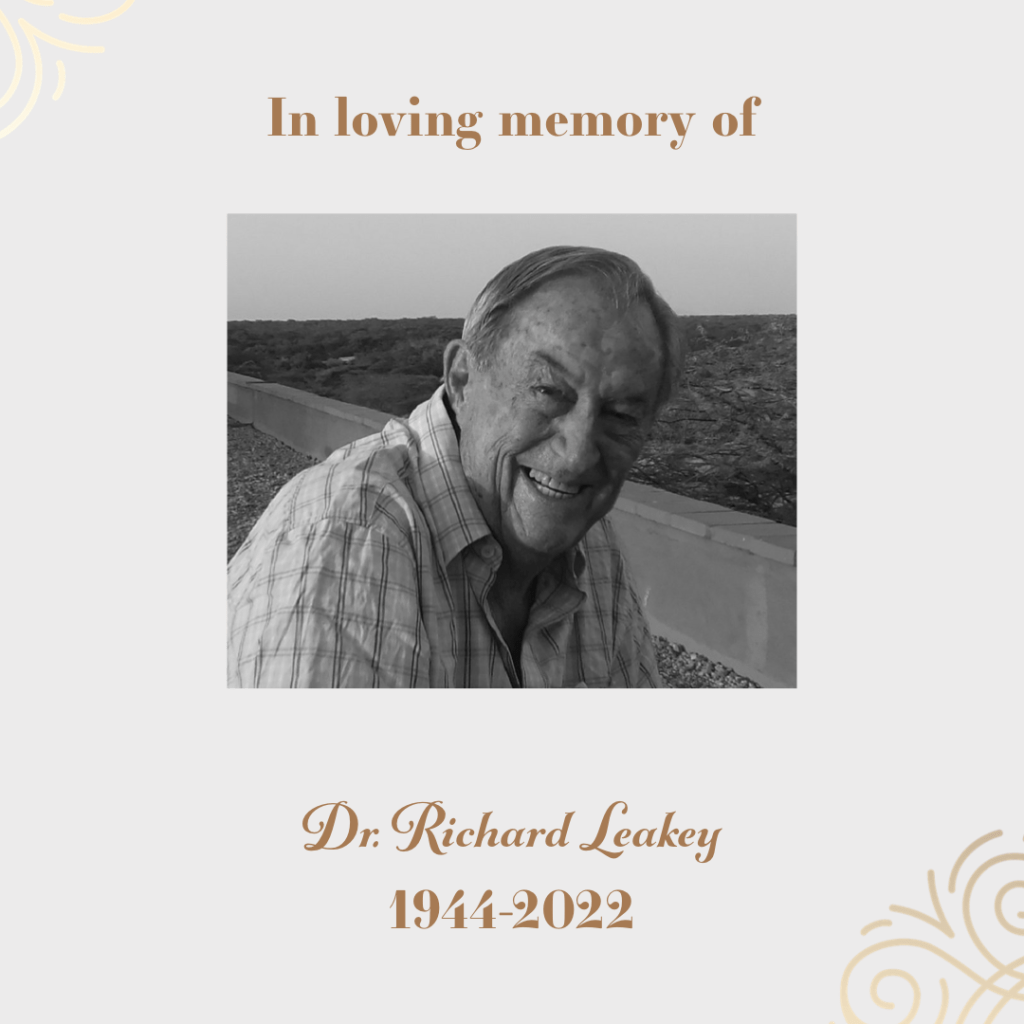
In Memorandum: Richard Leakey 12/19/44-1/3/22

Richard Erskine Frere Leakey

Richard Erskine Frere Leakey, born to the famous paleoanthropologists Mary and Louis Leakey, passed away shortly after the start of the new year on January 2nd, in Kenya. Per the family’s wishes, we send our thoughts and well wishes to the Leakey family, and respect their request for distance, and time for mourning. We send them our most sincere condolences for the loss of such a grand gentleman who has changed the world over, and for the better.

You can read the statement put out by Samira, Richard’s youngest daughter, on behalf of the Leakey family here,

“On Sunday 2 January, we lost a true warrior, an individual so large in presence that he left a void that can never be filled. He has been described as iconic, and a force of nature, but to us he was Richard, Dad, and Babu.

As a family, we are enormously grateful for the outpouring of warmth and support that we have received from so many friends here in Kenya and across the world. It brings us great comfort to know how much his life meant to so many.

As we struggle to come to terms with our loss, we are respectfully asking for a few moments of privacy so that we can mourn as a family before we celebrate his extraordinary life as a son of Kenya. We are also conscious of the Covid19 protocol rules that have been advised by our national health authorities and so at this time, given the vulnerability of Richard’s widow Meave, we will not be allowing any visits to the home. The family also requests no flowers.

Arrangements have been made to have a condolence book at the offices of the National Museum and the KWS, where anyone wishing to express their condolences can visit. Tributes commemorating Richard can also be left online, using the following link to the ForeverMissed memorial site – https://www.forevermissed.com/richard-leakey/tributes

In keeping with Richard’s wishes, we, this afternoon, interred his body at a place of his choosing, on his favorite ridge overlooking the majestic Rift Valley that he so loved.

We will share our plans for celebration of his life in the coming days.

Samira Leakey

On behalf of the Leakey Family”

Richard lived a long, challenging, but very fruitful life that has been felt around the world, from his astonishing work in human origins, leading the teams that discovered such famous fossils as the nearly complete 1.6 million-year-old Homo erectus skeleton dubbed “Turkana Boy” KNM-WT 15000, as well as the “Black Skull” of Paranthropus aethiopithecus or KNM WT-17000 and the sapiens, remains at Omo Kibish, as well as stone tools finds at Lomekwi dating to 3.3 million years ago, making them the oldest stone tools yet found. His teams are also responsible for many finds at Koobi fora,

Aside from his paleoanthropological career, Dr. Leakey was known for his political and conservation know-how. Starting as a Safari guide, and finally becoming, and creating the Kenyan Wildlife Service in 1990, Richard was not only at the forefront of battling poachers and other challenges and dangers to the beauties of the Kenyan landscape, also fighting for the rights of the land, and the animals that inhabited it all over the continent. Fighting for elephants’ and rhinos’ existence in particular.

Almost meeting an early death on more than his fair share of occasions, Dr. Leakey passed away yesterday at the comfortable age of 77, survived by his wife Maeve, and daughters Anna, Louise, and Samira.

Per Dr. Lesley’s request, he has been laid to rest on a ridge overlooking possibly one of his most beloved places, a place made famous by his parents, and known now by the world as the birthplace of our species.

Rest In Peace Dr. Leakey

Respectfully,

Seth Chagi