What is Race, and if it’s not real, why do we look so different?

There are many misconceptions about race in our modern day world, and in fact for the last few centuries of scientific work.

The belief that people belong to different races, and that some are better than others has caused some of the worst problems in human history, from hate crimes to genocide, race is a major player in many cultures around the world.

But what does it mean? Science points to the idea that there is little to no differences between the populations of modern day humans on Earth.

Of course there is a range of fair modern variation, but as long as we fit into that, we all belong to the same species, H. sapiens. While we do look different, and we do things differently, these differences are caused by culture, and ecological niches, the needs of the environment, and the ways in which people interact with it.

This is but a brief introduction to race, why it doesn’t exist, and how we can overcome some of the systemic problems of race and racism.

Map: https://www.grida.no/resources/7125

Subscribe to my Podcast for more content here: https://podcasts.apple.com/us/podcast/the-story-of-us/id1614498858

There is always more to learn!

Update-Prof. William (Bill) Kimbel- RIP

Update: His funeral is being broadcasted to registered individuals via Zoom Saturday the 28th, you can register here.

It is with the utmost sadness that I inform you, for those who do not already know, that the famed paleoanthropologist, who served as the director of the IHO at ASU for 13 years, Dr. Bill Kimbel, passed on this morning.

Photo courtesy of Arizona State University

This is the third obituary for a famed, well loved, and amazing scientist that I have had to write, not since I started my career as a science communicator and journalist, but the third just this year.

We have lost many a great minds this year, it has been a crushing blow to paleoanthropology. From Richard Leakey, to Isaiah Nengo, and now Bill Kimbel, all of these professors have left a massive, permanent mark on the field. Whether you agree with their hypotheses, methods, or ways of doing things, there is no way to deny the contribution that these three men have made for the world of anthropology.

Dr. Kimbel received his Ph.D from Kent State University, and went on to lead an impressive career, from ASU’s website, “For more than 30 years, Kimbel has conducted research on Australopithecus and early Homo in Africa, Neanderthals in the Middle East, the evolution of hominin skull form and function, and concepts of biological systematics as applied to paleoanthropological problems. Since 1990, he has codirected or directed research at the Hadar hominin site in the Afar region of Ethiopia. Kimbel is also a Virginia M. Ullman Professor of Natural History and the Environment in the School of Human Evolution and Social Change. He is a founding member of the Afar Rift Valley Research Consortium, a group working on a region-wide understanding of human evolution and its contexts. Kimbel was elected Fellow of the American Association for the Advancement of Science in 2005.”

Dr. Kimbel will be deeply missed, not only by the friends and family that he leaves behind, but the many students and minds that he has touched.

After a long, and arduous battle with cancer, Dr. Kimbel passed away this morning, Sunday the 17th of 2022.

He has earned his rest, and may he take it in peace.

Seth Chagi

“Discovering Us” by Evan Hadingham Review

sethchagi's avatarWorld of Paleoanthropology

When you ask many anthropologists today, what got them into anthropology in the first place, many of them will tell you this or that, but often enough it is that they came across the now famous book, fondly known as “The Lucy Book” by Dr. Don Johnson, published in the 80’s. This book details the astounding discovery of the A. afarensis partial skeleton, the most complete of its time, detailing the anatomy, the adventure, and the science. So many people fell inn love with this book, that it drove them into the field themselves! People like Dr. Lee Berger, and many others owe their careers to the collective work of the past, and in thanks to mentors and people like Don Johnson.

Today, while “the Lucy book”, for those who are interested is still a great place to start, it is a little out dated. There is, however in my…

View original post 456 more words

What is Paleoanthropology? An introduction!

Today, in one hour I am excited to premiere a new video! (You can watch it on this page once it has premiered, otherwise this is the link: (https://youtu.be/pqpsqWktqMM). We are going to learn all about Paleoanthropology, what it is, and how it relates to our modern world. There is a great deal to learn about anthropology, humans, and our origins. 

But where does one begin? Well, a great place to start is with this video, as I introduce to you just what paleoanthropology is, and how it relates to our modern world, I hope you will all learn something new, and exciting. 

The goal of this video is to provide a basic introduction on what Paleoanthropology is, and why it is important. 

If you like this video, please like and subscribe, as I will be making more of them if the reception is positive enough. 

I had a blast making this video, and I hope you all enjoy it as much as I did making it! 

Enjoy! 

A small tooth, a big surprise, and Denisovans in Laos!

View on Academia.edu if you please 😉 I’d appreciate it!

If you have been on the up and upon the most recent goings-on in paleoanthropology and human evolution, by the way, evidence points these days, is that up until as recently as 70 kya; we were living amongst as many as six species of  humans. From the well-known Neanderthals, found in western Europe into the deserts of the Middle East, to the Hobbits on

 the island of Flores. Being the only bipedal ape on this planet is something relatively new. As we explored in my recent paper titled “Planet of the Apes”, you can read here which goes into much more detail on this subject. For today’s topic, however, we are going to be talking about one specific group, or population of ancient peoples, commonly known as the Denisovans. 

The Denisovans are an enigmatic people, while not designated as an official species just yet, due to a lack of physical evidence, we have a wealth of knowledge about them from their DNA. For you see, back in 2008, in the Altai Mountains of Siberia, in a well-known archaeological site known as Denisova Cave, a tiny portion of a pinky bone was found. It would turn out that this pinky bone belongs to an ancient little girl, dating to around 75 kya. But there would be something extra special about this little girl, she was from a species previously unknown to science. 

Amazingly, from this small piece of bone, scientists at the Max Planck Institute for Evolutionary Sciences were able to gain a piece  of DNA that contained around 70% of the entire Denisovan genome. This was more than the entire yield of Neanderthal DNA yield that researchers at the Max Planck had at the time. We would learn a great deal about these people from their DNA, but we would go a long time without finding any more fossils that we could contribute to them. While there is some speculation, that certain skulls such as the Harbin, or “Dragon Man” skull may actually belong to Denisovans, without DNA, we cannot know for sure. 

Discovered some forty years ago, but only recently handed over to scientists, was a mandible found from a high Tibetan plateau, which had giant, almost nonhuman molars. DNA would show that this would be the first Denisovan fossil outside of Denisova Cave. It also showed how wide the range of these people could have been. But now, a new find is showing just how far that range could have been, with physical evidence. We know from the DNA that many people of Asian, and South Asian descent, as well as aboriginal Australians, have up to 7% of Denisovan DNA. This has to be explained by some introgression into the modern populations of Homo sapiens. 

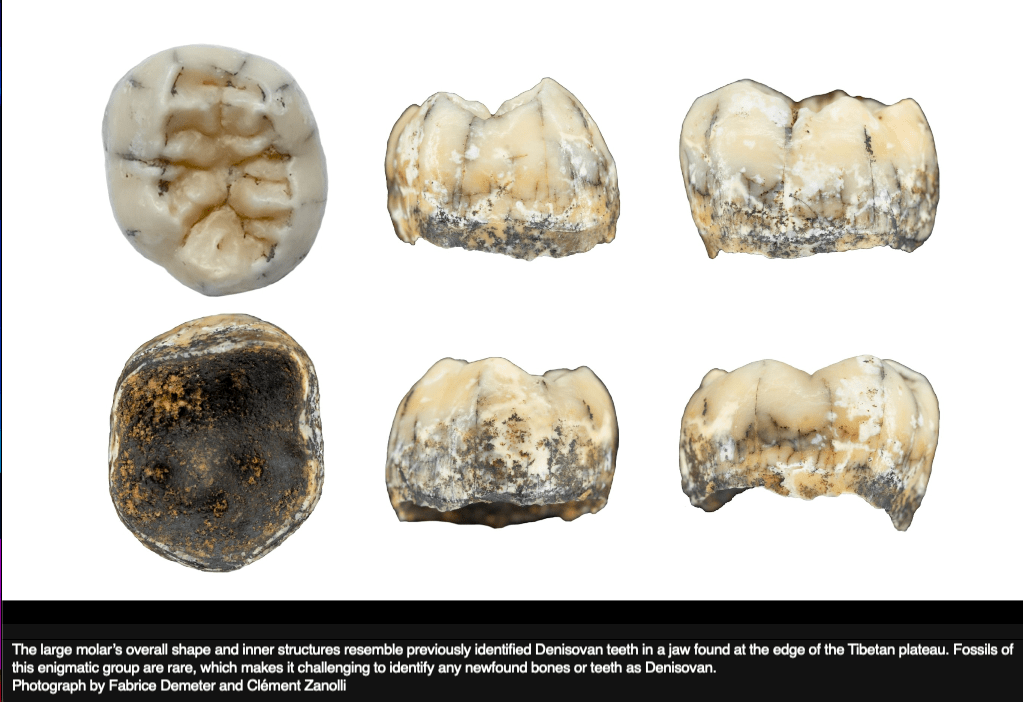
Now, however, a new find from Laos, in the Tam Gnu Hao 2, or Cobra Cave, a singular, small tooth was found and reported this last week. Dating to the middle Pleistocene, or 164-131 kya with the use of luminescence dating on the sedimentary matrix. These places the tooth well within the region of Densivoans who could have lived here at the time. According to the researchers, “Analyses of the internal structure of the molar in tandem with palaeoproteomic analyses of the enamel indicate that the tooth derives from a young, likely female, Homo individual. The close morphological affinities with the Xiahe specimen from China indicate that they belong to the same taxon and that Tam Ngu Hao 2 most likely represents a Denisovan.” 

So what does this mean? Well, it means that Denisovans were covering a great deal of ground, and were doing it up until somewhat recently. While there are three groups or populations of Denisovans that are known to science at this time, and we do not know which this belongs to, we know that this tooth, which again belonged to a small girl, is going to shed a great deal of light on the presence of Denisovans, and other early humans in Southeastern Asia.

As always, with more answers, and more information that we get, we are just led to more questions, but that is what makes science great! There is always more to learn, and if you keep at it, you will always be finding answers! 

Did you learn something about the Denisovans today? Are you surprised that they have been found so far south when compared to their close Neanderthal kin? 

Original Paper:

It’s here! Welcome to the Origins of Bipedal Walking!

Well, the day has come! Earlier today, Dr. Throckmorton, Dr. McNutt, Dr. Hammond and Dr. DeSilva and I got together and held a symposium about discussing the Origins of Bipedal Walking. 

This is a special recording of “The Story of Us” that we have been preparing for months. It has taken a great deal of effort and work to put this together, but we are all very happy and proud to present to you the following recording. 

Please enjoy, stir conversation, debate in the comments, ask questions! There is always more to learn! 

While I do not know what, or when the next Symposium will be, be sure there will be one, so stay tuned! 

The Origins of Bipedal Walking

We have an upcoming event that might peek the interests of any #paleoanthropologist! I have brought together some experts in the field, especially concerning the subject of the #origins of #bipedal #walking.

So join us! The event is not live, but recorded, and will be posted the same day. I encourage anyone who is interested to send their questions to worldofpaleoanthropology@gmail.com to have them asked during the Q/A that will follow the presentations.

If you want to learn about #TheOriginsOfBipedalism there is no better place to check it out! See you on the 9th!

Verisimilitude in Moche Iconography; A different aspect of Anthropology

Please view on Academia.edu if you can:

The Moche people are one of the greatest, and most organized pre-Incan cultures in the Northern Andes, existing during the Early Intermediate Period, the successor of the lands once ruled by the Chavín culture, until their fall around 700 AD, to the Wari culture. The Moche are well known for many things, from the large territories, and trade routes that they established and upheld, to the drastic and intricate rituals that they held. Most of all, they are probably known for the legacy of art that they left behind. Textiles, pottery, and finer arts are well known to have been produced by the Moche on an almost industrial scale, where there were workshops to produce these artifacts (Quilter, 2013). 

Their fine-line art is some of their most well-known contributions to Andean culture. Their art has mystified and made people wonder since modern eyes were first laid upon them, and many researchers have spent their lifetimes trying to determine just what this art means. Some of it seems easy to understand, acts of daily life, while others are of a more esoteric appearance. In the following papers that were examined, I have come to the following conclusion. The verisimilitude shown in Moche art is very apparent. It is how the iconography is interpreted, that changes the meaning. While it is clear that not everything that occurred during the Moche’s rule is depicted, those of highly ritualistic significance was. We can see from the archaeology, that these depictions are supported by finds such as those at Sipan (Bourget, 2001). But where is the line? We will go over evidence supporting various aspects of Moche iconography to support the hypothesis that Moche iconography has a strong verisimilitude within the ritualistic world that the people of the Moche found themselves in. We have a great amount of archaeological evidence to support the idea that what was being depicted in the fine Moche art, actually has a strong basis in reality, as we will see. 

While many Andean archaeologists like to focus on the warfare aspects of Moche culture, which of course are very important, other aspects can reveal light on the situation. One great example of the use of textiles that are represented in the art, and are found in the archaeology, is what archaeologists found in the multiple tombs at Sïpan, especially the one deemed “The Lord of Sïpan”(Bourget, 2001). With the archaeological aspects of the ceramic pottery were not fully looked into until the archaeological digs began to take place, around one hundred years ago, it becomes clear that “Moche images are not intended to describe, explain, or explore, but to convey lore meaning” (Benson, 2008). 

The textiles that the Moche took part in were of a wide variety, from tunics, stirrup-type pottery and ceramics, icons, and many more types of art. Much of the art depicts various scenes, many of which are grand burial, or sacrificial themes. So detailed are these scenes, that it has made researchers ponder just how real to life they were. Until the finds at Sípan, it was doubted just how accurate these textiles were when it came to what individuals were wearing and doing during these events. But after the tombs were discovered and opened, it is uncanny how accurate the iconographical decisions are when it comes to real-life (Bourget, 2001). The individuals in the tombs were dressed and were in possession of many of the items depicted in the art, whether it be ceramics, textiles, or other forms of art. 

Another aspect of Moche life that has been highly contested, is the place of warfare among them. Some researchers believe that the Moche had one polity and that any warfare occurred in a foreign place, and not within the “empire”. Others, however, are conceived that there was a great amount of inter Moche conflict (Butters, 2014). While the art shows that a great deal of conflict did occur, the evidence for this is not highly available in the archaeological record. We do not have large battlefields, or for that matter, even small ones where there are injured, and slain individuals. It is also important to note, that these warriors, who are so often depicted in the iconography, brave, and scary as some of them seem, do not carry the typical weapons of warfare( Butters, 2014). What we see instead, are weapons that are easy to break, such as ritualistically made clubs, that would not be of any use in an actual battle (Bourget, 2001). 

So what does this mean for the iconography? With so much battle and warfare depicted, sacrifices, death, and gore, why is there no physical evidence for it? Well, the story may not be as simple as that. While the Moche may have grown their empire through various ways, not military-related, such as through trade and relationships with their neighbors. Food and trade played a very important role for the Moche (Jackson, 2021). What is left of all the warfare that we see depicted almost more than anything else? Well, there is a strong possibility, with the discoveries at Huaca de la Luna, that there may have been another purpose for all of these depictions, one that is much more true to reality, and that of Moche life, was it more of a spiritual endeavor than a physical war? There may be evidence to support this idea above any other. 

The site of Huaca de la Luna is impressive, one of the greatest along the northern coast of the Andes. It is also one of the greatest examples of verisimilitude in Moche iconography ( Bourget, 2001). For the most part, until recently all that we have known about Moche iconography is from the iconography itself, and we have been left to interpret it the best we can, with very little archaeological evidence. One of the most complex, and often depicted scenes in fine-line Moche ceramics, is known as the “Sacrifice Ceremony”. In this scene, naked men are being sacrificed, by having their necks slit, and allowing their blood to flow out into Moche-styled bowls that we are very familiar with archaeologically. Sometimes the hearts are also removed and shown in the imagery (Bourget, 2001). Once the bowls are filled with blood, it seems that they are offered either to other humans of more elite status or to supernatural beings themselves. In 1995, the largest single sample of human remains around this time are found at Huaca de la Luna. 

More than seventy individuals were found and sacrificed during at least five different episodes, two of which were closely related to El Niño. ( Bourget, 2001). Some of these individuals had wounds that were healed, but then fatal wounds. This suggests, that it is possible that these men were captured during the battle, and were taken back to the temple and sacrificed. That there is the key point. There is much more evidence in Moche iconography, and within the archaeological record to support the fact that the Moche were not having warfare in the sense that we think of it today. No armies were meeting across battlefields, but rather, as the iconography depicts, there are small scale, even one on one individual, ritualistic battles between individuals. The losers were then sacrificed to the powers at be. With so little evidence of actual/ secular warfare among the Moche, this seems to be a much more appropriate explanation (Bourget, 2001). 

While there is a great deal that we can learn from Moche iconography about the lives they lived, how they dressed how they were buried, and what their lives were like, there is still a great deal of mystery surrounding their lifeways. Especially those aspects that surround death, battle, and sacrifice. But with the archaeological evidence that we do have, as limited as it is, if the iconography is interpreted as a more spiritual and ritualistic scene than that of what happened, then we have a good match of the two. Instead of war, which is not depicted in the art, (we know this once again because they lacked the proper weapons for war) but rather had what was required to pursue ritualized versions of battle, and death. As far as how close Moche art is in general to reality, it is strikingly close. From the clothing and arts that we see in ancient tombs of the elite, and even burials of those of lower classes, to the sacrificial pits of Huaca de la Luna, we can see that the Moche life was diverse in behavior, but generally followed a similar outline of spiritual belief, mixed with reality to form their worldviews. I think we can conclude that Moche art is very high in its rate of verisimilitude.

Recoures Cited 

Benson, Elizabeth

2008 Iconography Meets Archaeology.  In Art and Archaeology of the Moche, edited by Steve Bourget and Kimberly L. Jones, pp. 1-22. University of Texas Press, Austin.

Bourget, Steve

2001 Rituals of Sacrifice: Its Practice at Huaca de la Luna and Its Representation in Moche Iconography. In Moche Art and Archaeology in Ancient Peru, edited by Joanne Pillsbury, pp. 89-110. Studies in the History of Art 61, Center for Advanced Study in the Visual Arts Symposium Papers XL, National Gallery of Art, Yale University Press, New Haven.

Castillo Butters, Luis Jaime 

2014 Taming the Moche. In Embattled Bodies, Embattled Places: War in Pre-Columbian Mesoamerica and the Andes, edited by Andrew K. Scherer and John W. Verano, pp. 257-282. Dumbarton Oaks, Washington, D.C.

Jackson, Margaret.A. 

2021 The Symbolic Value of Food in Moche Iconography. In Andean Foodways, edited by J.E. Staller, pp 257-279. The Latin American Studies Book Series. Springer,

Quilter, Jefferey. 

2013. “The Early Intermediate” in The Ancient Central Andes. London: Taylor and Francis. Apple Books 

“Discovering Us” by Evan Hadingham Review

When you ask many anthropologists today, what got them into anthropology in the first place, many of them will tell you this or that, but often enough it is that they came across the now famous book, fondly known as “The Lucy Book” by Dr. Don Johnson, published in the 80’s. This book details the astounding discovery of the A. afarensis partial skeleton, the most complete of its time, detailing the anatomy, the adventure, and the science. So many people fell inn love with this book, that it drove them into the field themselves! People like Dr. Lee Berger, and many others owe their careers to the collective work of the past, and in thanks to mentors and people like Don Johnson. 

Today, while “the Lucy book”, for those who are interested is still a great place to start, it is a little out dated. There is, however in my opinion, a book that has just come out that may take the crown for the most influential anthropology book for the next few decades. A book that covers not just one find, but all of anthropology, from the far reaches, to the dear and near. A book that takes a close look at individuals doing the work themselves, and making the world a better place. We get to see, as if we were there through the astonishing writing ability of author Evan Hadingham. 

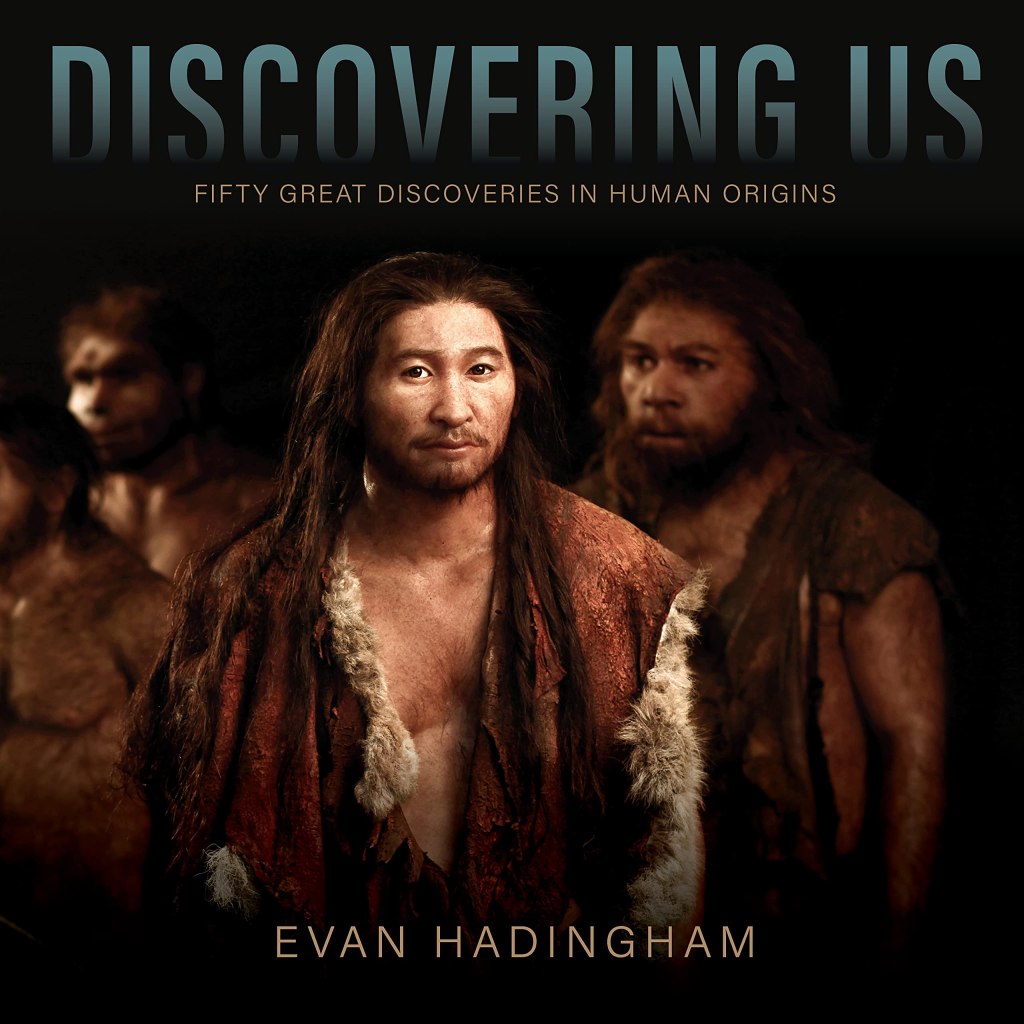
In “Discovering Us” by Evan Hardingham, in conjunction with The Leakey Foundation, we are taken on a journey of the last fifty years, through fifty miraculous discoveries from people all over the world. We hear astonishing stories, and see the finds themselves through the elaborately formatted and incredibly well photograph filled book. 

We follow along with fifty of some of the greatest stories in paleoanthropology on the path to discovering just who we are, and how we came to be here. Not only does the reader get a grand understanding of what it means to be human, but also the journey it took us to get here. Through expeditions and extravagant fossil finds, including Lucy, we are able to see the whole picture of what the science is today. I truly cannot say enough good things about this book, and little to nothing bad at all. 

If you want to support, and be involved with the current scientific work that is going on, this is a great way to find out about who is doing what, where they are in their careers as of the writing of this book (which was published in late 2021) and support them how you can, and see fit. While this book was not written to drive attention to The Leakey Foundation, it is abundantly true that this book would not have happened without them. As Mr. Hardingham tells us in our interview at the book, which you can find at the bottom of this page, The Leakey Foundation’s team is very small, and it was a great collaborative effort to get all of this done. 

While this book is on the more pricey end of books, it is more than worth the read, especially if you can find it in a local library or other such place. This book, is going to inspire the next few generations of anthropologists, I have no doubt about it. As someone who is so utterly 100% dedicated to the field, and have been told by many they have not seen others with such passion for this field, I can tell you, the people in this book share that passion; and it screams off the page at you. 

Pick up this book!

The Story of Us- Ep 34 with Evan Hardingham

Welcome to the next episode of The Story of Us! 

On this episode we are joined by non other than the Senior Editor of NOVA, brought to us by PBS. Evan has been working at Nova for over 30 years, an illustrious career. Although he started by exploring ice age caves in France and Spain, and working as an archaeologist. 

Today, he is a successful author, editor, and archaeologist known world round. 

We are honored to have him, as most of you know those of my generation, and others grew up on NOVA, so this, for me at least was a BIG DEAL! 

On this episode, we are discussing his newly published book, created in tandem and with close partnership with The Leakey Foundation, titled “Discovering Us,” one of the best books on the field as a whole I have read, ever. Period. And that is an unpaid opinion, as all of my opinions are! You get them whether you want them or not! 

So please join us on this episode, you can view it on 

And Listen with a subscription on Apple Podcasts (3-Day Free trial, $2.99 a month after that, each episode becomes free the following month)

“Discovering Us”- Buy your copy here: https://www.signaturebooks.com/books/p/discovering-us

I hope you enjoy, and above all I hope you have learned something, and if I dare to hope, you have even been inspired by our discussion! 

Thanks, and see you next time! 

Seth 

Project Director 

World of Paleoanthropology